India Cyprus relations serve as strategic counterweight to Turkey
Source:Indian Express ↗
Why It Matters
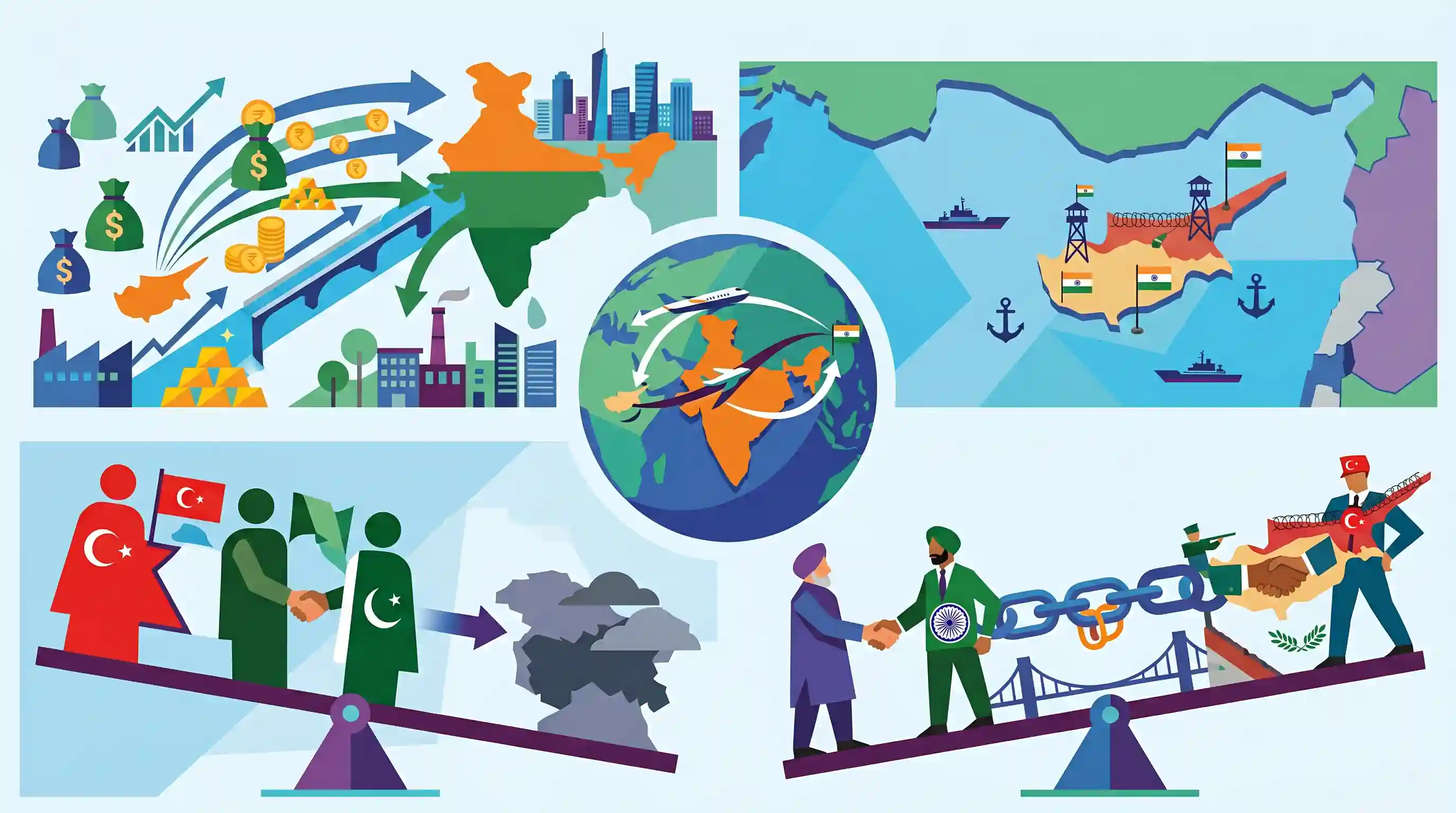
India's foreign policy is increasingly using strategic partnerships in the Mediterranean (like Cyprus and Greece) to secure economic gateways to Europe and to push back against nations like Turkey that interfere in India's internal affairs.
Summary
Prime Minister Narendra Modi's visit to Cyprus highlights the island nation's growing strategic and economic importance to India. The bilateral relationship is driven by three main factors: Cyprus's role as a major route for Foreign Direct Investment (FDI) into India, its strategic location providing India a foothold in the Eastern Mediterranean, and a shared geopolitical alignment against Turkey. The "Turkey angle" is particularly significant; as Ankara repeatedly sides with Pakistan on the Kashmir issue at global forums, New Delhi is utilizing its robust ties with Nicosia—which faces an ongoing territorial occupation by Turkey in Northern Cyprus—to diplomatically counterbalance Turkish influence.
Key Points
- Strategic Counterweight: India is strengthening its relationship with Cyprus as a diplomatic countermeasure to Turkey's consistent anti-India stance, particularly Turkey's support for Pakistan on the Kashmir issue at international forums.
- Cyprus Dispute: Cyprus has been divided since a 1974 Turkish invasion, with Turkey occupying the northern third. India supports the sovereignty and territorial integrity of the Republic of Cyprus, aligning their geopolitical interests.
- Economic and FDI Ties: Cyprus is a significant economic partner for India and has historically been one of the top routes for Foreign Direct Investment (FDI) into the Indian economy, facilitated by past tax treaties.
- Mediterranean Footprint: Engaging with Cyprus, alongside Greece, helps India establish a strategic and economic foothold in the Eastern Mediterranean, serving as a gateway to European markets and enhancing India's trans-regional connectivity.
Important Terms
Double Taxation Avoidance Agreement (DTAA)

A bilateral treaty preventing the same income from being taxed in two countries. The 2016 India-Cyprus revision shifted capital gains taxation from residence-based to source-based to curb tax evasion.
UPSC context
GS Paper II (International Relations) and GS Paper III (Economy); relevant for FDI regulation and tax transparency.
Northern Cyprus Issue
The self-declared state in the northern part of Cyprus, recognized only by Turkey. India supports the Republic of Cyprus's sovereignty over this territory in line with UN resolutions.
UPSC context
GS Paper II; tests understanding of territorial disputes and India's principled stance on sovereignty vs. Turkey's influence.
Bizonal, Bicommunal Federation
The UN-endorsed solution for Cyprus, envisioning a single federal state with two constituent zones (Greek and Turkish) ensuring political equality between both communities.
UPSC context
GS Paper II; crucial for understanding UN-led conflict resolution frameworks and India's diplomatic support for Cyprus.
Eastern Mediterranean Geopolitics
A strategic region where India seeks to enhance ties (e.g., Greece, Cyprus) to secure trade routes, energy access, and counterbalance the Turkey-Pakistan axis.
UPSC context
GS Paper II; important for India’s expanding maritime interests and its 'Link West' strategic positioning.
India-Middle East-Europe Economic Corridor (IMEC)
A transit corridor connecting India, the Middle East, and Europe. Cyprus is positioned as a potential Mediterranean hub to facilitate maritime trade and energy flow.
UPSC context
GS Paper II (International Relations) and GS Paper III (Infrastructure); tests knowledge of global connectivity initiatives and strategic infrastructure.
Link West Policy
India's strategic framework to deepen engagement with West Asia and the Mediterranean, moving beyond energy interests to include defense, technology, and maritime security.
UPSC context
GS Paper II; fundamental framework for India's bilateral and regional diplomacy in West Asia and Southern Europe.
Prelims Trap
Northern Cyprus is recognised as an independent nation by the United Nations.
Only Turkey recognises Northern Cyprus. The UN, EU, and India officially recognise only the Republic of Cyprus and advocate for its territorial integrity.
Static Concepts Connected
What is a DTAA and how does it historically impact FDI inflows?
- Tax relief: Bilateral pacts designed to prevent identical income from being taxed in two different countries, easing the burden on cross-border investors.
- Treaty shopping: Loopholes historically allowed 'round-tripping'; India later amended treaties with hubs like Mauritius and Cyprus to tax capital gains at the source.
- FDI routing: Explains why tiny economies (Cyprus, Mauritius, Singapore) account for disproportionately large foreign direct investment into India.
What are the geographical features and resource disputes of the Eastern Mediterranean?
- The Levant: Includes the coastlines of Turkey, Syria, Lebanon, Israel, Palestine, Egypt, and the island of Cyprus.
- Gas disputes: The region is a highly contested geopolitical hotspot due to newly discovered offshore natural gas fields (e.g., Zohr, Leviathan) creating overlapping EEZ claims.
- Chokepoint proximity: Serves as the strategic western maritime gateway to the Suez Canal, connecting the Mediterranean Sea to the Red Sea.
Cross-Topic Patterns
Countering the Turkey-Pak nexus
Similar to India's defence engagement with Armenia to counter the Turkey-Azerbaijan-Pakistan triad, ties with Cyprus and Greece geographically and diplomatically check Ankara's anti-India rhetoric.
IMEEC's European maritime gateway
Cyprus and Greece offer stable Mediterranean entry points for the India-Middle East-Europe Economic Corridor (IMEEC), ensuring secure supply chains into European markets bypassing hostile chokepoints.

Mapping the Eastern Med (Cyprus, Greece, Turkey) + its role in IMEEC and offshore gas disputes is highly probable for Prelims 2026.
Linked PYQs · 3
Linked PYQs · 3
- 2014PrelimsGS1
Turkey is located between
- 2017PrelimsGS1
Mediterranean Sea is a border of which of the following countries? 1. Jordan 2. Iraq 3. Lebanon 4. Syria Select the correct answer using the code given below:
- 2022PrelimsGS1
The term "Levant" often heard in the news roughly corresponds to which of the following regions?
