Prime Minister Modi visits Cyprus to reinforce bilateral ties
Source:The Hindu ↗
Why It Matters
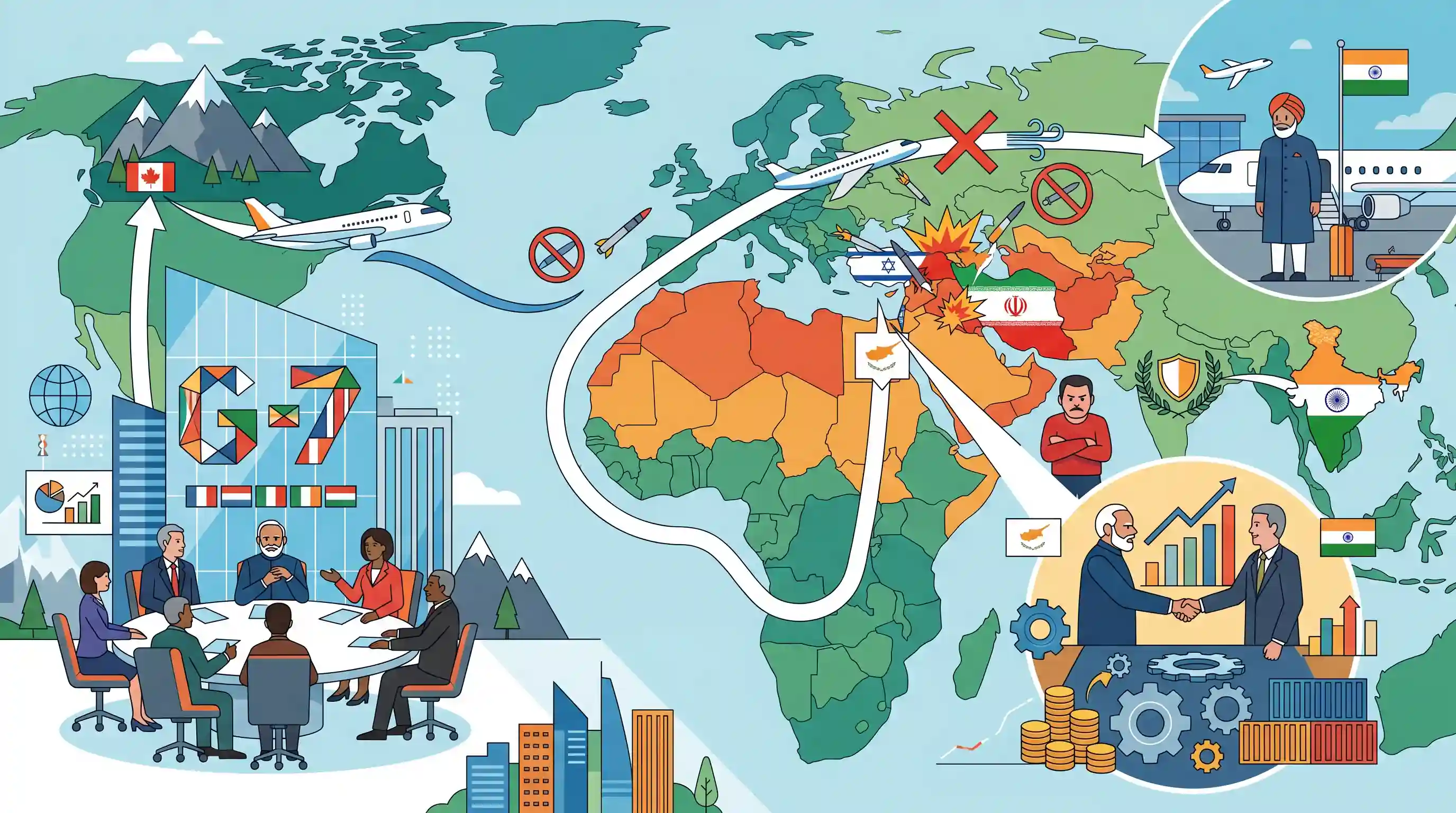
The visit illustrates India's diplomatic strategy of cultivating ties with nations like Cyprus to offset geopolitical challenges (e.g., Turkey's stance on Kashmir), while the flight rerouting serves as a practical example of how regional conflicts (Israel-Iran) impact global logistics and diplomacy. The participation in the G-7 summit reinforces India's growing influence in major global groupings.
Summary
Prime Minister Narendra Modi's visit to Cyprus on his three-nation tour emphasizes strengthening bilateral trade and investment while projecting a strategic message to Turkey, given Cyprus's consistent support for India on the Kashmir issue. The trip also highlights the geopolitical fallout of the ongoing Israel-Iran conflict, which forced the PM's aircraft to detour over Africa to avoid closed Middle Eastern airspace. From Cyprus, Modi will head to Calgary, Canada, to attend the G-7 summit.
Key Points
- PM Modi's visit to Cyprus underscores India's strategic outreach in the Mediterranean and serves as a counterbalance to Turkey's adversarial stance on Kashmir.
- Cyprus has reiterated its solidarity with India following terror attacks and maintains a strong pro-India position on the Kashmir dispute.
- Geopolitical tensions between Israel and Iran led to the closure of Middle Eastern airspace, forcing the Prime Minister's flight to reroute via the Arabian Sea and the Horn of Africa.
- Following engagements in Cyprus, which included addressing the Indian diaspora and a business roundtable, PM Modi is scheduled to attend the G-7 summit in Calgary, Canada.
Important Terms
G-7

An informal forum of seven of the world's most advanced economies—Canada, France, Germany, Italy, Japan, the UK, and the US—plus the EU, focusing on global governance, security, and economics.
UPSC context
GS Paper 2: Important International institutions and their structure. Tests India's role as an 'Outreach Country' and its engagement with the West.
Turkey-Pakistan Axis
The strategic and military alignment between Turkey and Pakistan, which often involves mutual support on sensitive issues like Kashmir and Northern Cyprus, posing a diplomatic challenge for India.
UPSC context
GS Paper 2: Effect of policies and politics of countries on India’s interests. Relevant for 'Strategic Autonomy' and regional balancing.
Cyprus Question
The long-standing geopolitical dispute over the division of Cyprus since 1974 between the Greek Cypriot Republic of Cyprus and the Turkish-backed Northern Cyprus.
UPSC context
GS Paper 2: Bilateral, regional and global groupings. Tests understanding of India's principled stand on territorial integrity and UN-led resolutions.
IMEC (India-Middle East-Europe Economic Corridor)
A proposed multi-modal ship-to-rail transit network connecting India, the UAE, Saudi Arabia, Jordan, Israel, and Europe, intended to rival China’s Belt and Road Initiative.
UPSC context
GS Paper 2 & 3: Infrastructure and Connectivity. Tests knowledge of strategic corridors and economic diplomacy.
Cyprus Investment Route
A major source of Foreign Direct Investment (FDI) for India, Cyprus has historically been a top-10 investor, particularly in real estate, services, and the shipping industry.
UPSC context
GS Paper 3: Indian Economy (Investment Models). Relevant for understanding FDI inflows, DTAA, and tax treaties.
Cyprus Chamber of Commerce and Industry
The primary national business federation in Cyprus that facilitates bilateral trade roundtables and MoUs with Indian chambers like FICCI or regional Indian industry bodies.
UPSC context
GS Paper 2: Bilateral Relations. Tests understanding of the institutional mechanisms that drive economic diplomacy and Track II diplomacy.
Prelims Trap
Cyprus is a geographically European island nation and a member of the NATO alliance.
Cyprus is geographically located in Western Asia (Middle East), though it is politically in the EU. Furthermore, it is NOT a NATO member due to its ongoing conflict with Turkey.
Static Concepts Connected
What are the defining structural features of the Group of Seven (G-7)?
- Informal framework: It operates as an informal intergovernmental political and economic forum without a formal treaty, legal charter, or a permanent secretariat.
- Rotating presidency: The presidency rotates annually among member states, which assume responsibility for hosting the annual summit and determining the agenda.
- Outreach participation: The bloc frequently invites strategically important non-member democracies, such as India, to participate in summit proceedings as 'outreach' or guest countries.
Which nations comprise the geographically strategic Horn of Africa?
- Core nations: The region comprises Somalia, Ethiopia, Eritrea, and Djibouti, commonly remembered by aspirants using the acronym SEED.
- Strategic location: It juts into the Arabian Sea and overlooks the Bab el-Mandeb strait, a crucial maritime chokepoint connecting the Red Sea to the Indian Ocean.
Cross-Topic Patterns
Strategic Counter-Alignment Diplomacy
India increasingly bolsters bilateral ties with nations like Cyprus and Armenia to strategically counterbalance Turkey’s adversarial, pro-Pakistan stance on the Kashmir dispute at multilateral forums.
IMEC's Mediterranean Nodes vs Turkey
Cyprus is positioning itself as a vital maritime and logistical hub for the proposed IMEC, directly competing with Turkey’s proposed 'Development Road' via Iraq.
Airspace as Geopolitical Chokepoints
Middle Eastern conflicts closing regional airspace force global aviation to detour over the Horn of Africa, mirroring maritime vulnerabilities in the Red Sea and inflating logistical costs.

Eastern Mediterranean geography mapped against IMEC nodes, Turkey's regional footprint, and alternative air corridors is highly probable.
Linked PYQs · 4
Linked PYQs · 4
- 2018MainsGS2
“India’s relations with Israel have, of late, acquired a depth and diversity, which cannot be rolled back.” Discuss.
- 2022MainsGS2
How will I2U2 (India, Israel, UAE and USA) grouping transform India's position in global politics?
- 2012MainsGS2
What is meant by the G8 + 5 group?
- 2023PrelimsGS1
Consider the following statements: Statement-I: Israel has established diplomatic relations with some Arab States. Statement-II: The 'Arab Peace Initiative' mediated by Saudi Arabia was signed by Israel and Arab League. Which one of the following is correct in respect of the above statements?
