Ahilyabai Holkar Legacy Inspires Modern Governance Infrastructure
Source:The Hindu ↗
Why It Matters
Ahilyabai Holkar represents a crucial historical case study for GS1 (History/Culture) and GS4 (Ethics in Governance) regarding female leadership, administration, and cultural patronage. The associated infrastructure projects (Indore Metro, Datia/Satna airports) relate to GS3 themes of regional connectivity (UDAN scheme), while the Atal Gram Seva Sadan connects to GS2 topics on strengthening Panchayati Raj Institutions.
Summary
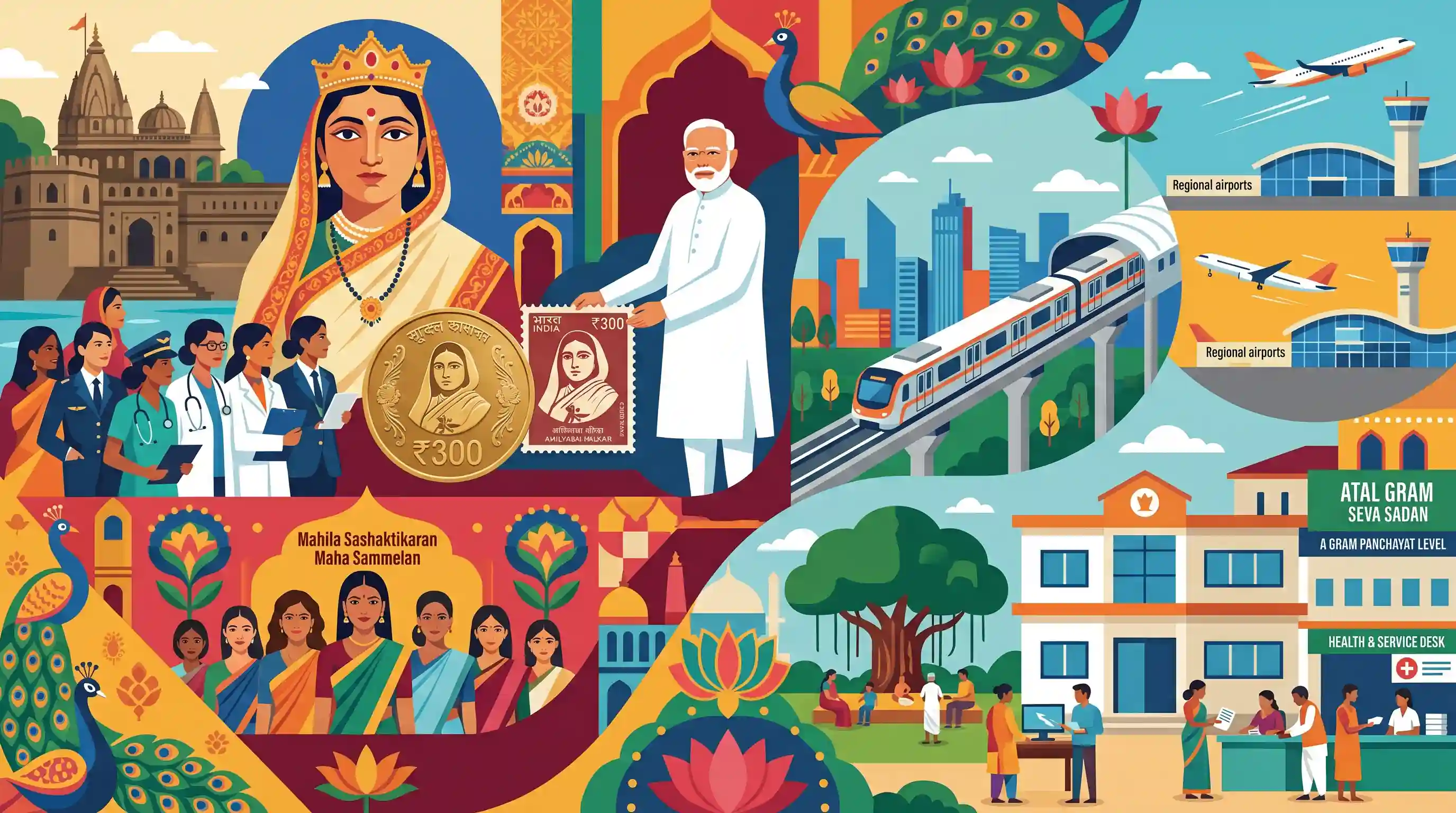
Prime Minister Narendra Modi participated in the 'Mahila Sashaktikaran Maha Sammelan' in Bhopal to celebrate the 300th birth anniversary of the legendary 18th-century ruler of Malwa, Ahilyabai Holkar. Emphasizing her role as a pioneer of women’s empowerment and good governance, the PM released a commemorative ₹300 coin and a postal stamp. Alongside honoring her cultural and historical legacy, the PM launched several key infrastructure and governance projects in Madhya Pradesh. These included the inauguration of the Indore Metro's Super Priority Corridor, the operationalization of regional airports at Datia and Satna, and the launch of the 'Atal Gram Seva Sadan' initiative to provide a unified administrative hub at the Gram Panchayat level.
Key Points
- PM Modi attended the Mahila Sashaktikaran Maha Sammelan in Bhopal to commemorate the 300th birth anniversary of Ahilyabai Holkar, highlighting her as a historical beacon of women's empowerment.
- Ahilyabai Holkar, the 18th-century Holkar queen of Malwa, was praised for her exemplary administrative skills, cultural preservation, and restoration of temples across India.
- The Prime Minister released a commemorative ₹300 coin and a postal stamp to honor Ahilyabai's legacy, and conferred the National Devi Ahilyabai Award for contributions to tribal/folk arts.
- To boost regional infrastructure, the Super Priority Corridor of the Indore Metro was inaugurated, and regional airports at Datia and Satna were operationalized.
- The launch of the 'Atal Gram Seva Sadan' (Panchayat Bhawans) aims to centralize administrative services at the village level, strengthening local self-governance.
Important Terms
Ahilyabai Holkar

Legendary 18th-century Maratha queen of Malwa. She is revered for her administrative acumen, extensive restoration of Hindu temples like Kashi Vishwanath, and pioneering socio-economic reforms, including the empowerment of women through the Maheshwari handloom industry.
UPSC context
GS Paper I (Modern History/Personalities). Tests knowledge of 18th-century rulers and their role in cultural and social revival.
Atal Gram Seva Sadan
Unified administrative hubs established at the Gram Panchayat level in Madhya Pradesh. These "Panchayat Bhawans" streamline government service delivery, grievance redressal, and rural development initiatives, strengthening grassroots democracy and local self-governance.
UPSC context
GS Paper II (Governance/Panchayati Raj). Relevant for decentralized administration and digital service delivery in rural India.
National Devi Ahilyabai Award
A prestigious honor presented by the Madhya Pradesh government to female artists for exceptional contributions to tribal, folk, and traditional arts. It recognizes women's roles in preserving India's diverse cultural and indigenous heritage.
UPSC context
GS Paper I (Art and Culture). Highlights state-led recognition of traditional arts and women's artistic contributions.
Mahila Sashaktikaran Maha Sammelan
A high-profile women’s empowerment convention held in Bhopal to commemorate Ahilyabai Holkar’s legacy. The event serves as a platform to launch welfare schemes and celebrate women-led development in nation-building.
UPSC context
GS Paper II (Social Justice/Women Empowerment). Important for understanding government strategies to promote gender equality and leadership.
Indore Metro Super Priority Corridor
A 6-km operational segment of the Indore Metro Yellow Line. It marks a significant advancement in Madhya Pradesh’s urban infrastructure, providing sustainable, modern, and pollution-free public transit in India’s cleanest city.
UPSC context
GS Paper III (Infrastructure). Focuses on urban transit development and sustainable city planning.
Malwa Region
A historic and geographical plateau region in west-central India, primarily in Madhya Pradesh. It was the heart of the Holkar dynasty’s rule and is significant for its strategic location and cultural synthesis.
UPSC context
GS Paper I (History/Geography). Significant for regional history and the territorial administration of the Maratha Confederacy.
Prelims Trap
The Rashtriya Devi Ahilya Samman is conferred by the Union Government to both men and women for excellence in classical arts.
Despite 'Rashtriya' (National) in its name, it is a state-level award given by Madhya Pradesh exclusively to women artists for tribal/folk arts.
Static Concepts Connected
Who were the major ruling houses of the Maratha Confederacy and their territories?
- Holkars: Ruled the Malwa region with their capital at Indore (and Maheshwar). Ahilyabai Holkar was their most prominent 18th-century ruler.
- Bhonsles: Governed Nagpur and Berar regions. They played a significant role in expanding Maratha influence into Eastern India (Bengal/Odisha).
- Other houses: Gaekwads ruled Baroda (Gujarat), Scindias controlled Gwalior, and the Peshwas served as the administrative and political head of the confederacy in Pune.
What constitutional provisions empower village-level administrative hubs like the Atal Gram Seva Sadan?
- Article 243G: Authorizes State legislatures to endow Panchayats with powers and authority necessary to function as institutions of self-government and prepare economic development plans.
- Eleventh Schedule: Lists 29 functional items devolved to Panchayats, requiring localized physical infrastructure (like Panchayat Bhawans or Common Service Centres) to efficiently deliver these civic services.
Cross-Topic Patterns
Maratha Patronage & Cultural Revival
Ahilyabai's reconstruction of major Hindu shrines (Kashi Vishwanath, Somnath) connects 18th-century Maratha state-building to pan-Indian cultural preservation and architectural patronage.
Women in 18th-Century Statecraft
Her 300th anniversary makes comparative questions on female rulers (Ahilyabai, Tarabai, Rani Durgavati) highly probable for UPSC themes concerning historical female agency and statecraft.

Ahilyabai's 300th anniversary makes a Prelims statement on her shrine restorations or a pair-matching Q on Maratha confederacies highly likely.
Linked PYQs · 5
Linked PYQs · 5
- 2024MainsGS3
What is the need for expanding the regional air connectivity in India? In this context, discuss the government's UDAN Scheme and its achievements.
- 2024MainsGS2
Analyse the role of local bodies in providing good governance at local level and bring out the pros and cons merging the rural local bodies with the urban local bodies.
- 2015MainsGS2
In absence of a well-educated and organized local level government system, 'Panchayats' and 'Samitis' have remained mainly political institutions and not effective instruments of governance. Critically discuss.
- 2024MainsGS1
Distinguish between gender equality, gender equity and women's empowerment. Why is it important to take gender concerns into account in programme design and implementation?
- 2021PrelimsGS1
From the decline of Guptas until the rise of Harshavardhana in the early seventh century, which of the following kingdoms were holding power in Northern India? 1. The Guptas of Magadha 2. The Paramaras of Malwa 3. The Pushyabhutis of Thanesar 4. The Maukharis of Kanauj 5. The Yadavas of Devagiri 6. The Maitrakas of Valabhi Select the correct answer using the code given below.
