India Achieves Non-Fossil Energy Capacity Target Ahead of Schedule
Source:The Hindu ↗
Why It Matters
India's early achievement of its 2030 Nationally Determined Contribution (NDC) target for non-fossil fuel capacity highlights its pivotal role and commitment in global climate action. It is highly relevant for GS-3 sections on Infrastructure (Energy) and Environment (Conservation and Climate Change).
Summary
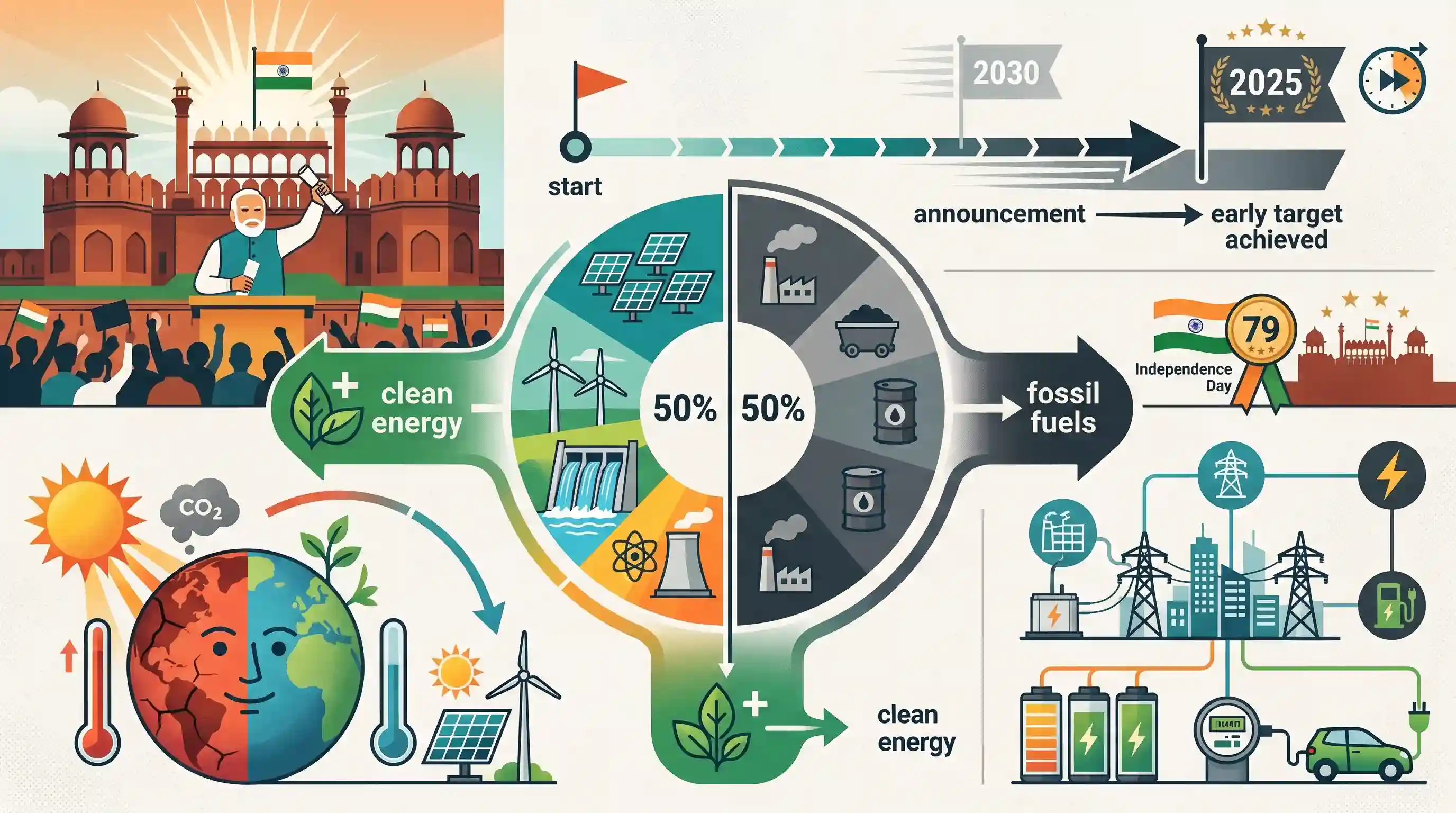
Prime Minister Narendra Modi announced during his 79th Independence Day speech that India has met its climate target of generating 50% of its cumulative installed electricity capacity from non-fossil-fuel sources. Originally set for 2030 as part of India's climate commitments, the target was achieved five years early in 2025. By the end of June 2025, non-fossil sources including renewables, large hydropower, and nuclear energy made up 242.8 GW (50.08%) of the nation's total installed capacity of 484.8 GW, marking a significant milestone in India's clean energy transition and climate action efforts.
Key Points
- India achieved its target of securing 50% of its cumulative installed electricity capacity from non-fossil-based sources five years ahead of the 2030 deadline.
- The milestone was formally announced by Prime Minister Narendra Modi during his 79th Independence Day address on August 15, 2025.
- As of June 30, 2025, India's total installed electricity capacity reached 484.8 GW.
- Non-fossil-fuel sources—encompassing renewables, large hydropower, and nuclear energy—contributed 242.8 GW (50.08%) to this total capacity.
Important Terms
Nationally Determined Contributions (NDCs)

Climate action plans under the Paris Agreement where countries outline self-defined targets for reducing greenhouse gas emissions and adapting to climate impacts, updated every five years.
UPSC context
GS Paper III (Environment); vital for questions on international climate treaties and India's global environmental commitments.
Panchamrit
India’s five-point climate roadmap announced at COP26, featuring targets like 500 GW non-fossil capacity, 50% renewable energy share by 2030, and net-zero by 2070.
UPSC context
GS Paper III (Energy/Environment); tests specific knowledge of India’s updated climate goals and transition strategy.
Non-Fossil Fuel Sources
Electricity generation capacity derived from sources other than coal, oil, or natural gas, including solar, wind, hydropower, biomass, and nuclear energy.
UPSC context
GS Paper III (Infrastructure: Energy); relevant for energy security and decarbonization of the power sector.
Net Zero
The balance between the amount of greenhouse gas produced and the amount removed from the atmosphere. India has committed to achieving this by 2070.
UPSC context
GS Paper III (Environment); central to discussions on long-term climate strategies and global warming mitigation.
Emissions Intensity
A measurement of greenhouse gas emissions relative to a country's Gross Domestic Product (GDP), used to track the carbon efficiency of economic growth.
UPSC context
GS Paper III (Economy/Environment); tests ability to link economic growth with environmental sustainability and decarbonization metrics.
COP26 (Glasgow Summit)
The 2021 UN climate summit in Glasgow where India introduced the 'Panchamrit' targets and the LiFE (Lifestyle for Environment) movement.
UPSC context
GS Paper II/III (International Relations/Environment); crucial for understanding multilateral climate diplomacy and India's leadership role.
Prelims Trap
India now generates more than 50% of its total electricity from non-fossil fuel sources.
The 50% target applies only to "installed capacity," not actual generation. Due to the lower plant load factors of renewables, coal still generates roughly 75% of India's electricity.
Static Concepts Connected
What are India's updated Nationally Determined Contributions (NDCs) under the Paris Agreement?
- Emission Intensity: Reduce the emissions intensity of its GDP by 45% by 2030, compared to 2005 levels.
- Energy Capacity: Achieve 50% cumulative electric power installed capacity from non-fossil fuel-based energy resources by 2030.
- Carbon Sink: Create an additional carbon sink of 2.5 to 3 billion tonnes of CO2 equivalent through additional forest and tree cover by 2030.
Which energy sources constitute India's "non-fossil fuel" installed capacity?
- Traditional Renewables: Includes solar, wind, biomass, and small hydro projects.
- Large Hydropower: Since 2019, large hydropower projects (over 25 MW) are officially classified as renewable energy sources.
- Nuclear Energy: Nuclear power is a non-fossil source, counting towards the 50% target, though it is not technically 'renewable'.
Cross-Topic Patterns
RE Capacity vs. Grid Stability
Reaching 50% non-fossil capacity highlights the urgency of Battery Energy Storage Systems (BESS) and Pumped Hydro to manage grid intermittency, linking climate goals to infrastructure constraints.
Clean Energy & Import Dependency
Expanding non-fossil capacity relies heavily on solar PVs and critical minerals, shifting India's strategic vulnerability from Middle-East fossil fuels to Chinese clean-tech supply chains.

Expect a 2026 Prelims trap confusing India's 50% non-fossil 'installed capacity' achievement with actual 'electricity generation' share.
Linked PYQs · 5
Linked PYQs · 5
- 2025MainsGS3
Write a review on India's climate commitments under the Paris Agreement (2015) and mention how these have been further strengthened in COP26 (2021). In this direction, how has the first Nationally Determined Contribution intended by India been updated in 2022?
- 2022MainsGS3
Do you think India will meet 50 percent of its energy needs from renewable energy by 2030 ? Justify your answer. How will the shift of subsidies from fossil fuels to renewables help achieve the above objective ? Explain.
- 2023PrelimsGS1
With reference to coal-based thermal power plants in India, consider the following statements: 1. None of them uses seawater. 2. None of them is set up in water-stressed district. 3. None of them is privately owned. How many of the above statements are correct?
- 2022PrelimsGS1
Consider the following statements: 1. Gujarat has the largest solar park in India. 2. Kerala has a fully solar powered International Airport. 3. Goa has the largest floating solar photovoltaic project in India. Which of the statements given above is/are correct?
- 2025PrelimsGS1
Consider the following statements about 'PM Surya Ghar Muft Bijli Yojana': I. It targets installation of one crore solar rooftop panels in the residential sector. II. The Ministry of New and Renewable Energy aims to impart training on installation, operation, maintenance and repairs of solar rooftop systems at grassroot levels. III. It aims to create more than three lakhs skilled manpower through fresh skilling, and up-skilling, under scheme component of capacity building. Which of the statements given above are correct?
