PM Modi Holds Strategic Talks with Venezuela Acting President
Source:The Hindu ↗
Why It Matters
As one of the world's largest oil importers, India's energy security is highly vulnerable to global supply shocks, particularly from West Asia. Re-establishing crude oil ties with Venezuela highlights India's strategic foreign policy maneuvering to secure diversified and affordable energy sources, directly impacting macroeconomic stability.
Summary
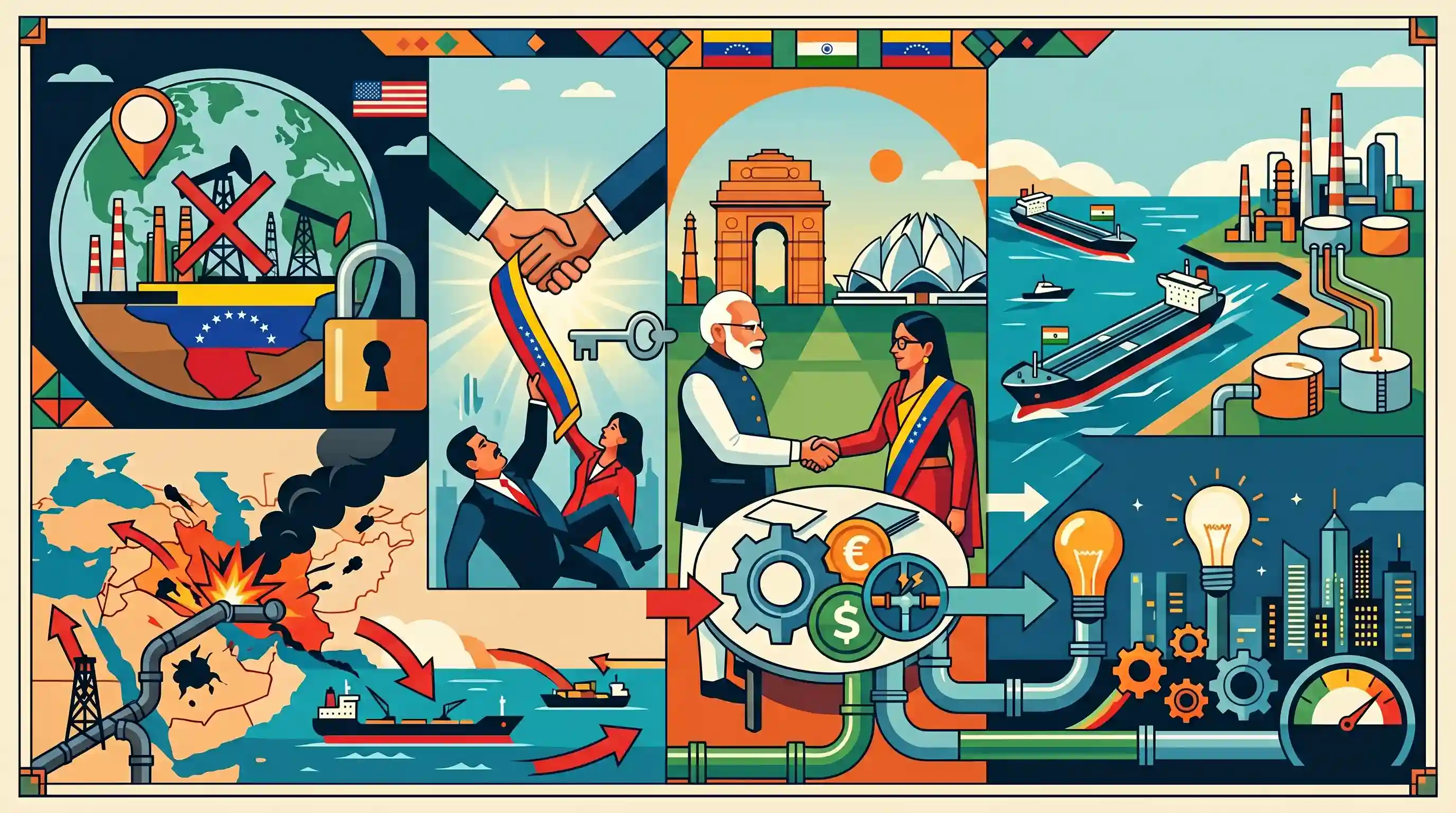
Prime Minister Narendra Modi recently held strategic talks with Venezuela's acting President Delcy Rodriguez in New Delhi, focusing on expanding cooperation in energy, trade, and investment. The visit comes at a critical time as India seeks to diversify its crude oil imports amidst supply disruptions stemming from the ongoing West Asia crisis. India, previously a major processor of Venezuelan heavy crude, had halted imports in 2020 due to stringent U.S. sanctions. However, following regime changes in Venezuela—where Rodriguez took charge after the U.S. detained Nicolas Maduro in January—and the subsequent lifting of sanctions, Indian oil marketing companies have aggressively resumed sourcing crude from the Latin American nation to bolster energy security.
Key Points
- Prime Minister Narendra Modi held talks with Venezuela's acting President Delcy Rodriguez to enhance bilateral ties in energy, trade, and investment.
- India is seeking to diversify its crude oil procurement from Venezuela amid supply disruptions caused by the West Asia crisis.
- Delcy Rodriguez assumed the role of acting President of Venezuela following the detention of former President Nicolas Maduro by U.S. forces in January.
- India had halted imports of Venezuelan heavy crude in 2020 due to sweeping U.S. sanctions.
- Following the lifting of sanctions post-Maduro's capture, Indian oil marketing companies have significantly ramped up crude oil sourcing from Venezuela.
Important Terms
Ministry of External Affairs (MEA)

The central government agency responsible for India's foreign relations, diplomatic missions, and formulating foreign policy under the leadership of the External Affairs Minister.
UPSC context
GS Paper 2: International Relations; essential for understanding India’s diplomatic outreach and institutional framework for global engagement.
Energy Security
The uninterrupted availability of energy sources at an affordable price, involving diversification of imports, domestic production, and maintaining strategic reserves to buffer supply shocks.
UPSC context
GS Paper 3: Indian Economy and Infrastructure; a core pillar of national security and economic stability.
Oil Marketing Companies (OMCs)
State-run entities (IOCL, BPCL, HPCL) and private players involved in refining and distributing petroleum products, critical for managing India's fuel supply and trade balance.
UPSC context
GS Paper 3: Economy; tests understanding of the energy sector, subsidies, and impact of global crude prices on fiscal deficit.
Heavy Crude
A high-density, high-viscosity crude oil containing high sulfur and metal content, requiring advanced refinery complexity (like Reliance's Jamnagar) to process into usable fuels.
UPSC context
GS Paper 3: Science & Technology and Economy; relevant for refinery capabilities and energy trade diversification strategies.
Strategic Autonomy
India's foreign policy doctrine of making independent decisions based on national interest without being coerced by external powers or global alliances.
UPSC context
GS Paper 2: International Relations; critical for analyzing India's stance on U.S. sanctions and balancing ties between competing global powers.
Sanctions
Restrictive measures used by countries or international bodies to coerce or punish states; U.S. secondary sanctions notably halted India's Venezuelan oil imports from 2020-2024.
UPSC context
GS Paper 2: Global Politics; tests knowledge of international law, extraterritoriality, and their impact on India’s bilateral trade.
Prelims Trap
"Saudi Arabia possesses the world's largest proven crude oil reserves."
Venezuela actually holds the world's largest proven oil reserves (mainly in the Orinoco Belt), despite Saudi Arabia or the US dominating global production.
Static Concepts Connected
Why are Indian refineries uniquely suited for Venezuelan crude?
- Heavy & Sour: Venezuelan oil is largely 'heavy and sour'—highly viscous and sulfur-rich—requiring complex, specialized processing compared to light, sweet crude.
- Nelson Complexity Index: Indian refineries boast a very high Nelson Complexity Index (NCI), enabling the highly profitable conversion of cheap, heavy crude into high-value distillates.
What are U.S. Secondary Sanctions?
- Extraterritorial Leverage: They operate extraterritorially by targeting third-party nations (like India) that conduct business with a sanctioned state, leveraging the dominance of the US financial system.
- Strategic Autonomy: India halted Venezuelan imports in 2020 to avoid these sanctions, reflecting the constant friction between India's pursuit of strategic autonomy and global financial compliance.
Cross-Topic Patterns
Red Sea crisis driving LAC shift
Volatility in West Asian maritime chokepoints like the Strait of Hormuz is accelerating India's structural shift toward Latin American energy imports to ensure supply security.
PSUs and "Equity Oil" abroad
OVL's investments in Venezuelan fields (like San Cristobal) mirror India's broader overseas 'equity oil' strategy, previously seen in Sakhalin (Russia) and Rovuma (Mozambique).

Expect a 2026 prelims question linking global oil reserve geography (Orinoco Belt) to crude types (heavy/sour) and India's refinery NCI.
Linked PYQs · 3
Linked PYQs · 3
- 2025MainsGS2
"Energy security constitutes the dominant kingpin of India's foreign policy, and is linked with India's overarching influence in Middle Eastern countries.” How would you integrate energy security with India's foreign policy trajectories in the coming years?
- 2017MainsGS2
The question of India's Energy Security constitutes the most important part of India's economic progress. Analyze India's energy policy cooperation with West Asian countries.
- 2024MainsGS2
Critically analyse India's evolving diplomatic, economic and strategic relations with the Central Asian Republics (CARs) highlighting their increasing significance in regional and global geopolitics.
