Political Splits and Anti Defection Law Challenges in Maharashtra
Source:The Hindu ↗
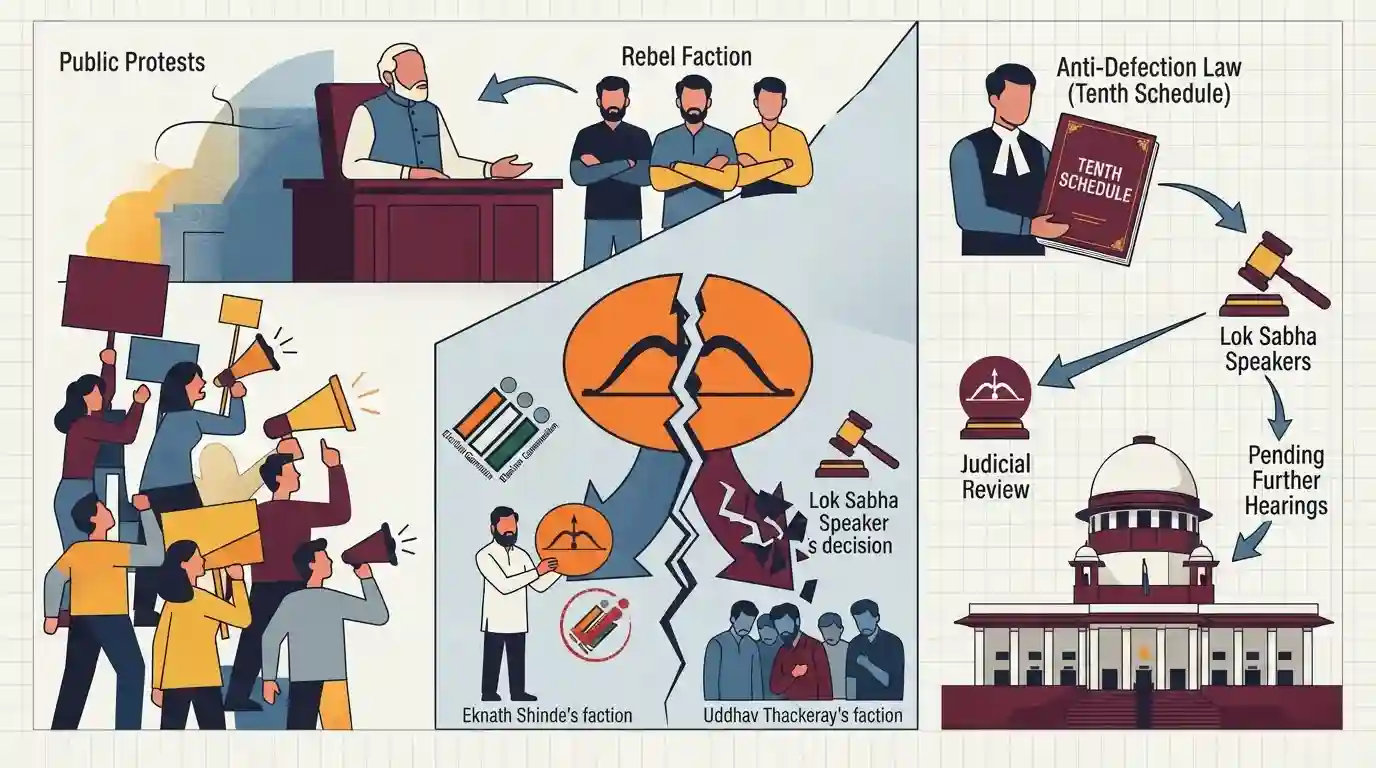
Why It Matters
The ongoing political crisis in Maharashtra provides a practical case study of the Tenth Schedule (Anti-Defection Law), the role of the Speaker in recognizing legislative mergers, and the quasi-judicial powers of the Election Commission of India in resolving disputes over party symbols during a split.
Summary
Uddhav Thackeray criticized Prime Minister Narendra Modi for allegedly prioritizing meetings with 'traitors' (rebel Shiv Sena MPs) over addressing the issues of protesting youth. The political controversy stems from the split in the Shiv Sena, highlighting disputes over the Election Commission's allocation of the party symbol to the Eknath Shinde faction and the Lok Sabha Speaker's recognition of defecting MPs. These ongoing issues involving the Anti-Defection Law and the Election Commission's dispute resolution powers are pending further hearings in the Supreme Court.
Key Points
- Shiv Sena (UBT) chief Uddhav Thackeray criticized PM Narendra Modi for meeting with defected leaders instead of addressing the grievances of protesting youth.
- The article highlights the ongoing legal and political battle over the 'real' Shiv Sena following a split, with the Election Commission of India having allocated the party symbol to the Eknath Shinde faction.
- Lok Sabha Speaker Om Birla's recognition of six MPs merging with the Shinde-led Shiv Sena brings the spotlight onto the application of the Anti-Defection Law (Tenth Schedule).
- The disputes over the party's recognition, symbol allocation, and disqualification of members are currently pending before the Supreme Court.
Important Terms
Tenth Schedule (Anti-Defection Law)

A constitutional schedule introduced by the 52nd Amendment (1985) to prevent political defections by disqualifying legislators who voluntarily leave their party or vote against party whips.
UPSC context
GS Paper II (Polity - Parliament and State Legislatures), testing understanding of floor-crossing, legislative stability, and powers of the Speaker.
Election Commission of India
An autonomous constitutional authority established under Article 324, responsible for administering, directing, and controlling elections to the Parliament, state legislatures, and high offices of India.
UPSC context
GS Paper II (Constitutional Bodies), testing the mechanism of conducting free and fair elections, institutional independence, and regulatory powers.
Judicial Review
The power of the Supreme Court and High Courts to examine and potentially invalidate legislative enactments, executive orders, or administrative actions that violate constitutional provisions.
UPSC context
GS Paper II (Judiciary), testing checks and balances, the basic structure doctrine, and the protection of constitutional supremacy.
Election Symbols (Reservation and Allotment) Order, 1968
A regulation empowering the Election Commission of India to recognize political parties, allocate election symbols, and resolve disputes over party identity or symbols during internal splits.
UPSC context
GS Paper II (Elections & Representation of People Act), testing political party recognition and regulatory powers of the ECI.
Supreme Court of India
The apex judicial tribunal and final interpreter of the Constitution of India, possessing extensive original, appellate, and advisory jurisdictions to safeguard fundamental rights and justice.
UPSC context
GS Paper II (Judiciary), testing the structure, jurisdiction, powers, and role of the highest court in constitutional adjudication.
Prelims Trap
A split of one-third of the members of a legislative party protects them from disqualification.
The 91st Constitutional Amendment (2003) deleted the exemption for a 'split' (1/3rd). Currently, only a 'merger' requiring at least two-thirds of legislators protects a defecting faction from disqualification.
Static Concepts Connected
What is the Election Commission's role in resolving intra-party disputes over symbols?
- Legal backing: The ECI derives this power from Paragraph 15 of the Election Symbols (Reservation and Allotment) Order, 1968.
- Quasi-judicial role: The ECI acts as a quasi-judicial body when resolving disputes between rival factions of a recognized political party.
- Test of Majority: The ECI applies the "Test of Majority" (established in Sadiq Ali vs ECI, 1971), evaluating both the legislative and organizational majority of the factions.
How does Judicial Review apply to the Anti-Defection Law (Tenth Schedule)?
- Tribunal status: In Kihoto Hollohan (1992), the Supreme Court ruled that the Speaker acts as a tribunal, making their final decisions subject to judicial review.
- Premature intervention barred: Courts generally cannot intervene or issue injunctions before the Presiding Officer makes a final decision on the disqualification petition.
- Pending removal exception: In Nabam Rebia (2016), the SC ruled a Speaker cannot decide defection petitions if a resolution for their own removal is pending.
Cross-Topic Patterns
Speaker's Tribunal vs Impartiality
Prolonged delays by Speakers in deciding defection petitions constantly trigger debates on amending the Tenth Schedule to transfer this adjudicatory power to an independent tribunal or the ECI.
RPA 1951 vs Symbol Order 1968
While the RPA 1951 handles the registration of political parties (Section 29A), resolving disputes over the name and symbol of a recognized but fractured party falls strictly under the 1968 Symbol Order.

Expect a mixed prelims statement combining the 91st CAA 'merger' criteria with the ECI's 'test of majority' for party symbol allocation.
Linked PYQs · 2
Linked PYQs · 2
- 2017PrelimsGS1
Consider the following statements: 1. The Election Commission of India is a five-member body. 2. Union Ministry of Home Affairs decides the election schedule for the conduct of both general elections and bye-elections. 3. Election Commission resolves the disputes relating to splits/mergers of recognised political parties. Which of the statements given above is/are correct?
- 2025PrelimsGS1
Consider the following statements : I. If any question arises as to whether a Member of the House of the People has become subject to disqualification under the 10th Schedule, the President's decision in accordance with the opinion of the Council of Union Ministers shall be final. II. There is no mention of the word 'political party' in the Constitution of India. Which of the statements given above is/are correct?
