Tribal Welfare Schemes and Birsa Munda Legacy
Source:The Hindu ↗
Why It Matters
The article highlights the intersection of historical recognition, socio-economic welfare, and public health targeted at India's tribal populations. It touches upon specific schemes (PM-JANMAN, EMRS) and health challenges (sickle cell disease) that are highly relevant for GS2 (Social Justice) and GS1 (Society and Modern History).
Summary
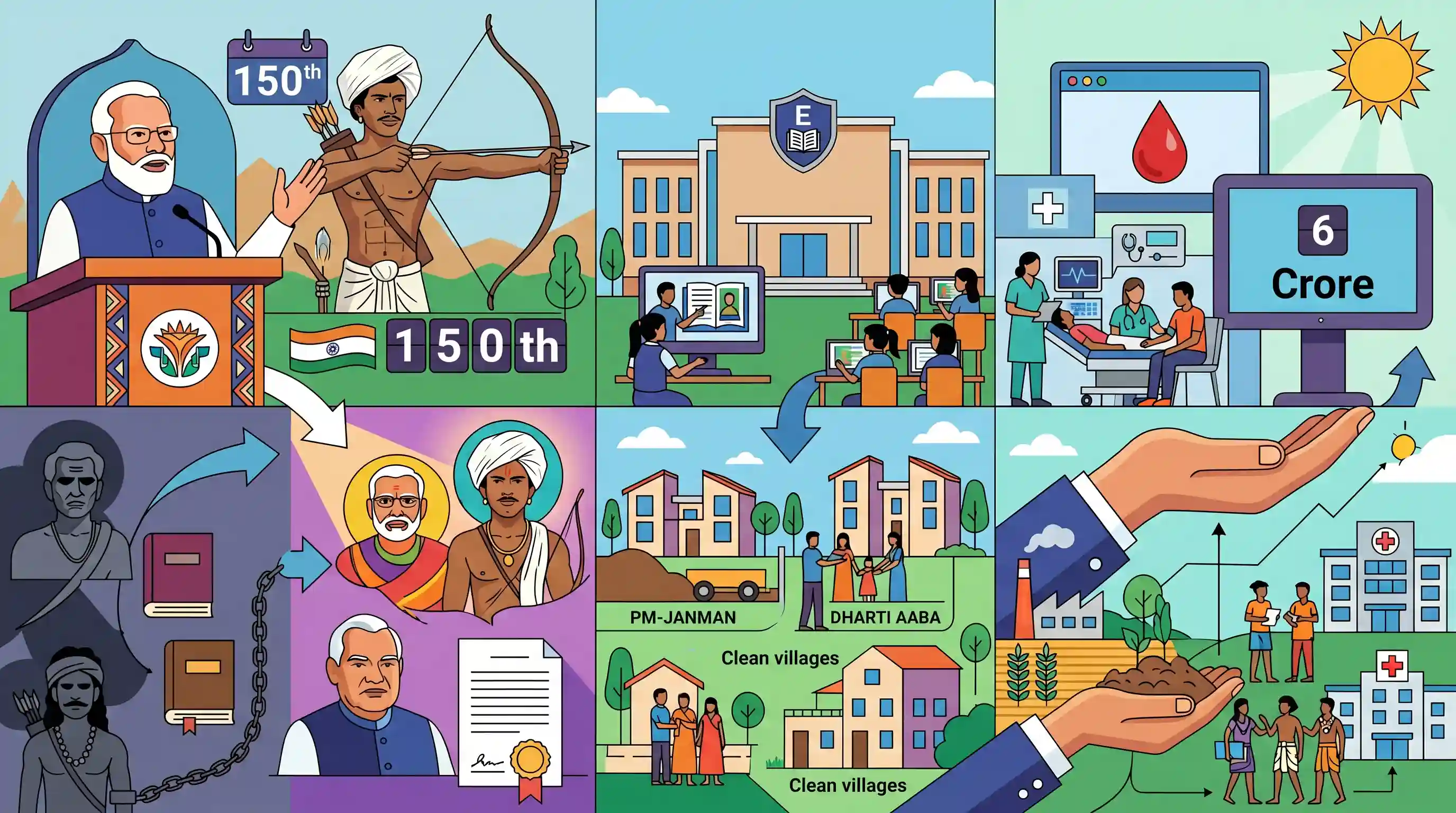
Addressing a gathering in Dediapada, Gujarat, to mark Janjatiya Gaurav Divas (Bhagwan Birsa Munda's 150th birth anniversary), PM Modi criticized the Congress for historically erasing the contributions of tribal freedom fighters. Highlighting a shift in governance, Modi emphasized the NDA's track record on tribal welfare, noting the establishment of the Ministry of Tribal Affairs by Atal Bihari Vajpayee. He outlined substantial investments in tribal education and housing through schemes like Eklavya Model Residential Schools, PM-JANMAN, and Dharti Aaba Janjatiya Gram Utkarsh Abhiyan. Furthermore, he highlighted public health milestones, including the screening of 6 crore individuals for sickle cell disease, reaffirming a comprehensive approach to the socio-economic and health development of vulnerable tribal populations.
Key Points
- PM Modi commemorated the 150th birth anniversary of Bhagwan Birsa Munda (Janjatiya Gaurav Divas), honoring tribal freedom fighters historically overlooked in national narratives.
- He criticized previous governments for neglecting tribal heritage and highlighted the creation of the Ministry of Tribal Affairs under the Atal Bihari Vajpayee administration.
- The government showcased major tribal welfare initiatives, including expanded budgets for Eklavya Model Residential Schools (EMRS) and housing inaugurations under PM-JANMAN and the Dharti Aaba Janjatiya Gram Utkarsh Abhiyan.
- Public health in tribal regions was emphasized, with over 6 crore people screened for sickle cell disease as part of targeted healthcare interventions.
Important Terms
PM-JANMAN

A mission launched in 2023 to provide 11 essential services—including housing, water, and electricity—to Particularly Vulnerable Tribal Groups (PVTGs) through a multi-ministerial convergence model.
UPSC context
GS Paper II (Welfare Schemes). Tests understanding of targeted interventions for the most marginalized tribal communities.
Dharti Aaba Janjatiya Gram Utkarsh Abhiyan
A comprehensive initiative aiming to saturate 63,000 tribal-majority villages with 25 basic services like roads and health infrastructure, building on the success of the PM-JANMAN model.
UPSC context
GS Paper II (Social Justice/Governance). Tests knowledge of rural saturation models for tribal-majority regions.
Janjatiya Gaurav Divas
Celebrated annually on November 15 (Bhagwan Birsa Munda’s birth anniversary) to honor the historical contributions and cultural heritage of India’s tribal freedom fighters.
UPSC context
GS Paper I (Modern History/Personalities). Relevant for questions on tribal movements and historical icons.
Eklavya Model Residential Schools (EMRS)
Model residential schools established to provide high-quality education to Scheduled Tribe students in remote areas, ensuring they have access to professional opportunities and higher education.
UPSC context
GS Paper II (Social Sector - Education). Focuses on human resource development among Scheduled Tribes.
Sickle Cell Anemia Elimination Mission
A mission launched in 2023 aiming to eradicate sickle cell disease by 2047 through mass screening of 7 crore individuals, particularly in high-prevalence tribal districts.
UPSC context
GS Paper II (Social Sector - Health). Addresses specific genetic health challenges and missions targeting tribal populations.
Ministry of Tribal Affairs
The nodal central ministry established in 1999 responsible for the overall policy, planning, and coordination of programs for the socio-economic development of Scheduled Tribes.
UPSC context
GS Paper II (Institutional Framework). Tests knowledge of administrative structures for safeguarding tribal interests.
Prelims Trap
"PM-JANMAN is a comprehensive mission launched for the socio-economic development of all Scheduled Tribes."
PM-JANMAN is strictly restricted to the 75 Particularly Vulnerable Tribal Groups (PVTGs), whereas broader schemes like Dharti Aaba target general tribal-majority villages.
Static Concepts Connected
What were the core features and outcomes of Birsa Munda's 'Ulgulan' revolt?
- Core Targets: Aimed to drive out 'dikus' (outsider landlords, moneylenders, and missionaries) and the British colonial authorities to establish an independent 'Munda Raj'.
- Legislative Outcome: Forced the British administration to pass this 1908 Act, which severely restricted the transfer of tribal land to non-tribals, recognizing tribal land rights.
How are PVTGs identified and classified in India?
- Commission Origin: Created based on the Dhebar Commission (1973) as 'Primitive Tribal Groups' (PTGs). They were renamed to PVTGs in 2006.
- Identification Criteria: Pre-agricultural level of technology, stagnant or declining population, extremely low literacy, and a subsistence level of economy.
- Demographic Spread: There are exactly 75 recognized PVTGs across 18 states and 1 Union Territory. Odisha hosts the highest number of PVTG communities.
Cross-Topic Patterns
Subaltern Freedom Movements
UPSC consistently shifts focus toward localized subaltern uprisings. Birsa Munda's 150th birth anniversary guarantees high relevance for tribal history, linking mainstream freedom narratives to regional revolts.
Tribal Genetics & Public Health
The intersection of tribal welfare and public health. Screening 6 crore people for Sickle Cell Disease aligns with the 2047 elimination target, connecting vulnerable populations (Social Justice) to genetic screening (Science & Tech).

Birsa Munda's 150th birth anniversary makes the Ulgulan revolt, PVTG criteria, and PM-JANMAN highly probable targets for 2026 Prelims.
Linked PYQs · 5
Linked PYQs · 5
- 2020PrelimsGS1
With reference to the history of India, "Ulgulan" or the Great Tumult is the description of which of the following events?
- 2019MainsGS1
The 1857 Uprising was the culmination of the recurrent big and small local rebellions that had occurred in the preceding hundred years of British rule. Elucidate.
- 2023MainsGS2
“Development and welfare schemes for the vulnerable, by its nature, are discriminatory in approach.” Do you agree? Give reasons for your answer.
- 2019MainsGS2
Performance of welfare schemes that are implemented for vulnerable sections is not so effective due to absence of their awareness and active involvement at all stages of policy process. Discuss.
- 2023PrelimsGS1
Consider the following statements in the context of interventions being undertaken under Anaemia Mukt Bharat Strategy: 1. It provides prophylactic calcium supplementation for pre-school children, adolescents and pregnant women. 2. It runs a campaign for delayed cord clamping at the time of child-birth. 3. It provides for periodic deworming to children and adolescents. 4. It addresses non-nutritional causes of anaemia in endemic pockets with special focus on malaria, hemoglobinopathies and fluorosis. How many of the statements given above are correct?
