India US trade relations and tariff dispute negotiations
Source:The Hindu ↗
Why It Matters
The article highlights the ongoing shift in global trade dynamics where major economies are prioritizing bilateral agreements and protectionist tariffs over multilateral free trade. For UPSC aspirants, this illustrates the complexities of India-U.S. relations, balancing strategic partnerships with hard economic negotiations over market access and tariffs.
Summary
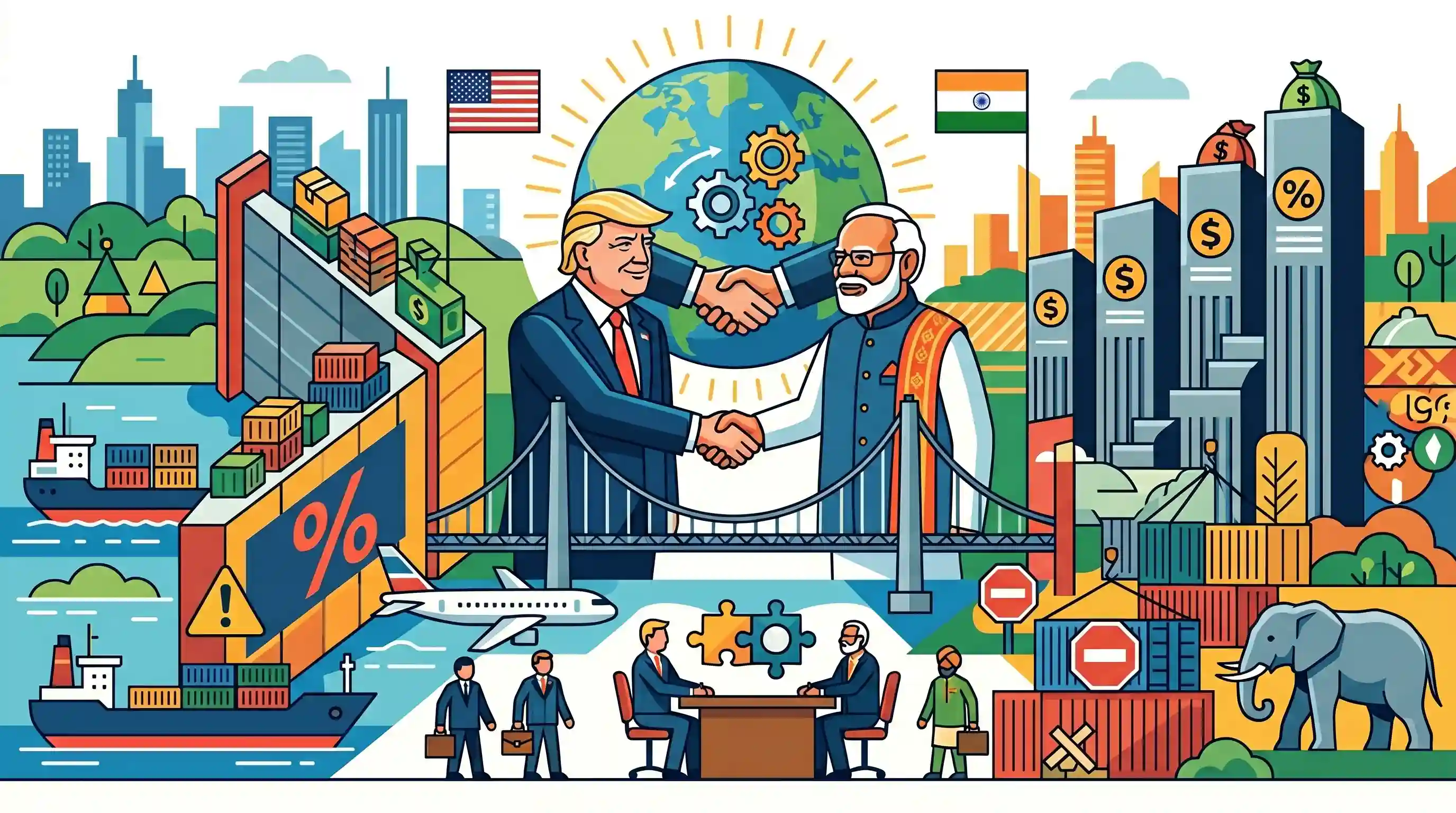
U.S. President Donald Trump expressed confidence in striking an interim bilateral trade deal with India, citing his strong friendship with Prime Minister Narendra Modi. Despite the positive diplomatic tone, Trump reiterated complaints about India's 'tremendous tariffs' and justified a proposed 12.5% U.S. tariff on Indian goods. The remarks followed a four-day visit by a U.S. delegation to India to negotiate the agreement, which India's Commerce Ministry praised as cooperative and pragmatic for strengthening bilateral economic ties.
Key Points
- U.S. President Donald Trump expressed optimism about concluding an India-U.S. trade deal, highlighting his strong personal rapport with Prime Minister Narendra Modi.
- Trump criticized India for imposing 'tremendous tariffs' on U.S. companies while justifying a newly proposed 12.5% U.S. tariff on Indian goods.
- A U.S. delegation recently completed four days of negotiations in India aimed at finalizing an interim bilateral trade agreement.
- India's Commerce Ministry described the ongoing trade talks as cooperative and pragmatic, emphasizing a commitment to strengthening bilateral economic ties despite tariff disputes.
Important Terms
Interim Trade Agreement

A limited-scope trade deal where countries liberalize tariffs on a select list of goods (often called an 'Early Harvest Scheme') before concluding a comprehensive Free Trade Agreement.
UPSC context
GS Paper II & III; crucial for understanding 'Trade Diplomacy' and incremental steps in complex international negotiations.
Section 301
A U.S. legal provision allowing the President to investigate and impose retaliatory tariffs or trade restrictions on countries deemed to have unfair trade practices.
UPSC context
GS Paper II; key friction point in India-US relations involving trade disputes and unilateral economic measures.
Ministry of Commerce and Industry
The central Indian government body responsible for formulating foreign trade policy, managing bilateral commercial relations, and negotiating international trade agreements through its Department of Commerce.
UPSC context
GS Paper II (Governance); primary executive authority for India's economic diplomacy and export promotion.
United States Trade Representative (USTR)
The executive office of the U.S. President responsible for developing trade policy and leading international trade negotiations, such as those with India's Commerce Ministry.
UPSC context
GS Paper II; important for identifying the counterpart agency in bilateral trade dialogues with the U.S.
Trade Protectionism
Economic policies, like high tariffs and quotas, intended to restrict imports to protect domestic industries from foreign competition.
UPSC context
GS Paper III (Economy); tests knowledge of global trade trends and their impact on India's export-led growth.
Non-Tariff Barriers (NTBs)
Trade restrictions such as quotas, sanctions, or technical regulations that hinder the flow of goods and services between countries without using direct taxes (tariffs).
UPSC context
GS Paper III; critical for understanding modern trade negotiations beyond simple duty reductions.
Prelims Trap
India runs a persistent trade deficit with its largest trading partner, the United States.
India consistently maintains a significant goods trade surplus with the US, making it a rare outlier among India's major trading partners.
Static Concepts Connected
What is the difference between GSP and MFN under WTO rules?
- MFN Principle: A foundational WTO rule requiring member countries to treat all their trading partners equally, without discrimination.
- GSP Exception: An authorized WTO exception that allows developed nations to offer non-reciprocal, tariff-free access to imports from developing countries.
- Unilateral nature: Unlike negotiated treaties, GSP is a voluntary concession. Donor countries can unilaterally revoke it, as the US did to India in 2019.
What are the main types of retaliatory tariffs and trade remedies?
- Countervailing Duties (CVD): Imposed to neutralize export subsidies provided by a foreign government, ensuring a level playing field for domestic producers.
- Anti-dumping Duties: Levied when a country exports a product at a price lower than its normal value in its own domestic market.
- Safeguard Duties: Emergency tariffs applied to protect a specific domestic industry from an unforeseen, massive surge in imports.
Cross-Topic Patterns
Economic friction vs. strategic synergy
While defense and strategic ties (Quad, iCET) rapidly advance, bilateral economic relations are frequently hindered by structural disputes over tariffs, price controls, and agricultural market access.
Trade surpluses & currency watchlists
India's persistent bilateral trade surplus with the US regularly risks placing India on the US Treasury's currency manipulator monitoring list, complicating the RBI's forex interventions.

A 2026 Prelims question will likely contrast India's persistent trade surplus with the US against its widening deficits with China and Russia.
Linked PYQs · 4
Linked PYQs · 4
- 2025MainsGS3
What are the challenges before the Indian economy when the world is moving away from free trade and multilateralism to protectionism and bilateralism? How can these challenges be met?
- 2018MainsGS3
How would the recent phenomena of protectionism and currency manipulations in world trade affect macroeconomic stability of India?
- 2014MainsGS2
The aim of Information Technology Agreements (ITAs) is to lower all taxes and tariffs on information technology products by signatories to zero. What impact would such agreements have on India's interests?
- 2018MainsGS2
India and USA are two large democracies. Examine the basic tenets on which the two political systems are based.
