Gadchiroli Development and Left Wing Extremism Eradication Strategy
Source:Indian Express ↗
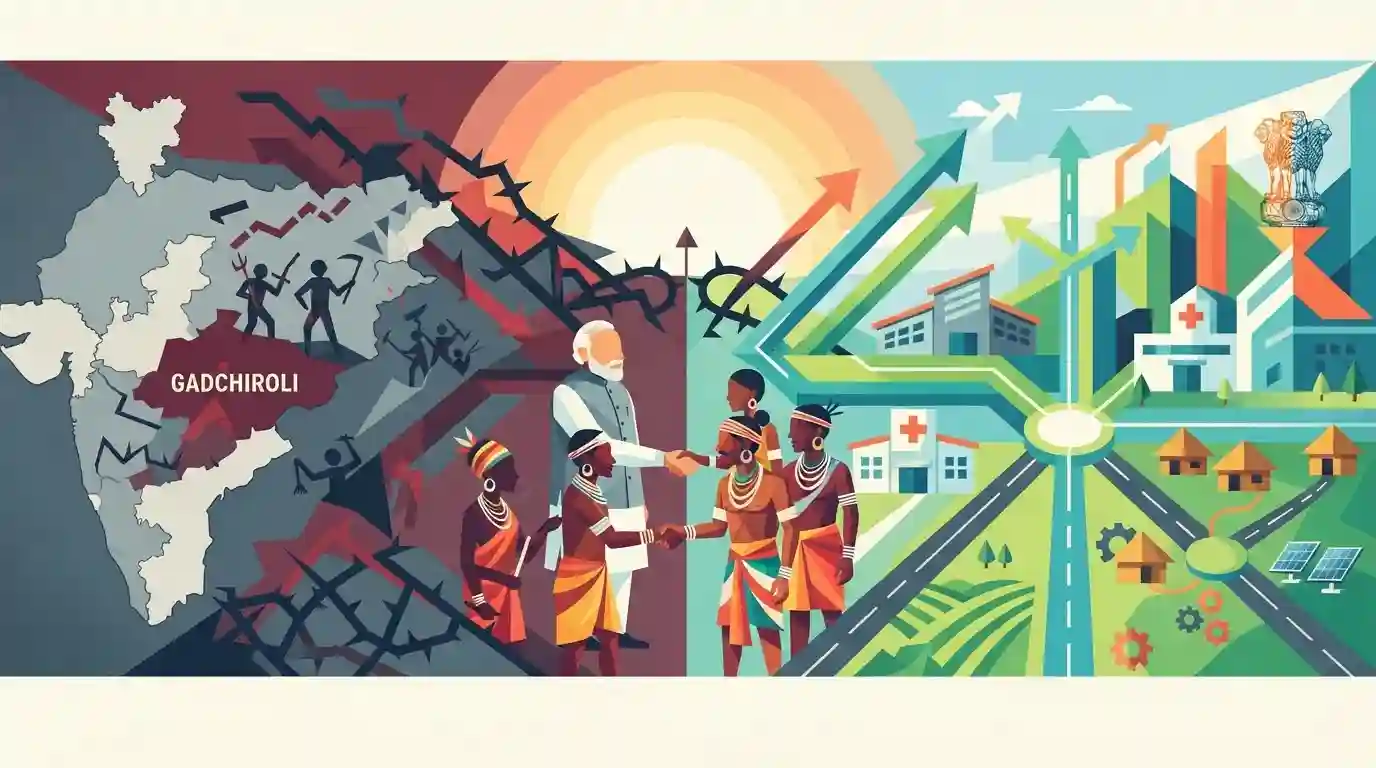
Why It Matters
This topic directly connects with GS3 Internal Security syllabi regarding the security challenges in LWE-affected areas, root causes of Naxalism, and the developmental strategies required to counter them.
Summary
Prime Minister Narendra Modi's focus on Gadchiroli underscores the synergy between tribal development and countering Left Wing Extremism. By targeting extreme poverty and improving infrastructure in LWE-affected regions, the state aims to integrate marginalized populations into the national mainstream.
Key Points
- Prime Minister Narendra Modi highlighted development initiatives in Gadchiroli, Maharashtra, aiming to eradicate extreme poverty and combat Left Wing Extremism (LWE).
- Gadchiroli, historically plagued by Maoist insurgency, is witnessing a shift towards tribal development, infrastructure connectivity, and economic integration.
- The strategy emphasizes addressing the socio-economic root causes of Naxalism, including lack of health, education, and livelihood opportunities in remote forested regions.
- Holistic interventions involving local participation, employment generation, and security measures are critical for neutralizing Left Wing Extremism.
Important Terms
Left Wing Extremism

An armed insurgency movement rooted in communist ideology, primarily active in remote, forested, and tribal-dominated parts of India, targeting state authority and infrastructure.
UPSC context
UPSC Mains Paper III (Internal Security): Crucial for studying security challenges, state response strategies, and developmental interventions in affected regions.
PM-JANMAN
A central scheme launched to socio-economically uplift Particularly Vulnerable Tribal Groups (PVTGs) by providing basic amenities like housing, clean water, healthcare, and education in remote areas.
UPSC context
UPSC Mains Paper II & III (Governance / Inclusive Growth): Evaluates government welfare delivery and social justice for marginalized tribal populations.
Eklavya Model Residential Schools
Residential schools established in remote tribal blocks to provide quality middle-to-higher secondary education to Scheduled Tribe (ST) students, bridging educational disparities.
UPSC context
UPSC Mains Paper II (Social Justice / Education): Tests policies and institutional frameworks aimed at human capital formation among tribal communities.
Gadchiroli
A remote district in Maharashtra historically serving as a major stronghold for Left Wing Extremism, now transitioning through targeted infrastructure and anti-insurgency efforts.
UPSC context
UPSC Prelims/Mains: Relevant for internal security case studies on successfully transforming LWE-affected conflict zones through development and security synergy.
Janjatiya Gaurav Diwas
A national day observed to honor tribal freedom fighters and celebrate the rich cultural heritage and socio-economic empowerment of India's tribal communities.
UPSC context
UPSC Mains Paper I (Indian Heritage and Culture) & Paper II (Social Justice): Focuses on the recognition and preservation of tribal history and contributions.
Prelims Trap
Left Wing Extremism is purely an internal security challenge best addressed exclusively through kinetic military operations and intelligence-led counter-insurgency.
Aspirants often assume LWE can be permanently resolved solely through police and military actions, ignoring the vital socio-economic pillars like the Aspirational Districts Programme and infrastructure.
Static Concepts Connected
What are the core pillars of India's multi-pronged strategy to counter Left Wing Extremism?
- Security Measures: Security measures: Deployment of central forces, modernization of state police, and specialized jungle warfare training.
- Developmental Push: Development interventions: Accelerated road connectivity, mobile towers, Eklavya schools, and Aspirational Districts Programme.
- Rights & Governance: Rights protection: Ensuring proper implementation of PESA Act and Forest Rights Act to curb land alienation.
Cross-Topic Patterns
LWE Security vs. Fifth Schedule Rights
Internal security strategies in LWE regions are increasingly evaluated through the lens of Fifth Schedule constitutional protections and land alienation rights under PESA.
Aspirational Districts and Cooperative Federalism
The Aspirational Districts Programme demonstrates how multi-dimensional poverty indices guide targeted fiscal federalism and district-level governance reforms.

Expect a statement-based question linking the SAMADHAN doctrine with socio-economic welfare schemes in LWE-affected tribal districts.
Linked PYQs · 3
Linked PYQs · 3
- 2025MainsGS3
The Government of India recently stated that Left Wing Extremism (LWE) will be eliminated by 2026. What do you understand by LWE and how are the people affected by it? What measures have been taken by the government to eliminate LWE?
- 2022MainsGS3
Naxalism is a social, economic and developmental issue manifesting as a violent internal security threat. In this context, discuss the emerging issues and suggest a multilayered strategy to tackle the menace of Naxalism.
- 2020MainsGS3
What are the determinants of left-wing extremism in Eastern part of India? What strategy should Government of India, civil administration and security forces adopt to counter the threat in the affected areas?
