India and Australia Hold Bilateral Talks at G20 Summit
Source:The Hindu ↗
Why It Matters
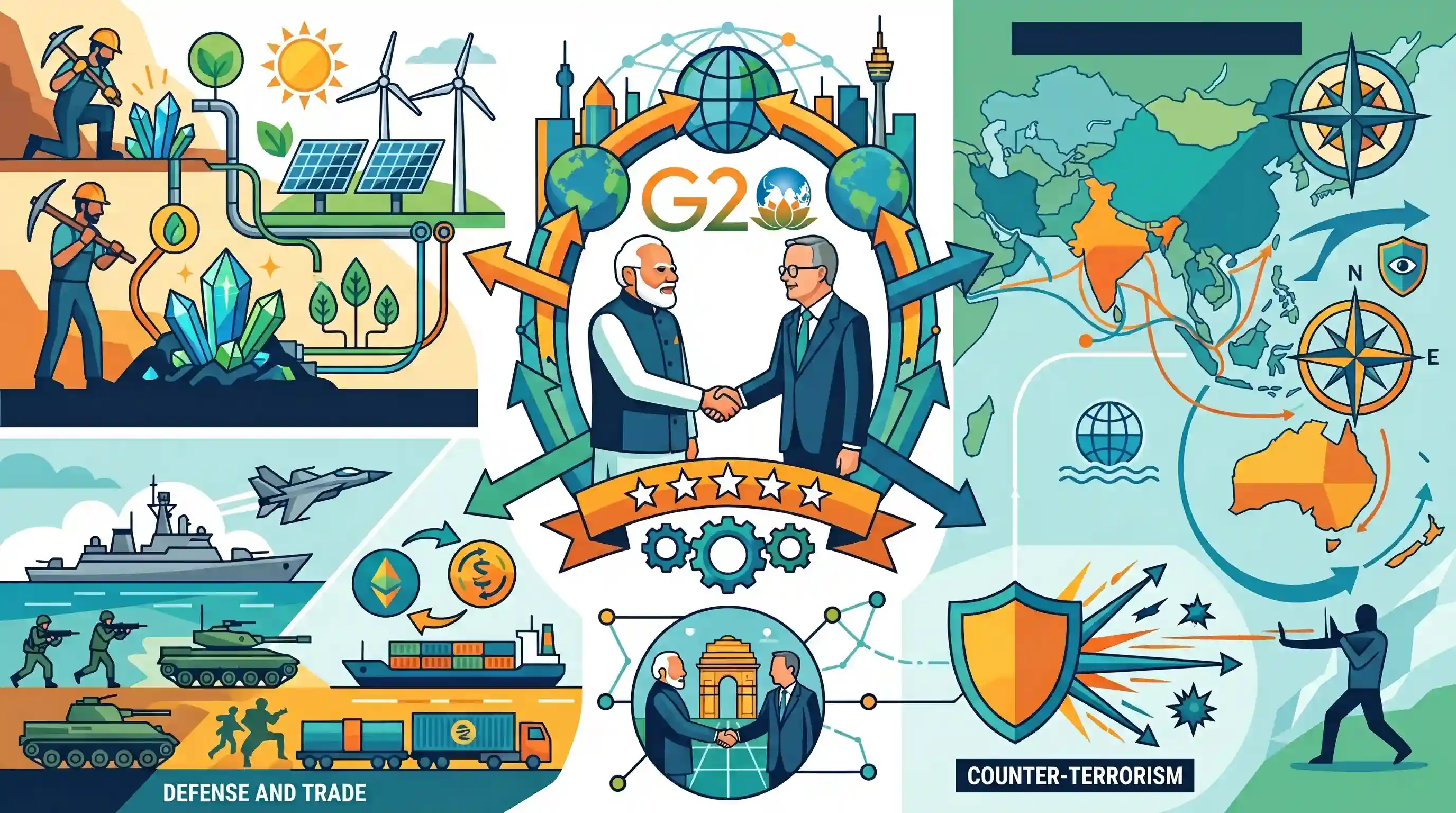
The deepening India-Australia partnership is crucial for India's Indo-Pacific strategy, securing defense cooperation, and establishing resilient supply chains for critical minerals necessary for energy transition.
Summary
Prime Minister Narendra Modi and Australian PM Anthony Albanese held bilateral talks on the sidelines of the G20 Leaders' Summit in Johannesburg, celebrating the fifth anniversary of the India-Australia Comprehensive Strategic Partnership (CSP). Discussions centered on expanding multifaceted cooperation across defense, critical minerals, clean energy, and trade. Furthermore, the leaders underscored their shared vision for a free, open, and secure Indo-Pacific and committed to strengthening the global fight against terrorism. These high-level talks were complemented by the 16th India-Australia Foreign Ministers' Framework Dialogue held in Delhi.
Key Points
- PM Modi and Australian PM Anthony Albanese met at the G20 Summit in Johannesburg to mark five years of the India-Australia Comprehensive Strategic Partnership.
- Discussions focused on boosting cooperation in defense and security, critical minerals, trade and investment, and clean energy.
- Both leaders reaffirmed their commitment to maintaining a free, open, secure, and prosperous Indo-Pacific.
- Parallel to the leaders' summit, the 16th India-Australia Foreign Ministers' Framework Dialogue was held in Delhi between S. Jaishankar and Penny Wong.
Important Terms
Comprehensive Strategic Partnership (CSP)

A high-level bilateral agreement established in 2020 to elevate India-Australia ties, focusing on deep cooperation in defense, trade, critical minerals, and maritime security.
UPSC context
GS-II (Bilateral Relations). Tests understanding of strategic alliances and India's 'Act East' and 'Indo-Pacific' outreach.
Foreign Ministers' Framework Dialogue (FMFD)
An institutional mechanism for annual high-level review of the bilateral relationship between Indian and Australian foreign ministers to coordinate on regional and global issues.
UPSC context
GS-II (International Relations). Significant for institutionalizing diplomatic ties and tracking bilateral progress in major partnerships.
G20
A premier forum for international economic cooperation comprising 19 countries, the European Union, and the African Union, representing major global economies.
UPSC context
GS-II (Global Groupings). Focuses on India's role as a leader of the Global South and multilateral diplomacy.
Critical Minerals
Metallic elements like lithium and cobalt essential for modern technologies and green energy, characterized by high economic importance and significant supply chain risks.
UPSC context
GS-III (Energy & Environment). Tests knowledge of the green transition, supply chain resilience, and resource diplomacy.
Indo-Pacific
A strategic maritime region spanning the Indian and Pacific Oceans, where India promotes a free, open, inclusive, and rules-based international order.
UPSC context
GS-II (Regional Geopolitics). Essential for questions on maritime security, QUAD, and balancing geopolitical influence in Asia.
Prelims Trap
"India and Australia currently trade under a finalized Comprehensive Economic Cooperation Agreement (CECA)."
They operate under the interim Economic Cooperation and Trade Agreement (ECTA) signed in 2022. The full CECA is still actively under negotiation.
Static Concepts Connected
What qualifies a mineral as "critical" for India?
- Economic necessity: Essential for advancing high-tech manufacturing, telecommunications, defense capabilities, and the green energy transition.
- Supply vulnerability: High import reliance and concentrated global extraction/processing, posing significant geopolitical and supply chain risks.
- Official framework: The Ministry of Mines established a formal framework in 2023, notifying a dedicated list of 30 critical minerals for India.
What is the significance of the 2+2 Ministerial Dialogue?
- Strategic structure: A diplomatic mechanism featuring simultaneous meetings between the Foreign and Defense Ministers of two partner nations.
- Quad alignment: India conducts this dialogue with all Quad members (USA, Japan, Australia), forming the bedrock of Indo-Pacific security cooperation.
- Exclusive club: The mechanism is reserved for top-tier partners and also includes Russia and the UK.
Cross-Topic Patterns
Green Tech & Geopolitics
India's clean energy transition (e.g., EV targets) depends heavily on Australia's lithium and cobalt reserves, deeply merging environmental syllabus themes with strategic supply-chain resilience and IR.
Bilateral depth for Minilateral strength
The bilateral CSP acts as the foundational glue strengthening broader minilateral architectures like the Quad, translating shared Indo-Pacific rhetoric into tangible military interoperability through exercises like AUSINDEX.

Expect a 2026 mains question on how bilateral partnerships (like India-Australia) secure critical mineral supply chains against monopolies.
Linked PYQs · 3
Linked PYQs · 3
- 2021MainsGS2
The newly tri-nation partnership AUKUS is aimed at countering China's ambitions in the Indo-Pacific region. Is it going to supersede the existing partnerships in the region? Discuss the strength and impact of AUKUS in the present scenario.
- 2020MainsGS2
What is the significance of Indo-US defence deals over Indo-Russian defence deals? Discuss with reference to stability in the Indo-Pacific region.
- 2025MainsGS3
Mineral resources are fundamental to the country's economy and these are exploited by mining. Why is mining considered an environmental hazard? Explain the remedial measures required to reduce the environmental hazard due to mining.
