India and France Inaugurate Bharat Innovates Conference in Nice
Source:The Hindu ↗
Why It Matters
The article highlights two major developments for UPSC aspirants: 1) the strategic deepening of India-France relations in critical and emerging technologies (AI, space, and defense), and 2) a significant domestic policy shift via the SHANTI Act, which allows private sector entry into India's traditionally state-monopolized nuclear energy sector to accelerate clean energy goals.
Summary
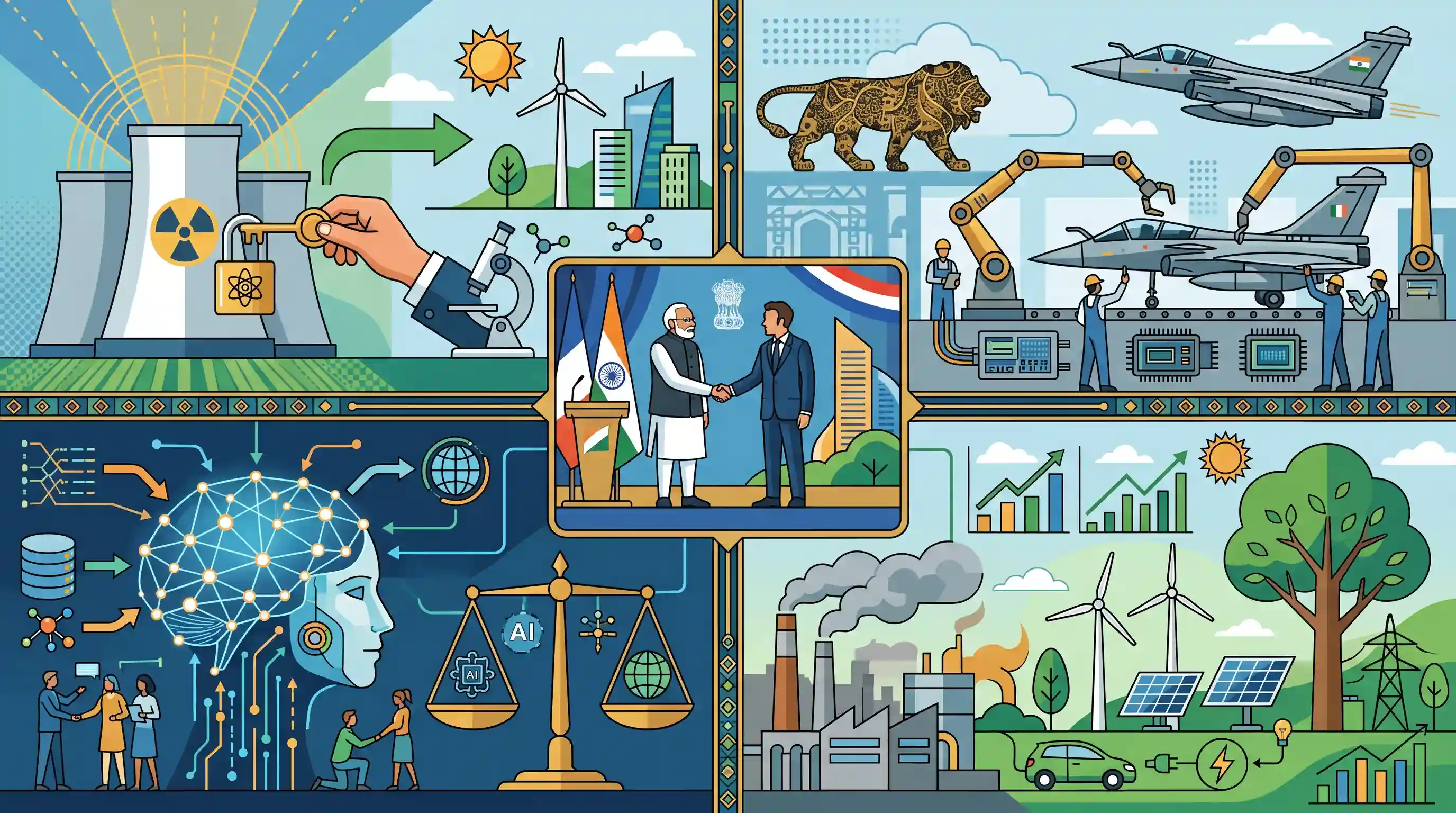
Prime Minister Narendra Modi and French President Emmanuel Macron inaugurated the "Bharat Innovates 2026" conference in Nice, France, highlighting the robust bilateral ties between the two nations. A major highlight was India's newly passed SHANTI Act, which opens the Indian nuclear power sector to private participation, aiming to boost clean energy and advanced reactor research. The discussions also focused on strategic defense indigenisation (with "Make in India" linked to Rafale jets) and forging a cooperative, multilateral approach to Artificial Intelligence and LLMs to balance global technological dominance.
Key Points
- PM Narendra Modi and French President Emmanuel Macron inaugurated the 'Bharat Innovates 2026' conference in Nice, France, emphasizing deep strategic and technological cooperation.
- The leaders discussed the newly passed 'SHANTI Act' in India, a landmark legislation enabling private sector participation in the nuclear power sector to promote clean energy and advanced reactors.
- Macron praised India's space achievements, particularly Chandrayaan-3, and called for a cooperative, multilateral approach to AI and Large Language Models (LLMs) to counter tech dominance by the US and China.
- Bilateral defence ties were highlighted, notably the potential sale of 114 Rafale fighter jets aligned with the 'Make in India' initiative, ensuring technology transfer and self-reliance.
Important Terms
SHANTI Act (2025)

A landmark 2025 law (Sustainable Harnessing and Advancement of Nuclear Energy for Transforming India) that ended India's state monopoly by allowing private sector participation and foreign investment in nuclear power.
UPSC context
GS-3 (Infrastructure/Energy) and GS-2 (Government Policies). Marks a structural shift in India's energy policy and liability framework.
Bharat Innovates 2026
A premier deep-tech conclave inaugurated in June 2026 in Nice, France, to catalyze investment and research partnerships between Indian startups and global innovation ecosystems.
UPSC context
GS-2 (International Relations) and GS-3 (Science & Technology). Focuses on deep-tech diplomacy and India-France strategic technology ties.
Make in India (Defense context)
A flagship initiative aimed at transforming India into a global manufacturing hub; recently expanded to include co-development and local manufacturing of 114 Rafale fighter jets.
UPSC context
GS-3 (Internal Security/Defense). Tests knowledge of indigenisation, technology transfer (ToT), and reducing import dependency.
Small Modular Reactors (SMRs)
Advanced nuclear reactors with smaller footprints and capacity (up to 300 MW) designed for flexible deployment, emphasized in the SHANTI Act for private industrial use.
UPSC context
GS-3 (Science & Technology/Energy). Critical for net-zero goals and decentralized baseload power for sectors like AI data centers.
India-France Year of Innovation
A bilateral diplomatic initiative (2026) facilitating high-level cooperation in frontier technologies like semiconductors, AI, and space, between New Delhi and Paris.
UPSC context
GS-2 (Bilateral Relations). Highlights the transition from traditional defense-centric ties to a comprehensive technology-led strategic partnership.
Right of Recourse
A legal provision allowing operators to sue equipment suppliers for defects; its removal under the SHANTI Act aligns India with international nuclear liability norms.
UPSC context
GS-3 (Energy Security). Crucial for understanding the trade-off between attracting foreign investment and ensuring corporate accountability in hazardous industries.
Prelims Trap
"Under Indian law, civilian nuclear power plants can solely be owned and operated by government enterprises."
This was true under the Atomic Energy Act 1962, but the recent SHANTI Act ends this monopoly, explicitly permitting private sector ownership and operation.
Static Concepts Connected
What is the regulatory framework for India's nuclear energy sector?
- State Monopoly: Historically established by the Atomic Energy Act 1962, restricting nuclear power generation strictly to state-owned entities like NPCIL and BHAVINI.
- Private Entry: The newly passed SHANTI Act reforms the sector, enabling private corporations to build, own, and operate civilian nuclear power plants.
- Operator Liability: Governed by the Civil Liability for Nuclear Damage (CLND) Act 2010, which strictly channels nuclear incident liability to the operator.
How do Small Modular Reactors (SMRs) differ from conventional nuclear reactors?
- Lower Capacity: SMRs generate up to 300 MW(e) per unit, which is roughly one-third of the generating capacity of traditional large-scale nuclear reactors.
- Modularity: Components are factory-assembled and transported to the site as a single unit, significantly reducing on-site construction time and capital costs.
- Passive Safety: They heavily utilize passive safety systems that rely on natural forces (like gravity or convection) requiring no human intervention to shut down.
Cross-Topic Patterns
Multilateral AI & Global South leadership
India uses its GPAI chair status to push for democratized, open-source AI models, countering Western tech monopolies and projecting Global South leadership in emerging tech.
Defence Acquisition Procedure (DAP) categories
Major foreign defence deals like Rafale test the 'Buy (Global–Manufacture in India)' DAP category, which legally mandates a minimum 50% indigenisation via technology transfer.

SHANTI Act ending the 1962 nuclear monopoly + SMR technical features is highly likely to form a multi-statement Prelims question in 2026.
Linked PYQs · 3
Linked PYQs · 3
- 2022MainsGS2
Critically examine the procedures through which the Presidents of India and France are elected.
- 2023MainsGS3
Introduce the concept of Artificial Intelligence (AI). How does Al help clinical diagnosis? Do you perceive any threat to privacy of the individual in the use of Al in healthcare?
- 2018MainsGS3
“Access to affordable, reliable, sustainable and modern energy is the sine qua non to achieve Sustainable Development Goals (SDGs).” Comment on the progress made in India in this regard.
