Prime Minister Modi Inaugurates Full Delhi Meerut RRTS Corridor
Source:The Hindu ↗
Why It Matters
Mass rapid transit systems like the RRTS are critical to solving India's urban congestion and pollution crises. Understanding the role of multi-modal integration, regional planning, and sustainable public transport is important for answering questions on infrastructure development and urbanization in GS Paper 1 and GS Paper 3.
Summary
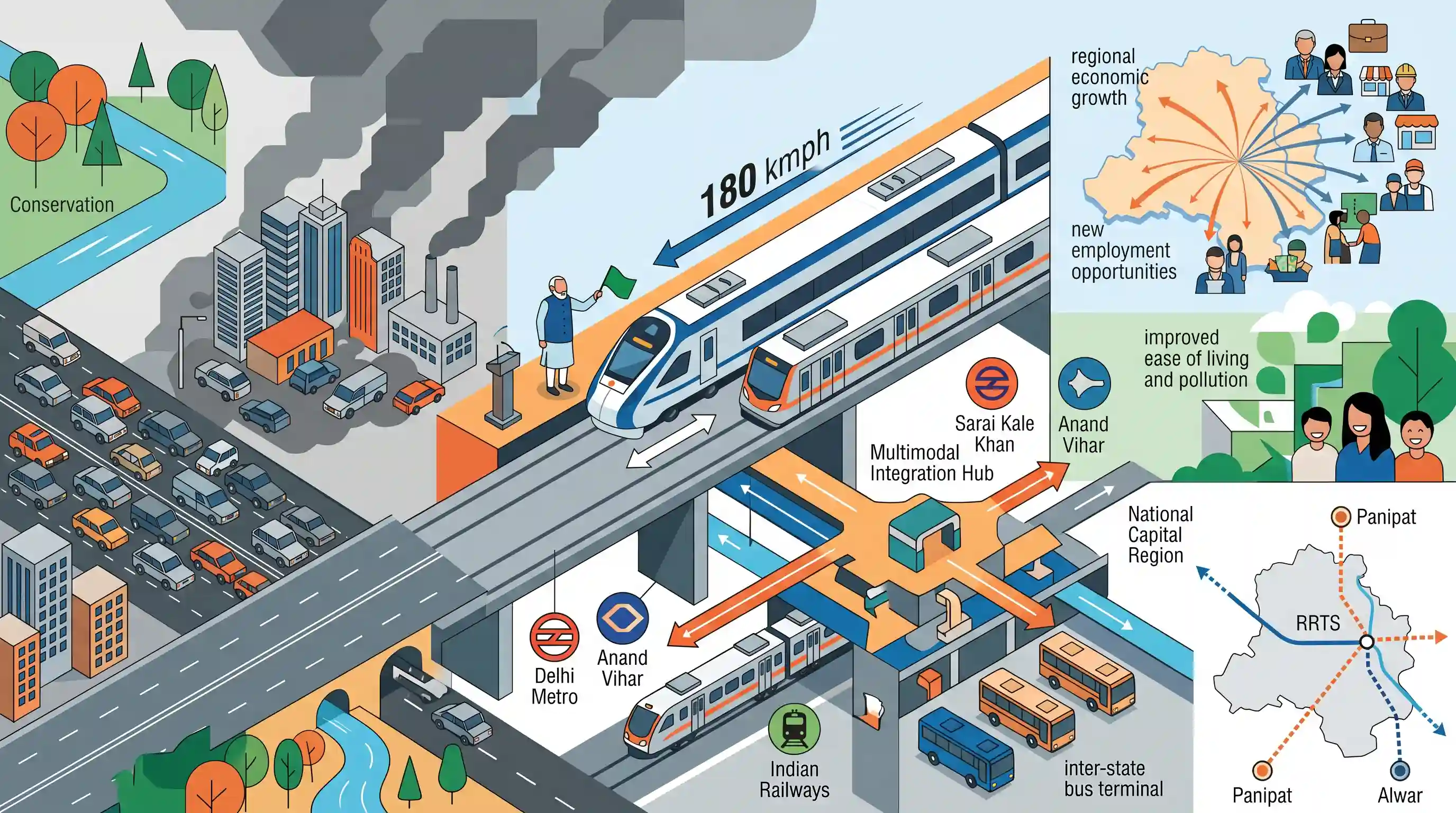
Prime Minister Narendra Modi recently inaugurated the complete 82-km Delhi-Meerut Regional Rapid Transit System (RRTS) corridor, officially flagging off the high-speed Namo Bharat train alongside the Meerut Metro services. As India's pioneering Regional Rapid Transit System, it features an impressive design speed of 180 kmph and is tailored to reduce travel time between major regional nodes significantly. A standout characteristic of the corridor is its focus on multi-modal integration, connecting seamlessly with the Delhi Metro, Indian Railways stations, and inter-state bus terminals at transit hubs like Sarai Kale Khan, Anand Vihar, and Ghaziabad. The infrastructure project is strategically designed to decongest the heavily populated National Capital Region (NCR), lower carbon emissions, and reduce vehicular traffic on highways. Furthermore, it aims to stimulate regional economic growth, enhance the overall ease of living, and generate new employment opportunities across the connected cities. Building on this momentum, the government has already planned additional rapid transit corridors to connect Delhi with Panipat and Alwar, reinforcing its commitment to sustainable urban mobility and balanced regional development.
Key Points
- Prime Minister Narendra Modi inaugurated the full 82-km Delhi-Meerut RRTS corridor, flagging off the Namo Bharat train and Meerut Metro services.
- The Namo Bharat train, with a design speed of 180 kmph, is India's first Regional Rapid Transit System (RRTS).
- The project features seamless multi-modal integration with Indian Railways stations, the Delhi Metro, and inter-state bus terminals at key transit hubs.
- The RRTS aims to decongest the National Capital Region (NCR), lower traffic and environmental pollution, and boost regional economic activity and employment generation.
- Future RRTS corridors are planned connecting Delhi to Panipat and Alwar.
Important Terms
Regional Rapid Transit System (RRTS)

A rail-based, semi-high-speed, high-frequency commuter transit system designed for regional connectivity. It features a design speed of 180 kmph, filling the gap between inter-city railways and intra-city metros.
UPSC context
GS Paper 3: Infrastructure (Railways). Tests understanding of modern mass-transit solutions and sustainable urban mobility.
Namo Bharat
The official brand name for India's first RRTS trains. These are indigenously manufactured semi-high-speed trains (operational speed 160 kmph) equipped with modern amenities like Wi-Fi and ergonomic seating.
UPSC context
GS Paper 3: Infrastructure and 'Make in India' initiative. Relevant for questions on indigenous technological advancements.
National Capital Region Transport Corporation (NCRTC)
A Joint Venture company of the Government of India and the states of Delhi, Haryana, Rajasthan, and UP, mandated to implement the RRTS project across the National Capital Region.
UPSC context
GS Paper 2: Statutory/Regulatory Bodies; GS Paper 3: Infrastructure. Demonstrates cooperative federalism in executing mega-projects.
Multi-modal Integration
The seamless physical and operational connection between different transport modes (rail, bus, metro) at a single hub to facilitate efficient passenger transfers and reduce urban congestion.
UPSC context
GS Paper 1: Urbanization; GS Paper 3: Infrastructure (PM GatiShakti). Critical for urban planning and environmental sustainability.
Meerut Metro
An innovative urban Mass Rapid Transit System (MRTS) that operates on the same infrastructure and tracks as the RRTS, making it the fastest metro service in India (120 kmph).
UPSC context
GS Paper 3: Infrastructure. Represents a unique resource-sharing model for cost-effective urban transport development.
Prelims Trap
"The RRTS is completely funded and operated by the Ministry of Railways as a central sector initiative."
RRTS is implemented by NCRTC, which is not exclusively Central. It is a 50:50 joint venture between the Government of India and four state governments.
Static Concepts Connected
How does RRTS fundamentally differ from conventional Metro rail systems?
- Primary Purpose: RRTS connects regional, inter-city nodes, whereas Metro caters strictly to high-frequency intra-city commuting.
- Station Spacing: RRTS stations are spaced 5-10 km apart to maintain high speeds, compared to Metro stations which are typically 1-2 km apart.
- Speed Dynamics: RRTS features a higher design speed (180 kmph) and operational speed compared to the slower, stop-heavy Metro systems.
What is Transit-Oriented Development (TOD) in the context of urban planning?
- Core Concept: Creating compact, walkable, pedestrian-oriented, mixed-use communities centered around high-quality train systems.
- Objective: To maximize the amount of residential, business, and leisure space within walking distance of public transport hubs.
- Application in RRTS: RRTS leverages TOD to boost regional economic activity, generating non-fare box revenue and reducing reliance on private vehicles.
Cross-Topic Patterns
Polycentric Development & Counter-magnets
RRTS shifts demographic pressure from core Delhi to peripheral hubs, practically implementing the geographic concept of 'counter-magnet' towns to manage rapid urbanization.
Cooperative Federalism in Urban Transit
NCRTC exemplifies cooperative federalism, pooling financial and administrative resources from the Centre and four distinct state governments (Delhi, Haryana, Rajasthan, UP) to execute cross-border infrastructure.

Expect a multi-statement Prelims question comparing the operational purpose, stopping frequencies, and implementing agencies of RRTS vs Metro.
Linked PYQs · 4
Linked PYQs · 4
- 2016MainsGS1
With a brief background of quality of urban life in India, introduce the objectives and strategy of the 'Smart City Programme'.
- 2017MainsGS1
"The growth of cities as I.T. hubs has opened up new avenues of employment, but has also created new problems." Substantiate this statement with examples.
- 2022MainsGS3
Why is Public Private Partnership (PPP) required in infrastructural projects ? Examine the role of PPP model in the redevelopment of Railway Stations in India.
- 2023MainsGS3
The adoption of electric vehicles is rapidly growing worldwide. How do electric vehicles contribute to reducing carbon emissions and what are the key benefits they offer compared to traditional combustion engine vehicles?
