Prime Minister Modi Flags Off India First Hydrogen Train
Source:Indian Express ↗
ఇది ఎందుకు ముఖ్యం
The transition to hydrogen fuel-cell propulsion on commercial rail routes marks a critical practical application of India's green hydrogen ambitions. It connects infrastructure development (GS3) with indigenous science and tech (GS3) and climate change mitigation, showcasing a tangible path towards the Railways' Net Zero 2030 targets.
సారాంశం
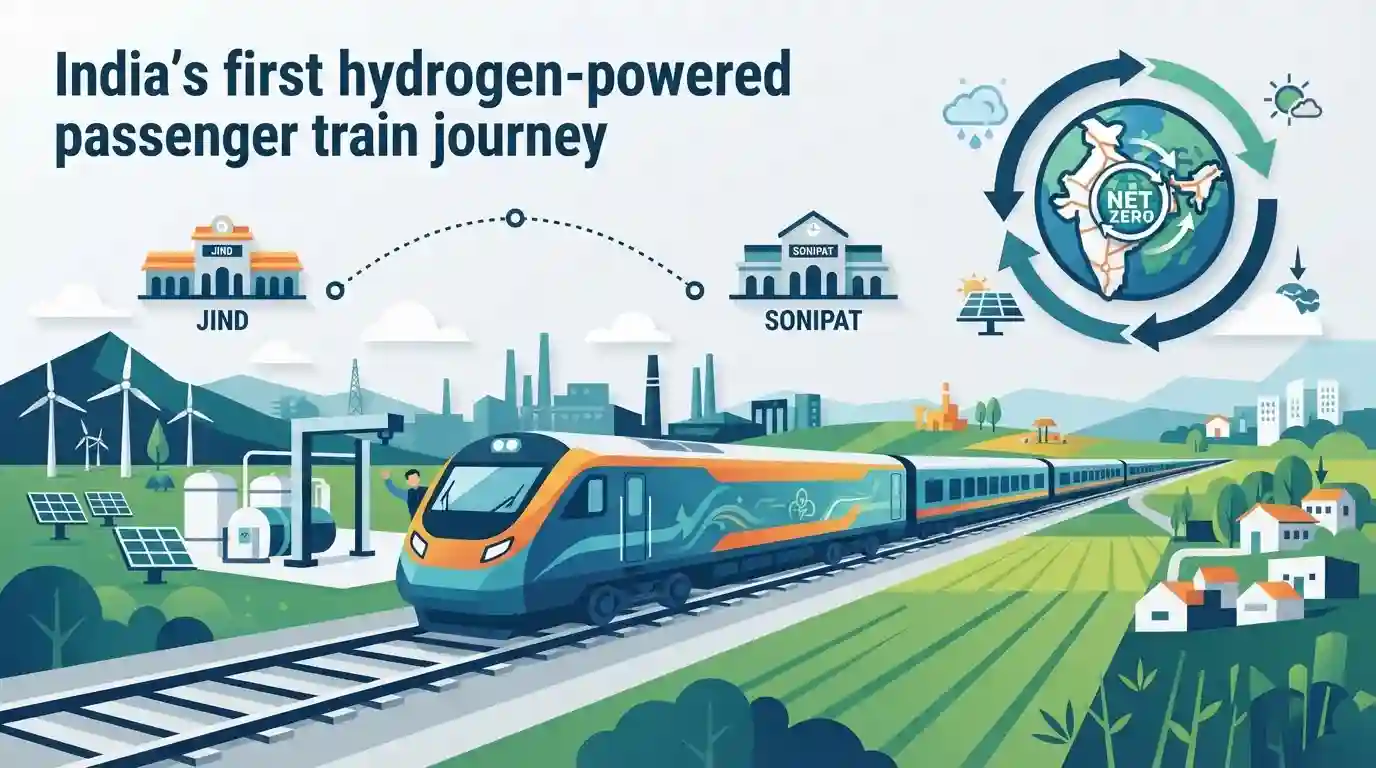
India's first hydrogen-powered passenger train, developed indigenously by the Chennai-based Integral Coach Factory (ICF), was flagged off by Prime Minister Narendra Modi on the Jind-Sonipat route in Haryana. Supported by a newly built hydrogen refueling and storage facility at Jind (approved by PESO), this launch enters India into an elite league of nations using hydrogen rail propulsion, accelerating Indian Railways' journey toward its Net Zero Carbon Emissions 2030 goal.
ముఖ్య అంశాలు
- Prime Minister Narendra Modi flagged off India's first hydrogen-powered passenger train on the 89 km long Jind-Sonipat route in Haryana.
- The train was developed indigenously by the Integral Coach Factory (ICF) in Chennai, marking a major milestone under the green mobility and self-reliance initiative.
- The 10-car trainset includes 2 Driving Power Cars (1,200 kW each, totaling 2,400 kW) and 8 passenger coaches, with a maximum speed of 75 kmph.
- A specialized hydrogen refueling and storage facility has been set up at the Jind station, with approvals secured from the Petroleum and Explosives Safety Organisation (PESO).
- With this launch, India joins a select group of countries—including Germany, Japan, China, and the USA—exploring or deploying hydrogen rail technology.
- The development aligns with Indian Railways' broader national target of achieving Net Zero Carbon Emissions by 2030.
ముఖ్యమైన పదాలు
Integral Coach Factory (ICF)

A premier manufacturing unit of the Indian Railways located in Chennai, specializing in designing and producing passenger coaches, Vande Bharat trainsets, and hydrogen-powered coaches.
UPSC context
GS Paper 3: Infrastructure and Indigenization of Technology. Tests knowledge of domestic manufacturing capability.
Petroleum and Explosives Safety Organisation (PESO)
A statutory regulatory body under India's DPIIT, Ministry of Commerce and Industry, that regulates safety, storage, transport, and licensing of hazardous substances, compressed gases, and explosives nationwide.
UPSC context
GS Paper 2 & 3: Statutory Bodies & Disaster Management. Tests knowledge of safety regulations for hazardous materials.
Hydrogen Fuel Cell Technology
An electrochemical technology that generates electricity by reacting hydrogen and oxygen, emitting only water vapor and heat, and powering zero-emission transport solutions like hydrogen trains.
UPSC context
GS Paper 3: Science & Technology and Clean Energy. Tests understanding of alternative fuels and decarbonization.
National Green Hydrogen Mission
A Union Government initiative to facilitate demand creation, production, utilization, and export of green hydrogen, aiming to decarbonize major sectors and make India energy-independent.
UPSC context
GS Paper 3: Government Policies and Renewable Energy. Tests initiatives to combat climate change and reduce fossil fuel reliance.
Net Zero Carbon Emissions by 2030
Indian Railways' targeted commitment to eliminate its entire greenhouse gas footprint by 2030 through complete electrification, solar installations, and clean energy transition.
UPSC context
GS Paper 3: Environmental Conservation and Infrastructure. Tests strategies for clean mobility and sustainable development.
ప్రిలిమ్స్ ఉచ్చు
"Hydrogen fuel storage and refueling in India is regulated by the Ministry of New and Renewable Energy."
While MNRE handles the National Green Hydrogen Mission, the safety, storage, and dispensing of compressed hydrogen gas are regulated by PESO, which falls under DPIIT (Ministry of Commerce and Industry).
అనుసంధానమైన స్థిర భావనలు
How do Hydrogen Fuel Cells generate power for vehicles?
- Chemical Process: It generates electricity onboard by combining stored hydrogen gas with ambient oxygen through a Proton Exchange Membrane (PEM).
- No Combustion: Unlike internal combustion engines, this process involves no burning of fuel. It produces zero tailpipe carbon emissions.
- By-products: The only by-products released into the environment from a hydrogen fuel cell are pure water vapour and heat.
What is the Petroleum and Explosives Safety Organisation (PESO)?
- Mandate: It is the apex national safety regulator for hazardous materials, explosives, petroleum, and compressed gases (like hydrogen).
- Nodal Ministry: It functions under the Department for Promotion of Industry and Internal Trade (DPIIT), Ministry of Commerce and Industry.
- Statutory Backing: It administers historical legislation including the Explosives Act, 1884, and the Petroleum Act, 1934.
అంతర-అంశ నమూనాలు
Green Hydrogen + Heritage Railways
The 'Hydrogen for Heritage' scheme uses this technology to avoid building overhead electric lines in ecologically sensitive areas like the Kalka-Shimla route, bridging clean energy with heritage conservation.
Fuel Cells vs Battery Electric Vehicles
Unlike battery EVs that store grid power, fuel cells generate electricity onboard. This makes hydrogen ideal for heavy payloads and long-distance rail transport where large lithium-ion batteries are unviable.

Expect a 2026 Prelims question pairing PEM fuel cell mechanics with the nodal regulatory authority (PESO vs MNRE) for hydrogen storage.
అనుసంధాన PYQలు · 3
అనుసంధాన PYQలు · 3
- 2023PrelimsGS1
With reference to green hydrogen, consider the following statements: 1. It can be used directly as a fuel for internal combustion. 2. It can be blended with natural gas and used as fuel for heat or power generation. 3. It can be used in the hydrogen fuel cell to run vehicles. How many of the above statements are correct?
- 2024PrelimsGS1
Which one of the following is the exhaust pipe emission from Fuel Cell Electric Vehicles, powered by hydrogen ?
- 2025PrelimsGS1
Consider the following types of vehicles : I. Full battery electric vehicles II. Hydrogen fuel cell vehicles III. Fuel cell-electric hybrid vehicles How many of the above are considered as alternative powertrain vehicles?
