India First Vande Bharat Sleeper Train Launch And Rail Modernisation
Source:Indian Express ↗
Why It Matters
Highlights India's progress in upgrading transport infrastructure and indigenous manufacturing capabilities, which are crucial for improving connectivity, boosting economic growth, and modernizing Indian Railways.
Summary
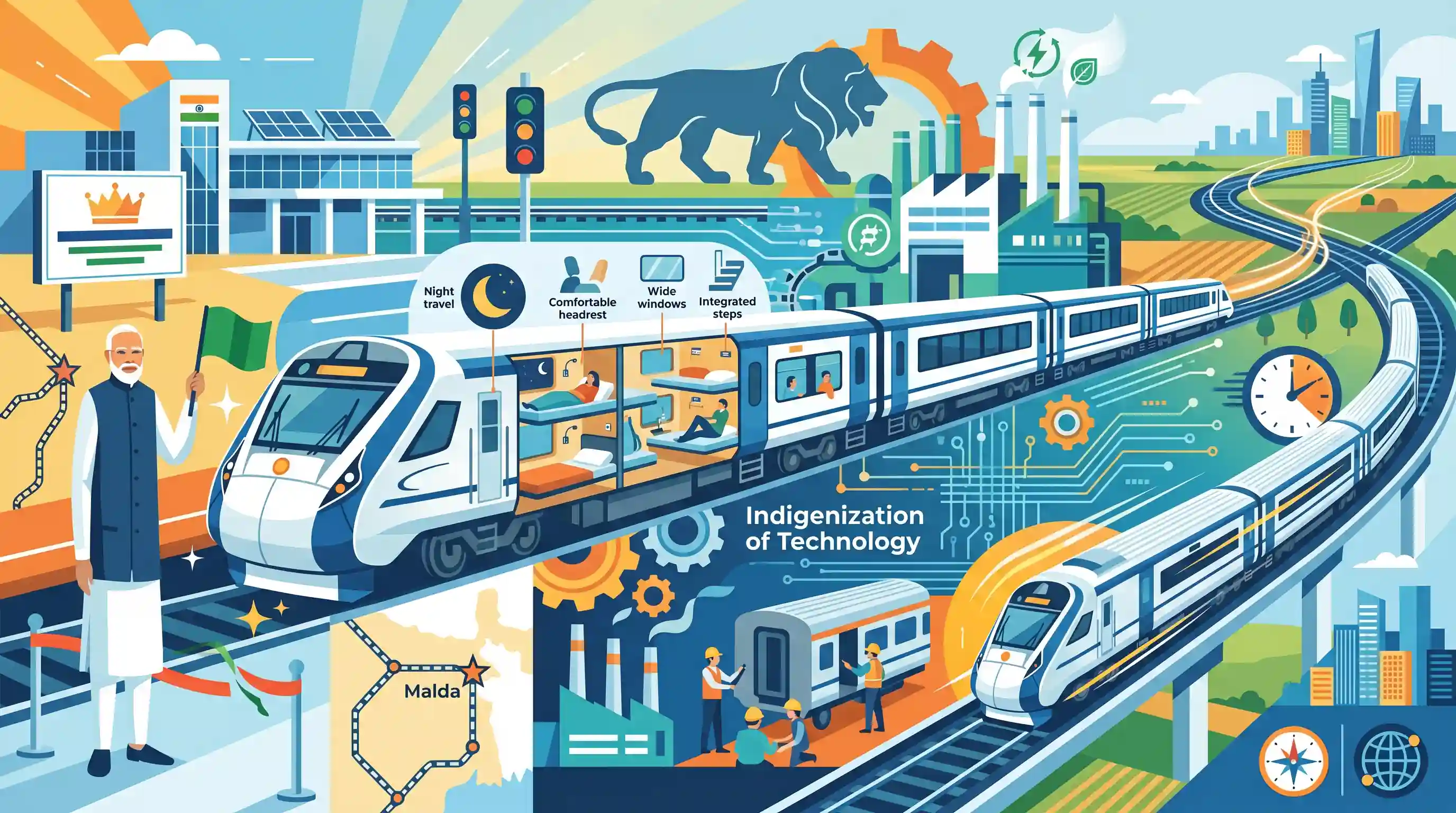
Prime Minister Narendra Modi launched India's first Vande Bharat Sleeper train from Malda, marking a significant advancement in the nation's railway infrastructure. Expanding upon the successful indigenous Vande Bharat semi-high-speed series, the sleeper variant is designed to revolutionize long-distance and overnight rail travel with enhanced passenger comfort and speed. The project underscores the success of the 'Make in India' initiative in developing advanced transport technology and highlights the ongoing modernization of Indian Railways to improve connectivity and travel efficiency.
Key Points
- Prime Minister Narendra Modi flagged off India's first Vande Bharat Sleeper train from Malda, West Bengal.
- The Vande Bharat Sleeper trains are designed to cater to long-distance, overnight journeys, expanding the semi-high speed Vande Bharat portfolio.
- The trains represent a modern upgrade to existing premium overnight services like the Rajdhani Express, promising improved passenger amenities and reduced travel times.
- This launch highlights the ongoing modernization of Indian Railways and stands as a significant milestone in indigenous manufacturing under the Make in India initiative.
Important Terms
Vande Bharat Sleeper

An indigenous semi-high-speed, self-propelled trainset designed for overnight long-distance travel. Reaching speeds of 160-180 km/h, it features enhanced safety systems and passenger amenities like AC berths, representing a major leap in rail modernization.
UPSC context
GS Paper 3: Infrastructure. Tests knowledge of transport modernization, indigenous manufacturing, and the role of high-speed rail in regional connectivity.
Make in India
A flagship national program launched in 2014 to transform India into a global manufacturing hub. It focuses on boosting investment, fostering innovation, and enhancing domestic production across 27 sectors to achieve economic self-reliance.
UPSC context
GS Paper 3: Indian Economy. Tests understanding of industrial policy, employment generation, and strategies to increase manufacturing's contribution to GDP.
Indigenization of Technology
The process of designing and producing technology locally using domestic resources and R&D. It aims to reduce import dependence and achieve strategic autonomy, forming a core pillar of the "Atmanirbhar Bharat" (Self-Reliant India) vision.
UPSC context
GS Paper 3: Science and Technology. Tests awareness of technological self-reliance, R&D capabilities, and the impact of homegrown innovations on development.
Railway Infrastructure
The national network of tracks, stations, and rolling stock. Recent modernization focuses on PM Gati Shakti integration, electrification, and dedicated freight corridors to improve logistics efficiency and national connectivity.
UPSC context
GS Paper 3: Infrastructure. Tests knowledge of logistics efficiency, multi-modal integration, and public sector investment in critical utilities.
Kavach
An indigenously developed Automatic Train Protection (ATP) system designed to prevent train collisions and overspeeding. It is a critical safety technology integrated into modern trainsets like the Vande Bharat series.
UPSC context
GS Paper 3: Science and Technology/Safety. Tests knowledge of indigenous safety technologies and their role in upgrading critical national infrastructure.
Prelims Trap
"Vande Bharat trains are hauled by a high-power indigenous locomotive engine attached to the front of the train."
Vande Bharat trains are Electric Multiple Units (EMUs). They do not use a separate locomotive; instead, they rely on a self-propelled 'Distributed Power System' with traction motors across coaches.
Static Concepts Connected
What is the 'Kavach' system in Indian Railways?
- Indigenous ATP: It is India's indigenous Automatic Train Protection (ATP) system developed by the Research Designs and Standards Organisation (RDSO).
- Collision Avoidance: It automatically applies brakes if the loco pilot fails to act, preventing signal passing at danger (SPAD) and avoiding collisions.
- SIL-4 Certified: It holds Safety Integrity Level 4 (SIL-4) certification, which is the highest level of safety certification for electronic systems.
How does a Distributed Power System (EMU) differ from conventional trains?
- No Central Locomotive: Unlike locomotive-hauled trains, power and traction equipment are distributed among the individual passenger coaches, eliminating the need for a central engine.
- Faster Acceleration: Distributed motors allow for significantly faster acceleration and deceleration, which reduces overall travel time for journeys with multiple stops.
- Energy Efficient: It employs advanced regenerative braking systems, feeding power back into the grid and saving energy compared to traditional locomotive trains.
Cross-Topic Patterns
Make in India + Railway Indigenization
The shift from importing rolling stock to domestic design and manufacturing (ICF Chennai, BEML Bengaluru) connects railway infrastructure modernization directly to the Make in India and Atmanirbhar Bharat initiatives.
Semi-High Speed Rail + Kavach Safety
Upgrading to 160-kmph speeds necessitates advanced safety systems. Expect questions linking the expansion of semi-high-speed rail networks to the mandatory deployment of the indigenous Kavach ATP system.

Expect a Prelims statement comparing the 'Distributed Power System' of Vande Bharat to conventional Rajdhani locomotives, alongside Kavach.
Linked PYQs · 3
Linked PYQs · 3
- 2021MainsGS3
“Investment in infrastructure is essential for more rapid and inclusive economic growth.” Discuss in the light of India's experience.
- 2022MainsGS3
Why is Public Private Partnership (PPP) required in infrastructural projects ? Examine the role of PPP model in the redevelopment of Railway Stations in India.
- 2025PrelimsGS1
Consider the following statements : I. Indian Railways have prepared a National Rail Plan (NRP) to create a 'future ready' railway system by 2028. II. 'Kavach' is an Automatic Train Protection system developed in collaboration with Germany. III. 'Kavach' system consists of RFID tags fitted on track in station section. Which of the statements given above are not correct?
