India External Affairs Outreach: Multilateral and Bilateral Engagement
Source:The Hindu ↗
Why It Matters
The intensive diplomatic schedule underscores India's rising footprint as a global actor and its multifaceted engagement across different geographies. It reflects a strategic balancing act—engaging traditional partners (Europe, USA), leading the Global South (Africa, CARICOM), and navigating regional geopolitical tensions (West Asia conflict, Strait of Hormuz).
Summary
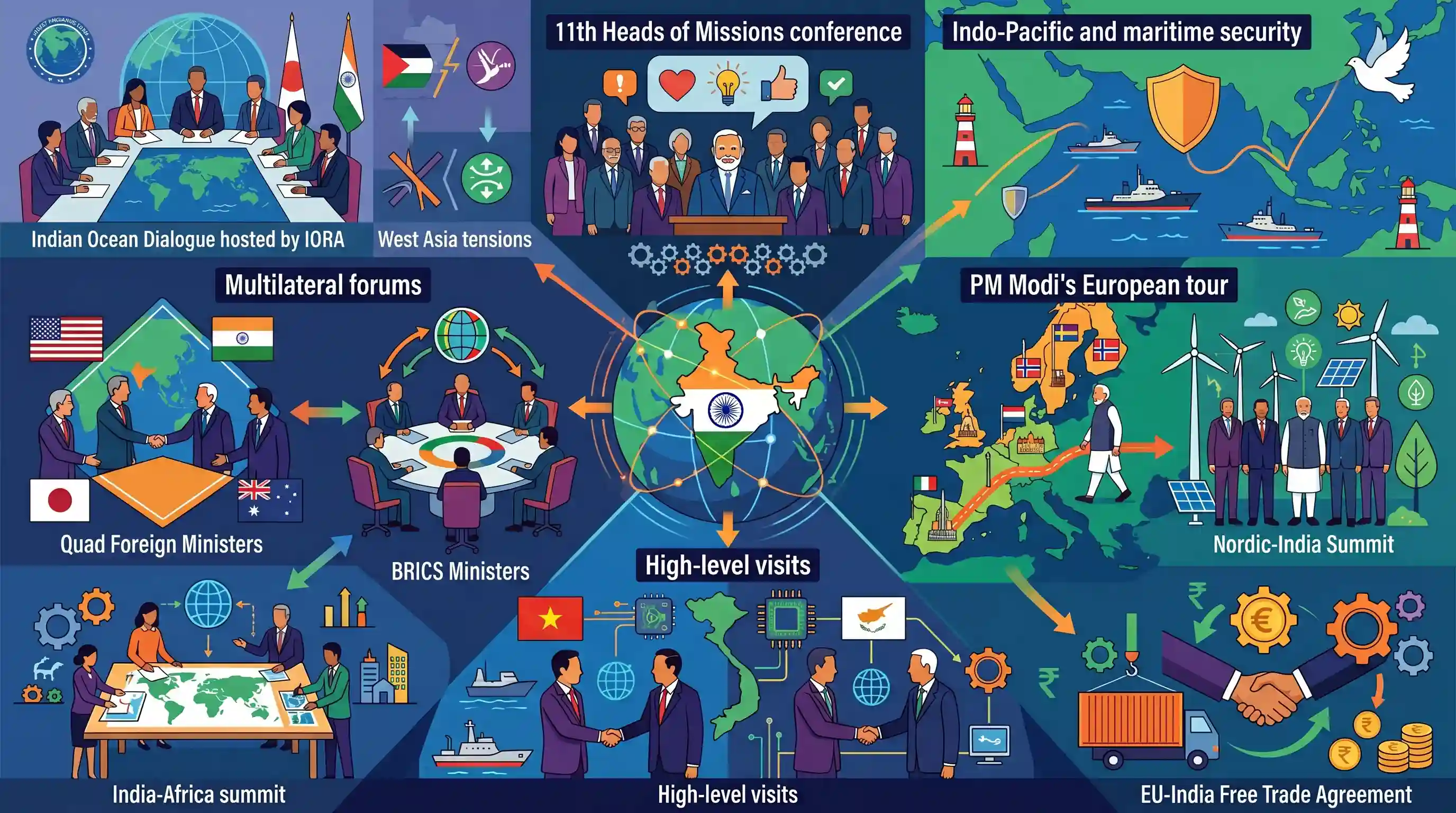
India's top leadership, including PM Modi and EAM S. Jaishankar, embarked on a significant and multi-geography diplomatic outreach in May 2026. This comprehensive schedule features extensive bilateral and multilateral engagements, kicked off by the 11th Heads of Missions conference emphasizing "positive messaging" globally. Key multilateral forums include the Indian Ocean Dialogue hosted by IORA amid West Asia tensions, the Quad Foreign Ministers meeting, the BRICS Ministers meeting, and preparations for a long-awaited India-Africa summit. Furthermore, PM Modi's five-nation European tour focuses on the Nordic-India Summit and advancing the EU-India Free Trade Agreement, while high-level visits from Vietnam and Cyprus highlight growing strategic, defense, and technological cooperation.
Key Points
- The 11th Heads of Missions conference urged Indian envoys to focus on positive global messaging and robust neighborhood ties.
- India is strengthening its engagement with the Global South through EAM's visits to CARICOM countries and preparations for the upcoming India-Africa Summit.
- PM Modi's five-nation European tour includes attending the Nordic-India Summit in Oslo and advancing discussions on the EU-India FTA and EFTA, with a focus on green tech and AI.
- The IORA hosted the 'Indian Ocean Dialogue' in Delhi to address critical maritime security concerns, including potential blockades of the Strait of Hormuz driven by the West Asia conflict.
- Strategic ties are being reinforced through bilateral visits, such as Vietnamese President To Lam's visit focusing on defense and critical technologies, as well as Quad and BRICS meetings.
Important Terms
EU-India Free Trade Agreement (FTA)

A landmark economic pact concluded in January 2026, aimed at removing tariffs on over 90% of goods and enhancing service trade between India and the 27-member European Union.
UPSC context
GS Paper II & III. Relevant for 'Bilateral Groupings' and 'Indian Economy.' Tests understanding of trade barriers and supply chain diversification.
India-Vietnam Comprehensive Strategic Partnership
India's highest level of bilateral cooperation with Vietnam, upgraded in 2016. It focuses on defense synergy, maritime security in the South China Sea, and digital connectivity.
UPSC context
GS Paper II. Crucial for 'Act East Policy' and 'Indo-Pacific' maritime security strategies.
IORA (Indian Ocean Rim Association)
An inter-governmental organization of 23 states bordering the Indian Ocean, focused on maritime security, trade facilitation, and sustainable 'Blue Economy' initiatives.
UPSC context
GS Paper II. Key for 'Maritime Security' and India's 'SAGAR' (Security and Growth for All in the Region) initiative.
Nordic-India Summit
A multilateral summit between India and five Nordic nations focusing on green energy transition, Arctic research, and technological innovation for sustainable development.
UPSC context
GS Paper II. Relevant for niche diplomacy and technological partnerships for climate action.
Quad (Quadrilateral Security Dialogue)
A strategic forum of India, USA, Japan, and Australia committed to a 'free and open Indo-Pacific' through cooperation on security, health, and emerging technologies.
UPSC context
GS Paper II. High-priority for 'Global Groupings' and regional maritime security.
European Free Trade Association (EFTA)
A trade bloc of four non-EU nations (Iceland, Liechtenstein, Norway, Switzerland) that signed a $100 billion investment-linked trade agreement (TEPA) with India.
UPSC context
GS Paper III. Important for 'Economic Agreements' and investment-driven trade models.
CARICOM (Caribbean Community)
A grouping of 15 Caribbean nations with which India has accelerated engagement on climate resilience, digital public infrastructure, and Global South advocacy.
UPSC context
GS Paper II. Relevant for 'Global South outreach' and India's diplomatic footprint in the Western Hemisphere.
BRICS
A major bloc of emerging economies (Brazil, Russia, India, China, South Africa) seeking to reform global financial governance and promote a multipolar world order.
UPSC context
GS Paper II. Tests India's 'multi-alignment' and leadership in 'South-South' cooperation forums.
Prelims Trap
The India-EFTA Trade and Economic Partnership Agreement (TEPA) is a sub-agreement under the broader European Union Free Trade Agreement.
EFTA (Iceland, Liechtenstein, Norway, Switzerland) is a distinct intergovernmental bloc separate from the European Union (EU). TEPA is an independent trade agreement, not an EU pact.
Static Concepts Connected
How does EFTA differ from the European Union (EU) in trade?
- Membership: Comprises four nations (Iceland, Liechtenstein, Norway, Switzerland) that are explicitly not EU member states.
- Trade Independence: EFTA participates in the European Single Market but maintains independent external trade policies, allowing it to sign separate FTAs.
- TEPA Linkage: The India-EFTA TEPA is uniquely structured, legally linking a binding $100 billion FDI commitment to tariff phase-outs.
What is the mandate and membership structure of the IORA?
- Littoral Membership: Includes 23 member states and 12 dialogue partners whose shores are washed by the Indian Ocean.
- Core Mandate: Focuses heavily on maritime security, disaster risk management, blue economy, and trade facilitation.
- Consensus-based: Operates strictly on consensus and explicitly excludes bilateral or political disputes from its primary agenda.
Cross-Topic Patterns
Chokepoints and India's Energy Security
Discussions on the Strait of Hormuz within IORA highlight how West Asian geopolitical conflicts directly threaten India's energy imports, linking maritime security to macroeconomic stability.
Simultaneous Quad and BRICS multi-alignment
India's back-to-back participation in Quad (Indo-Pacific focus) and BRICS (multipolar focus) exemplifies its core strategic autonomy and multi-alignment doctrine in a polarized world.
Climate Targets via Regional Trade Blocs
The Nordic-India Summit ties diplomatic outreach to climate goals, showing a shift where trade partnerships now fundamentally embed green technology transfers and circular economy frameworks.

Expect a multi-statement Prelims question mixing EFTA vs EU membership, TEPA's unique FDI-linkage, and the Nordic-India Summit goals.
Linked PYQs · 3
Linked PYQs · 3
- 2012MainsGS2
Compare the significance of IBSA and BRICS in the context of India's multilateral diplomacy.
- 2024MainsGS2
‘The West is fostering India as an alternative to reduce dependence on China's supply chain and as a strategic ally to counter China's political and economic dominance.’ Explain this statement with examples.
- 2025MainsGS2
India-Africa digital partnership is achieving mutual respect, co-development and long-term institutional partnerships. Elaborate.
