Prime Minister Modi Visits South Africa for G20 Summit
Source:The Hindu ↗
Why It Matters
The G20 Summit in South Africa marks a crucial moment for Global South diplomacy, a central pillar of India's foreign policy. The inclusion of critical minerals, AI, and just energy transitions reflects the evolving global governance agenda that UPSC frequently tests in both GS2 (multilateral forums) and GS3 (environment and technology).
Summary
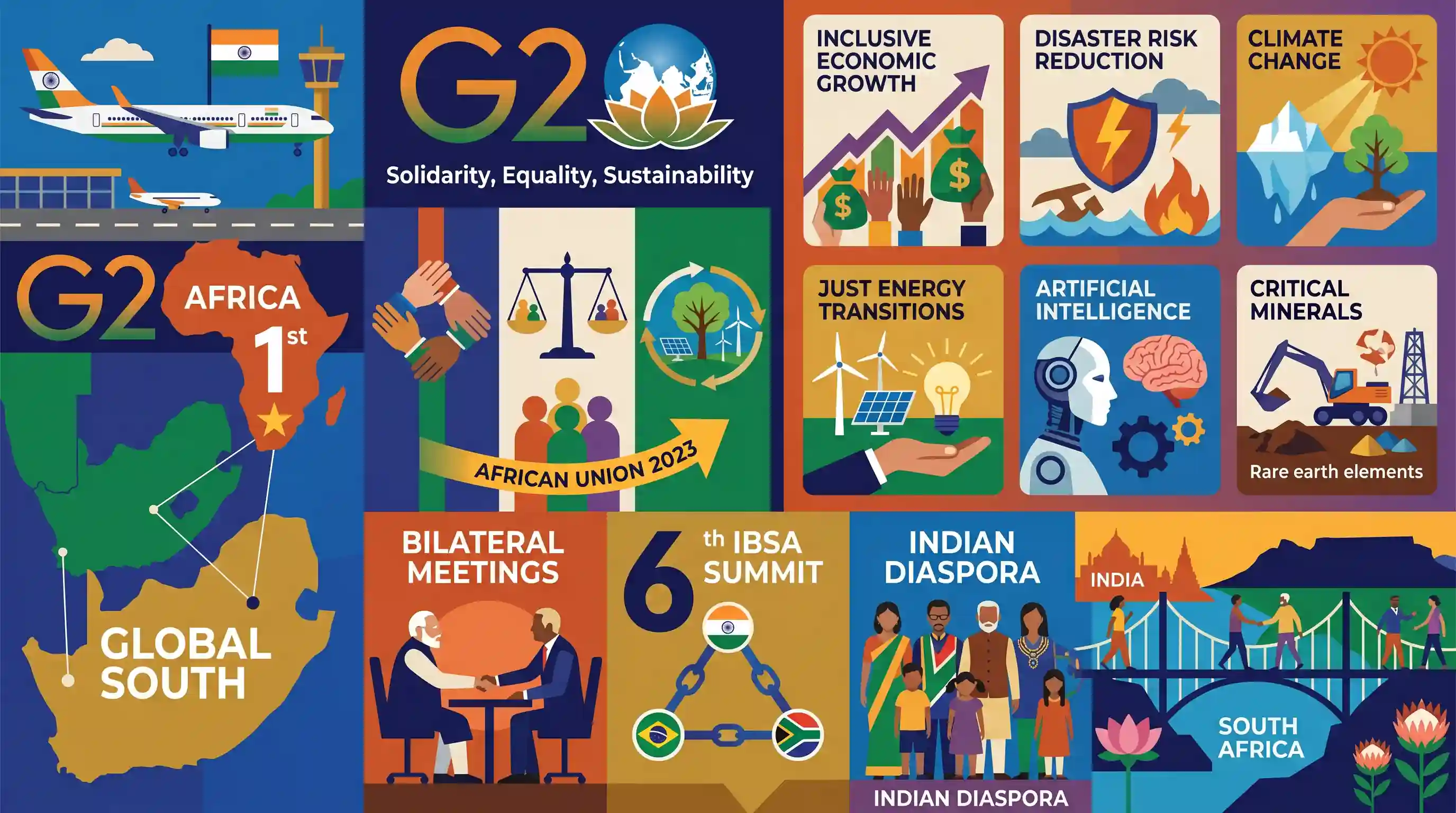
Prime Minister Narendra Modi has arrived in Johannesburg, South Africa, for the 2025 G20 Leaders' Summit, the first to be hosted on the African continent. Under the theme 'Solidarity, Equality and Sustainability', the summit continues the Global South-centric agenda championed by recent presidencies, following the African Union's inclusion in the G-20 in 2023. The Prime Minister is slated to participate in core sessions covering inclusive economic growth, disaster risk reduction, climate change, just energy transitions, artificial intelligence, and critical minerals. Additionally, Modi will hold bilateral meetings, participate in the 6th IBSA (India, Brazil, South Africa) Summit, and interact with the significant Indian diaspora in South Africa.
Key Points
- PM Modi is in Johannesburg to attend the G20 Leaders' Summit (Nov 22-23, 2025), which is the first G20 Summit held in Africa.
- The summit's theme is 'Solidarity, Equality and Sustainability', reflecting a continuous focus on Global South priorities set during the presidencies of India and Brazil.
- Key summit sessions revolve around inclusive economic growth, disaster risk reduction, climate change, just energy transitions, critical minerals, and AI.
- The African Union's inclusion in the G20 during India's 2023 presidency strengthens the focus on developmental priorities of the African continent.
- Modi will also participate in the 6th IBSA Summit (India, Brazil, South Africa) and interact with the Indian diaspora.
Important Terms
G-20

An intergovernmental forum for economic cooperation comprising 19 countries, the European Union, and the African Union. It addresses global issues like financial stability, climate change, and sustainable development.
UPSC context
GS Paper II: International Relations. Tests knowledge of global governance, multilateralism, and India’s leadership role in economic diplomacy.
African Union
A continental body representing 55 African nations. In 2023, it became a permanent member of the G20, giving the continent a direct voice in global economic policy-making.
UPSC context
GS Paper II: India-Africa relations. Tests understanding of regional blocs and the democratization of global governance institutions.
IBSA
A trilateral dialogue forum consisting of India, Brazil, and South Africa. It focuses on South-South cooperation, democratic values, and advocating for the interests of developing nations in global forums.
UPSC context
GS Paper II: South-South cooperation. Evaluates knowledge of plurilateral groupings that emphasize democratic governance and development.
Global South
A geopolitical term describing nations in Asia, Africa, and Latin America. These countries often share histories of colonialism and face similar socio-economic challenges in the modern global order.
UPSC context
GS Paper II: International Relations. Tests India’s role as a representative and leader for developing nations’ interests.
Just Energy Transition
The process of shifting from fossil fuels to clean energy while ensuring the social and economic welfare of workers and communities reliant on carbon-intensive industries.
UPSC context
GS Paper III: Environment and Climate Change. Tests the ability to balance environmental goals with socio-economic equity.
Critical Minerals
Minerals like lithium and cobalt that are essential for high-tech industries and clean energy technologies. They are strategically significant due to supply chain vulnerabilities and national security.
UPSC context
GS Paper III: Economy/Strategic Resources. Important for understanding supply chain resilience and India’s green energy transition.
Prelims Trap
The African Union was granted permanent G20 membership during the 2025 South Africa Summit.
The AU was admitted as a permanent member during India's 2023 New Delhi presidency. The 2025 SA summit is merely the first hosted in Africa.
Static Concepts Connected
What distinguishes the IBSA Dialogue Forum from the BRICS grouping?
- Democratic Core: IBSA consists strictly of large pluralistic democracies, whereas BRICS includes non-democracies like China and Russia.
- Geopolitical Stance: Focuses strictly on South-South cooperation and poverty alleviation, lacking the anti-Western geopolitical balancing posture increasingly associated with expanded BRICS+.
- IBSA Fund: A dedicated poverty-alleviation fund managed by the UN Office for South-South Cooperation, emphasizing capacity building without debt traps.
What are the core components of a Just Energy Transition (JET)?
- Socio-economic Cushion: Ensuring alternative livelihoods and reskilling for workers in fossil fuel-dependent sectors (like coal mining) to prevent economic destitution.
- Climate Finance: Requires developed nations to provide adequate low-cost capital and technology transfers, often structured through JET-Partnerships (JETPs).
Cross-Topic Patterns
The Global South G20 Troika
The unprecedented sequence of India, Brazil, and SA presidencies (2023-2025) structurally anchored developing world priorities like Digital Public Infrastructure and sovereign debt restructuring into global governance.
Critical Minerals + Energy Security
G20 discussions on resource equity directly map to India's 2025 National Critical Mineral Mission and Quad alliances, aiming to de-risk clean energy supply chains from single-nation dependencies.

Expect a multi-statement question comparing IBSA's democratic core with BRICS+, alongside the exact timeline of AU's G20 induction.
Linked PYQs · 3
Linked PYQs · 3
- 2012MainsGS2
Compare the significance of IBSA and BRICS in the context of India's multilateral diplomacy.
- 2025MainsGS3
Mineral resources are fundamental to the country's economy and these are exploited by mining. Why is mining considered an environmental hazard? Explain the remedial measures required to reduce the environmental hazard due to mining.
- 2019MainsGS3
Disaster preparedness is the first step in any disaster management process. Explain how hazard zonation mapping will help disaster mitigation in the case of landslides.
