Amrit Bharat station scheme redevelopment progress in Gujarat
Source:ians ↗
Why It Matters
Infrastructure development, specifically under nationwide schemes like the Amrit Bharat Station Scheme, is important for economic growth and regional development, making it a relevant topic for questions related to infrastructure, connectivity, and logistics in general studies.
Summary
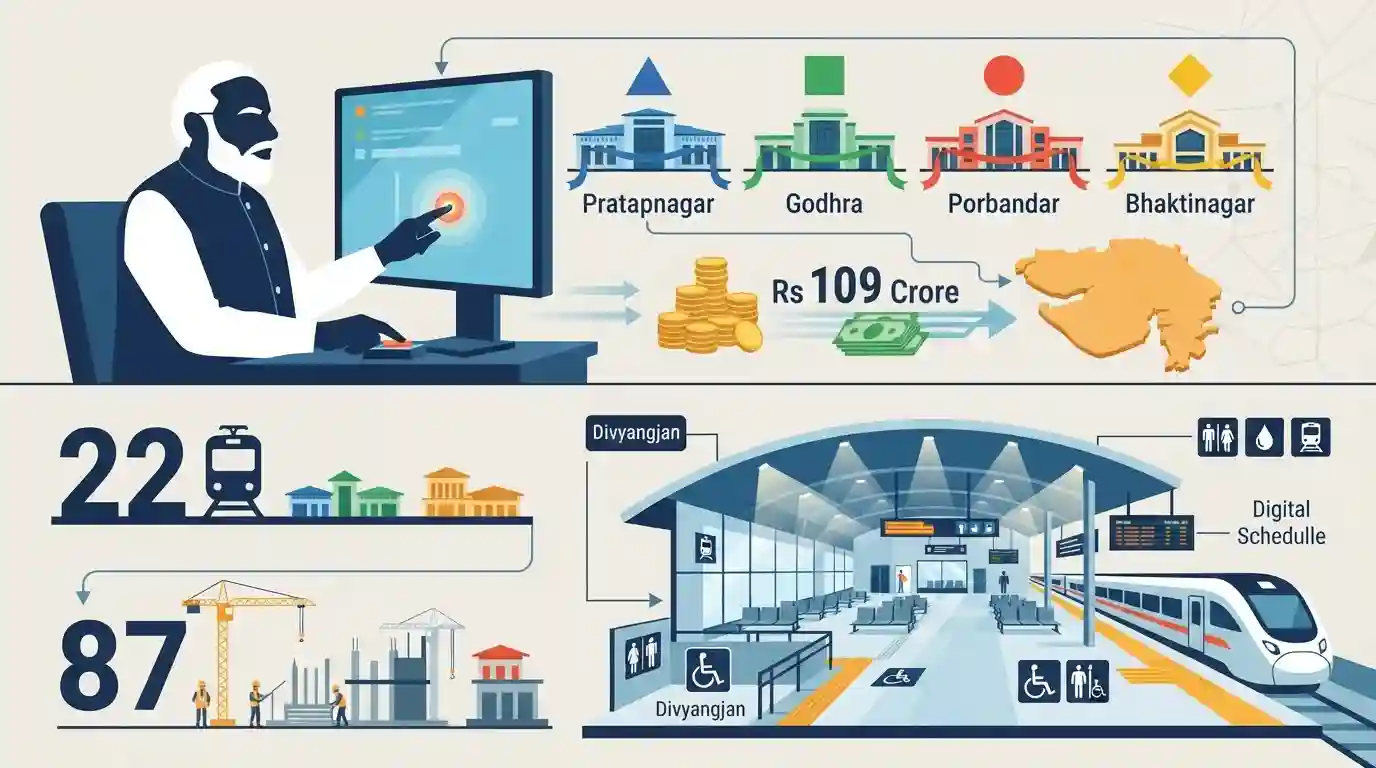
Prime Minister Narendra Modi has virtually inaugurated four newly redeveloped railway stations in Gujarat (Pratapnagar, Godhra, Porbandar, and Bhaktinagar), developed at a cost of nearly Rs 109 crore under the Amrit Bharat Station Scheme. This development increases the total number of redeveloped Amrit Bharat stations in the state to 22, while work on 87 more stations is ongoing. The modernized stations feature enhanced passenger amenities, including modern waiting halls, improved platforms, aesthetic enhancements, and dedicated facilities for Divyangjan.
Key Points
- Prime Minister Narendra Modi virtually inaugurated four redeveloped railway stations in Gujarat on July 18, 2026.
- The four stations—Pratapnagar, Godhra, Porbandar, and Bhaktinagar—were redeveloped at a combined cost of approximately Rs 109 crore.
- The redevelopment brings the total number of completed Amrit Bharat stations in Gujarat to 22.
- An additional 87 railway stations in Gujarat are currently undergoing redevelopment under the Amrit Bharat Station Scheme.
Important Terms
Amrit Bharat Station Scheme

A Central Sector Scheme launched by the Ministry of Railways to redevelop over 1,300 stations. It aims to create modern, passenger-friendly urban hubs featuring upgraded amenities, multimodal connectivity, and inclusive accessibility.
UPSC context
Relevant to GS Paper 3 (Infrastructure: Railways). Tests knowledge of urban modernization, multimodal connectivity, and integration with PM Gati Shakti.
Western Railway
One of the 19 zones of Indian Railways, headquartered in Mumbai. Established in 1951, it serves Maharashtra, Gujarat, Rajasthan, and Madhya Pradesh, managing crucial passenger networks and industrial freight corridors across western India.
UPSC context
Maps to GS Paper 1 (Geography) and GS Paper 3 (Infrastructure). Tests awareness of railway zoning, regional connectivity, and freight networks.
Divyangjan
A respectful Hindi term officially adopted by the Indian government to refer to persons with disabilities. It signifies a paradigm shift from sympathy to empowerment, highlighting inclusion, equal rights, and accessibility in public infrastructure.
UPSC context
Crucial for GS Paper 2 (Social Justice). Evaluates knowledge of welfare schemes, disability rights, and inclusive policies like Sugamya Bharat Abhiyan.
Prelims Trap
The scheme implements a standardized, one-size-fits-all architectural model across all 1,309 stations.
ABSS explicitly relies on location-specific Master Plans that integrate local culture and heritage into the facade, rejecting a uniform pan-India design.
Static Concepts Connected
What distinguishes Central Sector from Centrally Sponsored Schemes?
- Funding: Central Sector schemes are 100% funded by the Union government, while Centrally Sponsored schemes involve a shared funding ratio between the Centre and States.
- Implementation: Central Sector schemes are primarily implemented by central agencies (like the Ministry of Railways), whereas Centrally Sponsored schemes are implemented by State governments.
What are the three core pillars of the Accessible India Campaign (Sugamya Bharat Abhiyan)?
- Built Environment: Enhancing the proportion of accessible government buildings.
- Transportation: Ensuring airports, railway stations, and public transport systems are wheelchair-friendly and inclusive.
- ICT Ecosystem: Making government websites, public documents, and television broadcasts accessible to Persons with Disabilities.
Cross-Topic Patterns
Infrastructure inclusive of Divyangjans
The ABSS mandate for accessible stations bridges physical infrastructure with social inclusion under the Sugamya Bharat Abhiyan, a frequent theme in GS-2 vulnerability questions.
Transit-Oriented Development (TOD)
Developing stations as integrated "City Centres" reflects the broader urban planning push towards Transit-Oriented Development (TOD) and multi-modal connectivity via PM Gati Shakti.

Expect a 2026 Prelims question testing ABSS's Central Sector status and its explicit mandate for location-specific, heritage-based designs.
Linked PYQs · 1
Linked PYQs · 1
- 2025GPSC_PRELIMSGS1
According to the Socio-Economic Review, 2024-2025 of Gujarat, Gujarat comes in ______ category in Logistic Ease Across Different States (LEADS), 2024.
