Developmental progress and ecological challenges in Uttarakhand
Source:Indian Express ↗
Why It Matters
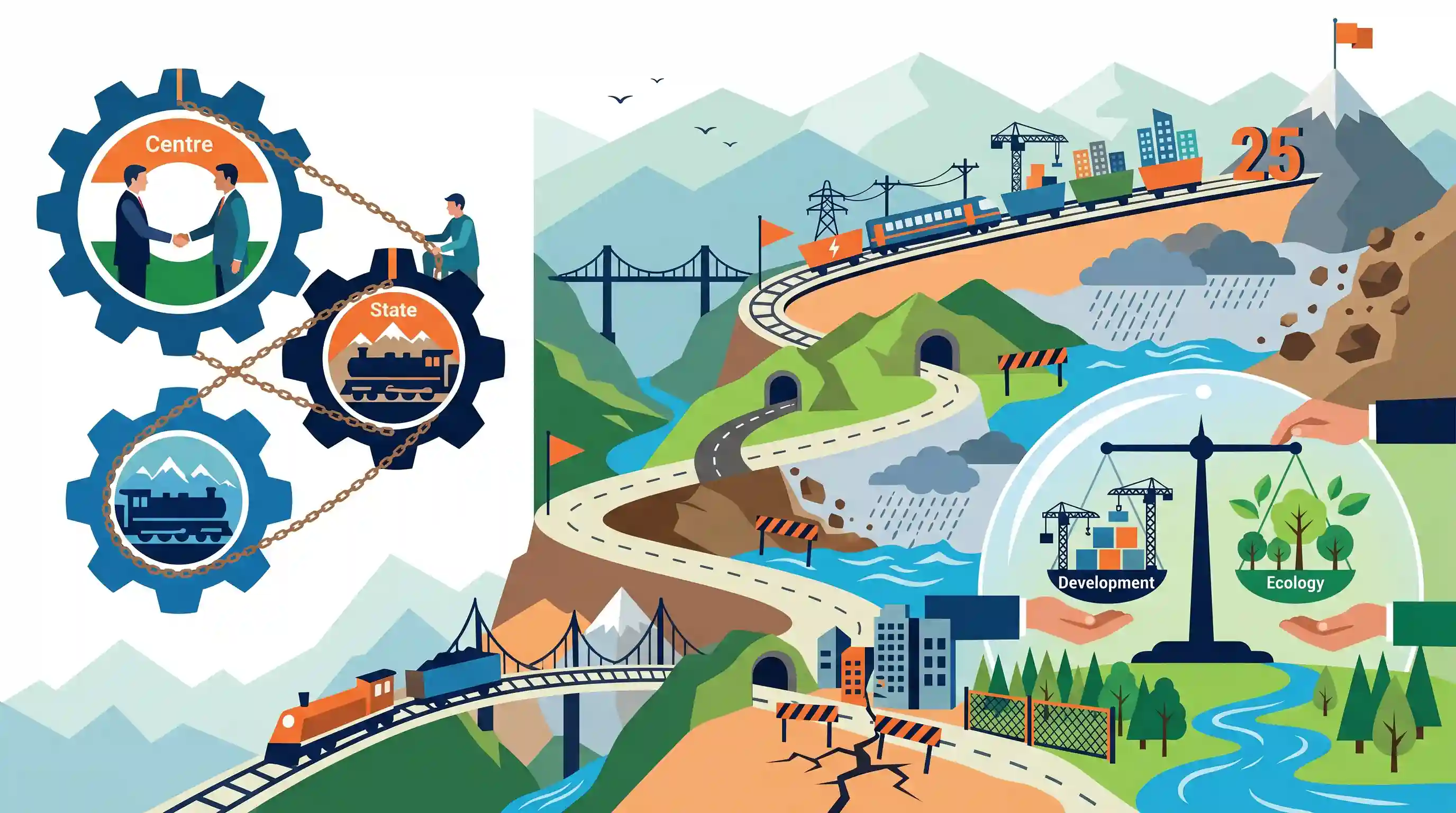
The article touches upon three core UPSC themes: the constitutional reorganization of states (completing 25 years), the political nuances of Centre-State relations under the \'double-engine\' framework, and the ecological consequences of rapid infrastructural development in the Himalayan region.
Summary
As Uttarakhand marked its 25th foundation year, PM Narendra Modi hailed the state\'s progress under a \'double-engine\' government, emphasizing improvements in connectivity, infrastructure, and regional development. The political framing highlights the dynamics of Centre-State relations, where aligned political leadership is credited with accelerating state growth, raising broader questions about cooperative federalism and state autonomy. Furthermore, the celebration of Uttarakhand\'s developmental \'rise\' brings to the fore the persistent challenge of managing rapid infrastructure growth within a highly sensitive Himalayan ecology vulnerable to disasters like landslides and cloudbursts.
Key Points
- Uttarakhand recently marked its 25th foundation year, having been carved out of Uttar Pradesh in the year 2000 alongside Jharkhand and Chhattisgarh.
- PM Modi highlighted the rapid developmental progress achieved due to a \'double-engine\' government, underscoring the ongoing debate over the impact of aligned central and state political leadership on cooperative federalism.
- The state\'s infrastructural \'rise\' brings attention to the critical need for balancing economic development, connectivity, and tourism with the ecological fragility of the Himalayan region, which is prone to landslides and cloudbursts.
Important Terms
Uttar Pradesh Reorganisation Act, 2000

Enacted by Parliament to bifurcate Uttar Pradesh, creating Uttarakhand (formerly Uttaranchal) on November 9, 2000. It detailed the division of assets, liabilities, and administrative structures between the two states.
UPSC context
GS Paper 2: Functions and responsibilities of the Union and the States; Article 3 (Formation of new States).
Double-Engine Government
A political term describing the scenario where the same party governs at both the Union and State levels, purportedly ensuring policy alignment and faster project execution.
UPSC context
GS Paper 2: Centre-State relations; impact of political alignment on federalism and state autonomy.
Cooperative Federalism
A federal model where the Union and States work as partners to address national challenges, characterized by mutual cooperation, resource sharing, and joint decision-making through bodies like NITI Aayog.
UPSC context
GS Paper 2: Indian Constitution—Federal structure; tests understanding of horizontal governance relationships.
Himalayan Ecology
The sensitive and disaster-prone nature of the Himalayan region, characterized by unstable geology, seismic vulnerability, and susceptibility to landslides, flash floods, and climate change impacts.
UPSC context
GS Paper 3: Environment, Disaster Management; tests balancing infrastructure growth with environmental conservation.
State Reorganisation
The constitutional process under Article 3 for altering state boundaries, names, or creating new states, aimed at addressing regional aspirations or administrative efficiency.
UPSC context
GS Paper 2: Indian Polity; examines the Parliament's power to redraw India's internal political map.
Prelims Trap
Formation of a new state under Article 3 requires a Constitutional Amendment under Article 368.
Article 4 explicitly states that laws made under Articles 2 and 3 for forming new states are NOT considered Constitutional Amendments under Article 368.
Static Concepts Connected
What is the constitutional process under Article 3 for forming a new state?
- Prior recommendation: A bill for state formation can only be introduced in Parliament with the prior recommendation of the President.
- State views non-binding: The President must refer the bill to the concerned state legislature, though its views are not binding on Parliament.
- Simple majority: The bill must be passed by a simple majority in both Houses of Parliament.
- Article 368 exemption: Such a law is not deemed to be an amendment to the Constitution for the purposes of Article 368.
Why is the Himalayan region highly vulnerable to infrastructure-induced disasters?
- High seismicity: The region falls in Seismic Zones IV and V, making it highly susceptible to major earthquakes that destabilize slopes.
- Geological fragility: These are young fold mountains with unconsolidated paraglacial deposits that are easily destabilized by heavy road construction and blasting.
- Hydropower impact: Run-of-the-river projects and extensive tunneling alter subsurface water flow, triggering fatal land subsidence, as witnessed in the Joshimath crisis.
Cross-Topic Patterns
Political alignment vs. Federal equity
The 'double engine' narrative sparks GS2 debates on whether cooperative federalism is being replaced by partisan conditionality for funds, exacerbating vertical fiscal imbalances for opposition-ruled states.
Statehood and the 'Palaayan' paradox
Despite statehood meant for regional development, urban-centric growth caused massive hill outmigration ('ghost villages'). This demographic void intersects directly with GS3 border security management along the Himalayas.

Expect a Mains question evaluating if the developmental rationale for creating hill states (Art 3) is undermined by ecological vulnerability.
Linked PYQs · 5
Linked PYQs · 5
- 2024MainsGS2
What changes has the Union Government recently introduced in the domain of Centre-State relations ? Suggest measures to be adopted to build the trust between the Centre and the States and for strengthening federalism.
- 2015MainsGS2
The concept of cooperative federalism has been increasingly emphasized in recent years. Highlight the drawbacks in the existing structure and the extent to which cooperative federalism would answer the shortcomings.
- 2022MainsGS2
“While the national political parties in India favour centralisation, the regional parties are in favour of State autonomy.” Comment.
- 2021MainsGS3
Describe the various causes and the effects of landslides. Mention the important components of the National Landslide Risk Management Strategy.
- 2016MainsGS3
Rehabilitation of human settlements is one of the important environmental impacts which always attracts controversy while planning major projects. Discuss the measures to be adopted to mitigate the impact of the recent incidents of cloudbursts in many places of Uttarakhand.
