1946 के इतिहास में कैबिनेट मिशन योजना और असम समूहीकरण विवाद
स्रोत:इंडियन एक्सप्रेस ↗
क्यों मायने रखता है
Understanding the nuances of the Cabinet Mission Plan and regional dynamics (like Assam's opposition to grouping) is crucial for the Modern History segment of GS1. It highlights how constitutional negotiations directly influenced the final boundaries and Partition of India.
सारांश
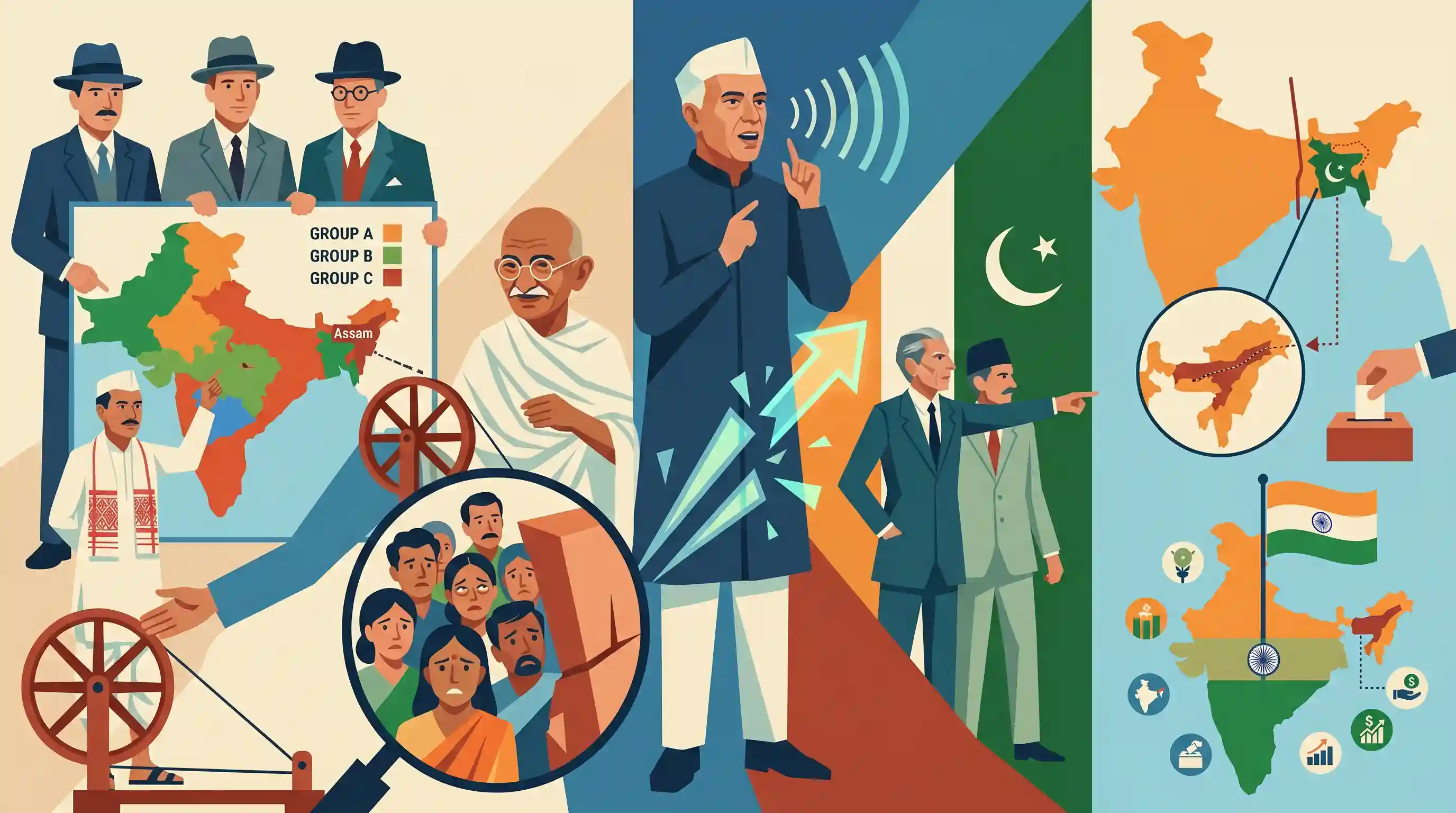
The article provides historical context to PM Narendra Modi's assertion that the Congress party would have allowed Assam to become part of East Pakistan in 1946. This refers to the Cabinet Mission Plan of 1946, which proposed grouping Indian provinces into three sections, placing Hindu-majority Assam in Group C alongside Muslim-majority Bengal. Fearing subsumption into a future Pakistan, Assam's Premier Gopinath Bordoloi strongly opposed the mandatory grouping clause. His stance received crucial backing from Mahatma Gandhi. Later, Jawaharlal Nehru publicly declared that provinces could opt out of the groupings, a position that led the Muslim League under Jinnah to reject the Cabinet Mission Plan and eventually pushed the subcontinent toward Partition. Ultimately, Assam remained in India, save for the Sylhet district which joined East Pakistan following a referendum.
मुख्य बिंदु
- The 1946 Cabinet Mission Plan proposed a three-tier government structure with a weak Centre and provinces divided into three sections (Groups A, B, and C).
- Assam was placed in Group C alongside Muslim-majority Bengal, raising fears that it would be subsumed into a future Pakistan.
- Assam Premier Gopinath Bordoloi vehemently opposed the mandatory grouping clause to protect the state's identity and future.
- Mahatma Gandhi firmly backed Bordoloi's resistance, advising Assam to reject the grouping and frame its own provincial constitution.
- Jawaharlal Nehru's subsequent assertion that grouping was not compulsory led the Muslim League, under Jinnah, to reject the plan, paving the way for Partition.
- Following Independence, Assam remained in India, while the Sylhet district went to East Pakistan via a 1947 referendum.
महत्वपूर्ण शब्द
Cabinet Mission Plan 1946

भारतीय एकता को बनाए रखने के लिए 1946 की एक ब्रिटिश पहल, जिसमें प्रांतों की 'grouping' के माध्यम से मुस्लिम लीग की मांगों को संबोधित करते हुए एक त्रि-स्तरीय संघीय ढांचे का प्रस्ताव दिया गया था।
UPSC context
GS Paper I (Modern History); essential for understanding constitutional deadlocks and the transition to Partition.
Gopinath Bordoloi
The first Chief Minister of Assam who successfully resisted the mandatory grouping of Assam with Bengal, preventing the state's inclusion in East Pakistan.
UPSC context
GS पेपर I (व्यक्तित्व); क्षेत्रीय नेताओं और स्वतंत्रता संग्राम में उनकी भूमिका के ज्ञान का परीक्षण करता है।
Grouping Scheme (Cabinet Mission)
A provision of the 1946 Plan categorizing provinces into three sections (A, B, C) based on religious demographics to frame provincial and group constitutions.
UPSC context
GS Paper I (Modern History); tests detailed understanding of administrative proposals during the transfer of power.
Sylhet Referendum
A 1947 plebiscite in Assam's Sylhet district where the majority voted to join East Bengal (Pakistan) rather than remain in India.
UPSC context
GS Paper I (History/Post-Independence); relevant to territorial changes and the specific history of Northeast India.
Muslim League
A political party led by M.A. Jinnah that advocated for Pakistan and initially accepted the Cabinet Mission Plan's compulsory grouping as a 'substance of Pakistan'.
UPSC context
GS Paper I (Modern History); fundamental for studying communal politics and the road to independence.
प्रारंभिक ट्रैप
"The Cabinet Mission Plan of 1946 formally conceded the demand for a separate state of Pakistan."
The Cabinet Mission explicitly rejected the Muslim League's demand for a sovereign Pakistan, proposing a united India with provincial groupings instead.
संबंधित अवधारणाएँ
What were the core proposals of the Cabinet Mission Plan 1946?
- Rejection of Pakistan: It explicitly rejected the Muslim League's demand for a full-fledged, sovereign Pakistan.
- त्रि-स्तरीय संरचना: Proposed a weak Central government limited to handling Defence, Foreign Affairs, and Communications, with residuary powers vested in the provinces.
- समूहन खंड: Provinces were to be grouped into Sections A (Hindu-majority), B (Muslim-majority NW), and C (Bengal and Assam).
How was the Assam-East Bengal border decided in 1947?
- सिलहट जनमत संग्रह: The Mountbatten Plan mandated a public referendum in the Muslim-majority Sylhet district of Assam to determine its dominion.
- The Outcome: Sylhet voted to join East Bengal (East Pakistan), while the rest of Assam remained with India.
- Radcliffe Line: The Boundary Commission ultimately transferred most of Sylhet to Pakistan, retaining only parts of Karimganj (Barak Valley) in India.
अंतर-विषय पैटर्न
Bordoloi and the Sixth Schedule
Gopinath Bordoloi not only led the anti-grouping movement but also chaired the Constituent Assembly sub-committee that formulated the Sixth Schedule, shaping tribal autonomy in the Northeast.
Referendums of the 1947 Partition
The Sylhet referendum links directly to the NWFP (North-West Frontier Province) referendum—both were specific geographic anomalies resolved via plebiscite under the Mountbatten Plan of 1947.

Expect a 2026 Prelims question matching Gopinath Bordoloi with the 1946 anti-grouping movement or the framing of the 6th Schedule.
संबद्ध PYQ · 2
संबद्ध PYQ · 2
- 2015PrelimsGS1
With reference to the Cabinet Mission, which of the following statements is/are correct? 1. It recommended a federal government. 2. It enlarged the powers of the Indian courts. 3. It provided for more Indians in the ICS. Select the correct answer using the code given below.
- 2022PrelimsGS1
With reference to the proposals of Cripps Mission, consider the following statements: 1. The Constituent Assembly would have members nominated by the Provincial Assemblies as well as the Princely States. 2. Any Province, which is not prepared to accept the new Constitution would have the right to sign a separate agreement with Britain regarding its future status. Which of the statements given above is/are correct?
