India diplomatic outreach amid Middle East crisis
Source:Indian Express ↗
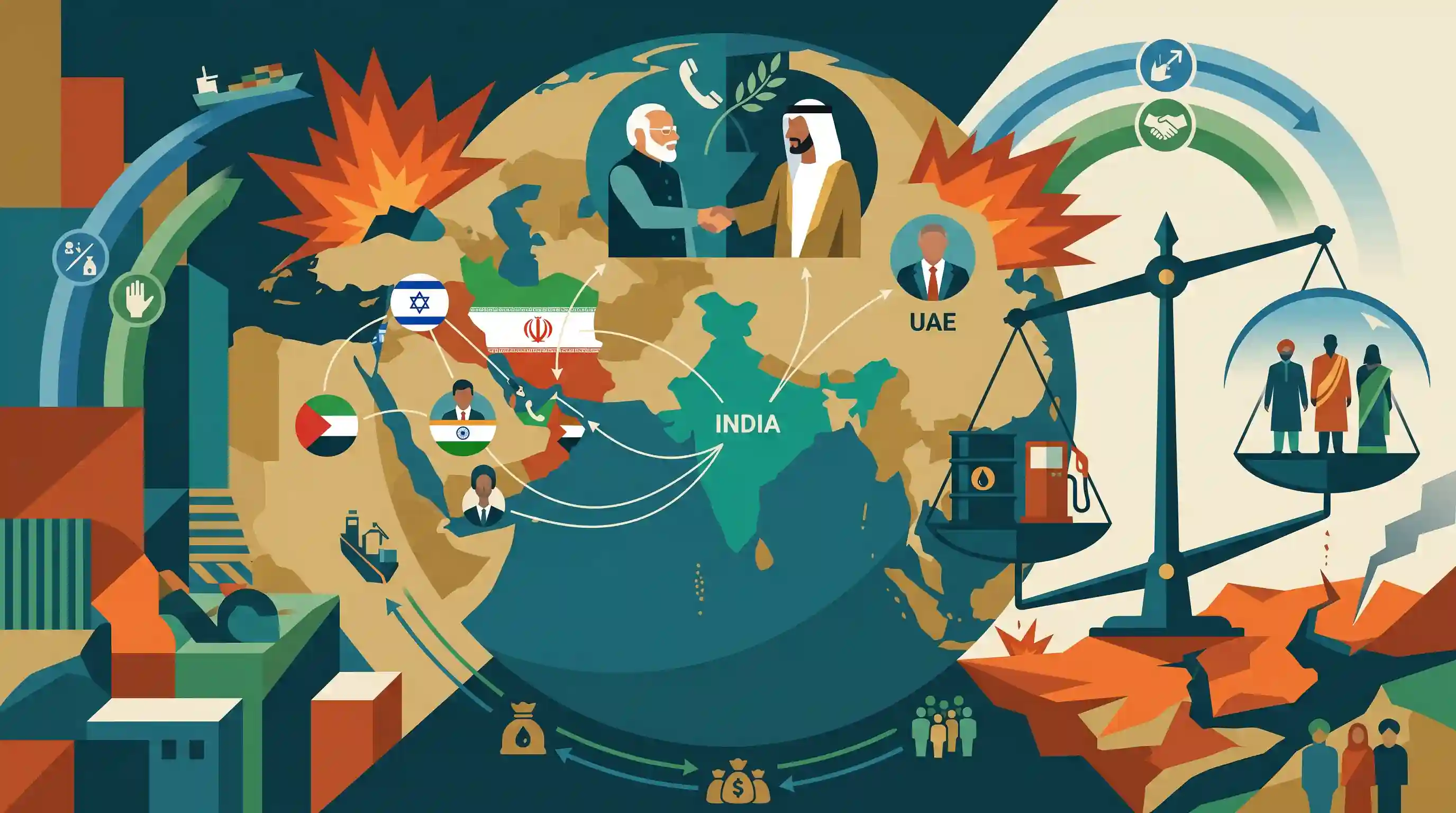
Why It Matters
The Middle East is critical to India's economy due to energy dependence and massive remittance flows from the Indian diaspora. Regional escalations test India's strategic autonomy and its diplomatic ability to balance relations among adversarial states (such as Iran, Israel, and the Arab Gulf states) without alienating any partner.
Summary
Prime Minister Narendra Modi strongly condemned recent attacks on the UAE amidst escalating tensions in the Middle East involving Iran, the US, Israel, and Gulf nations. In conversations with UAE President Sheikh Mohamed bin Zayed Al Nahyan and others, India expressed solidarity while advocating for de-escalation, restraint, and the pursuit of dialogue and diplomacy. External Affairs Minister S Jaishankar engaged with his counterparts across the region—including Iran, Israel, and several Gulf states—to emphasize regional stability and ensure the safety of the large Indian diaspora. The crisis underscores the delicate balancing act required by India to protect its energy security and geopolitical interests in West Asia.
Key Points
- PM Narendra Modi condemned recent attacks on the UAE, expressing strong solidarity with UAE President Sheikh Mohamed bin Zayed Al Nahyan amid rising regional tensions.
- The Middle East is experiencing severe escalations involving Iran, Israel, the US, and Gulf states such as the UAE, Bahrain, and Qatar.
- New Delhi's official stance urges all sides to exercise restraint, avoid further escalation, and resolve conflicts through dialogue and diplomacy.
- Ensuring the safety and well-being of the vast Indian diaspora in the Gulf is a primary diplomatic priority, prompting active outreach by EAM S Jaishankar to multiple regional counterparts.
- Ongoing geopolitical instability in the region threatens India's vital interests, including energy security, diaspora remittances, and its strategic diplomatic balancing.
Important Terms
Ministry of External Affairs (MEA)

The central government agency responsible for formulating and implementing India’s foreign policy, managing diplomatic missions, and safeguarding the welfare of Indian citizens abroad.
UPSC context
GS Paper II: Institutional framework for international relations and diaspora welfare.
Indian Diaspora
A community of 18+ million people of Indian origin living abroad, serving as a "living bridge" for soft power, strategic interests, and remittances.
UPSC context
GS Paper II: Impact of policies of developed/developing countries on India’s interests.
Energy Security
The uninterrupted availability of energy sources at affordable prices, critical due to India's high dependency (85%) on crude oil imports from West Asia.
UPSC context
GS Paper II & III: Energy diplomacy and national security vulnerabilities.
Strategic Autonomy
A doctrine where India maintains independent decision-making and avoids formal military alliances, engaging simultaneously with competing powers like Iran, Israel, and the US.
UPSC context
GS Paper II: Posture in a multipolar world and neutral diplomacy.
West Asia Geopolitics
The strategic landscape of West Asia involving power rivalries, energy wealth, and maritime choke points like the Strait of Hormuz.
UPSC context
GS Paper II: Regional politics and its effect on India’s interests.
Link West Policy
A proactive diplomatic strategy to strengthen engagement with the Gulf, Israel, and West Asian neighbors via economic, energy, and security partnerships.
UPSC context
GS Paper II: Policy frameworks for regional outreach and strategic balancing.
De-hyphenation Policy
A diplomatic approach of treating relations with rival nations (e.g., Israel and Palestine) independently, based on bilateral merits rather than zero-sum outcomes.
UPSC context
GS Paper II: Pragmatic shifts in India’s regional foreign policy.
Prelims Trap
India's Look West policy involves joining US-led military security coalitions to protect Middle East maritime routes.
India operates independently to protect sea lanes (e.g., Operation Sankalp) and strictly avoids joining US or NATO-led military coalitions in West Asia.
Static Concepts Connected
What is India's 'De-hyphenation' policy in West Asia?
- Independent Ties: Engaging with rival nations like Israel and Iran independently, ensuring ties with one do not limit relations with the other.
- Issue-Based Focus: Prioritizing transactional and strategic mutual interests such as energy, trade, and diaspora safety over ideological alliances.
Which maritime chokepoints in West Asia are critical to India's energy security?
- Strait of Hormuz: Links the Persian Gulf to the Gulf of Oman, acting as the primary transit route for the vast majority of India's crude oil imports.
- Bab el-Mandeb: Connects the Red Sea to the Gulf of Aden; a volatile transit point essential for India's trade with Europe via the Suez Canal.
Cross-Topic Patterns
Diaspora remittances and BoP
Gulf crises threaten the livelihoods of 8.5 million Indians. A severe drop in inward remittances directly worsens India's Current Account Deficit and overall Balance of Payments stability.
IMEC's geopolitical vulnerability
The proposed India-Middle East-Europe Economic Corridor relies fundamentally on UAE, Saudi, and Israeli ports, making its realization highly vulnerable to Iran-Israel or broader regional escalations.
Brent Crude and imported inflation
Escalations around the Strait of Hormuz trigger spikes in global crude prices, directly driving up India's imported inflation and straining the fiscal deficit through fuel subsidies.

Expect a 2026 Prelims map question on West Asian maritime chokepoints (Hormuz/Bab el-Mandeb) paired with a Mains question on IMEC's viability.
Linked PYQs · 4
Linked PYQs · 4
- 2025MainsGS2
"Energy security constitutes the dominant kingpin of India's foreign policy, and is linked with India's overarching influence in Middle Eastern countries.” How would you integrate energy security with India's foreign policy trajectories in the coming years?
- 2017MainsGS2
The question of India's Energy Security constitutes the most important part of India's economic progress. Analyze India's energy policy cooperation with West Asian countries.
- 2018MainsGS2
“India’s relations with Israel have, of late, acquired a depth and diversity, which cannot be rolled back.” Discuss.
- 2023MainsGS2
Indian diaspora has scaled new heights in the West. Describe its economic and political benefits for India.
