Prime Minister Economic Advisory Council Reviews Growth Strategies
Source:The Hindu ↗
Why It Matters
It highlights the intersection of global geopolitical crises (like the West Asia conflict) with domestic macroeconomic stability, demonstrating how the government relies on institutional advisory bodies like the EAC-PM to navigate economic challenges and drive structural reforms.
Summary
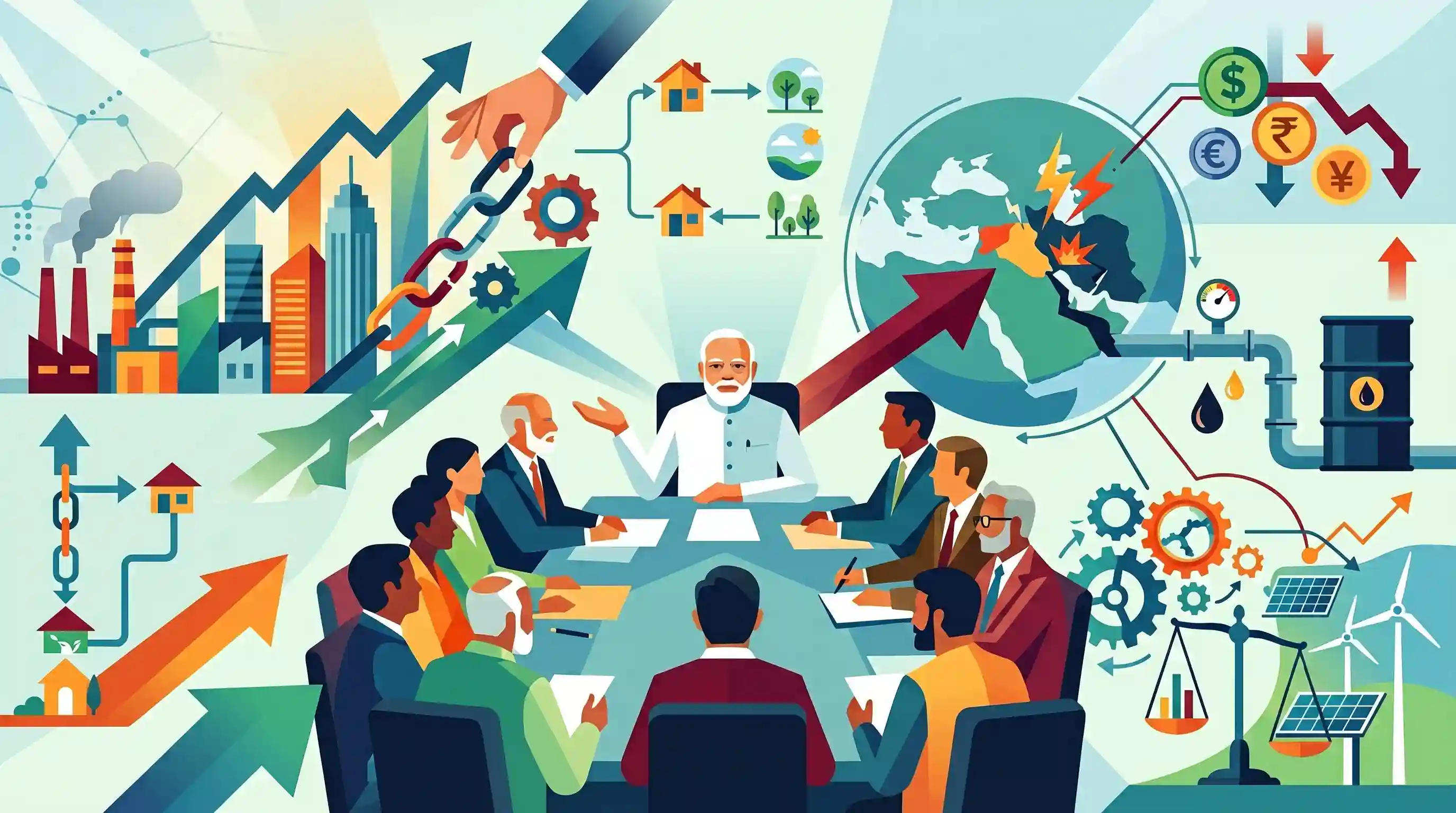
Prime Minister Narendra Modi chaired a meeting with the Economic Advisory Council to the Prime Minister (EAC-PM) to deliberate on measures to boost India's economic trajectory amid global uncertainties. The discussion centered around critical reforms to enhance the ease of living and ease of doing business. Furthermore, the council assessed the macroeconomic and geopolitical ramifications of the escalating West Asia conflict on both the Indian and global economies.
Key Points
- Prime Minister Narendra Modi chaired a meeting with the Economic Advisory Council to the Prime Minister (EAC-PM).
- The primary agenda was to devise measures to stimulate India's economic growth amid ongoing global economic turmoil.
- Discussions encompassed strategies and reforms aimed at improving the 'ease of living' and 'ease of doing business' in India.
- The EAC-PM members presented their assessment of the geopolitical and economic impacts of the West Asia conflict on India and the global landscape.
Important Terms
Economic Advisory Council to the Prime Minister (EAC-PM)

A non-constitutional, independent body that provides neutral economic advice directly to the Prime Minister on matters like inflation, industrial output, and macroeconomic policy.
UPSC context
GS Paper III (Economy). Key for understanding institutional frameworks that shape India's economic reforms and growth strategies.
Ease of Doing Business (EoDB)
The regulatory environment's efficiency in allowing businesses to start, operate, and exit. India notably improved its global standing before the World Bank replaced this index with 'Business Ready.'
UPSC context
GS Paper III (Industrial Growth & Investment). Evaluates administrative reforms, deregulation, and the business climate's impact on FDI.
Ease of Living Index
An assessment tool by the Ministry of Housing and Urban Affairs that evaluates quality of life, economic ability, and sustainability in Indian cities.
UPSC context
GS Paper II & III (Urbanization & Social Justice). Tests knowledge of governance outcomes and urban development metrics.
Energy Security
The uninterrupted availability of energy sources at an affordable price, critical for India which imports approximately 85% of its crude oil requirements.
UPSC context
GS Paper III (Infrastructure/Energy). Focuses on strategic autonomy, diversification of energy sources, and global supply chain vulnerabilities.
Macroeconomic Stability
A condition where an economy experiences low and stable inflation, sustainable fiscal balances, and steady growth, making it resilient to external shocks.
UPSC context
GS Paper III (Indian Economy). Tests the ability to analyze how global conflicts and price volatility impact domestic fiscal health.
Current Account Deficit (CAD)
A measurement of a country's trade where the value of the goods and services it imports exceeds the value of the products it exports.
UPSC context
GS Paper III (External Sector). Vital for understanding the impact of oil price spikes on India's balance of payments.
Prelims Trap
"EAC-PM is a statutory body constituted under the Ministry of Finance."
EAC-PM is neither constitutional nor statutory. It is an independent advisory body constituted by the PM, with NITI Aayog serving as its administrative nodal agency.
Static Concepts Connected
What is the Economic Advisory Council to the Prime Minister (EAC-PM)?
- Status: It is a non-constitutional, non-statutory, independent advisory committee.
- Mandate: To analyze and advise the Prime Minister on macroeconomic issues like inflation, microeconomics, and industrial output.
- Administration: NITI Aayog acts as its nodal agency for administrative, logistic, and planning purposes.
How do global geopolitical shocks impact India's macroeconomic vulnerabilities?
- Imported Inflation: With 85% crude oil dependency, price spikes lead to imported inflation, raising domestic fuel and transport costs.
- Current Account Deficit: Higher import bills for crude oil and edible oils directly widen India's trade deficit and Current Account Deficit.
- Fiscal Deficit: Elevated global natural gas prices force the government to spend more on fertilizer subsidies, stressing the fiscal deficit.
Cross-Topic Patterns
Supply chain disruptions + IMEC/INSTC push
The Red Sea disruptions and subsequent rerouting via the Cape of Good Hope make India's push for alternative connectivity corridors like IMEC and INSTC a geopolitical imperative.
Trust-based governance + Jan Vishwas Act
The emphasis on 'ease of doing business' directly aligns with the recent Jan Vishwas Act, marking a governance shift from clearance-based models to trust-based decriminalization of minor offenses.

Expect a 2026 multi-statement question interlinking West Asian maritime chokepoints (Red Sea/Hormuz) with macroeconomic fallout like CAD.
Linked PYQs · 4
Linked PYQs · 4
- 2023MainsGS3
Faster economic growth requires increased share of the manufacturing sector in GDP, particularly of MSMEs. Comment on the present policies of the Government in this regard.
- 2022MainsGS3
Economic growth in the recent past has been led by increase in labour productivity." Explain this statement. Suggest the growth pattern that will lead to creation of more jobs without compromising labour productivity.
- 2025MainsGS2
"Energy security constitutes the dominant kingpin of India's foreign policy, and is linked with India's overarching influence in Middle Eastern countries.” How would you integrate energy security with India's foreign policy trajectories in the coming years?
- 2017MainsGS2
The question of India's Energy Security constitutes the most important part of India's economic progress. Analyze India's energy policy cooperation with West Asian countries.
