India Canada Bilateral Relations and Strategic Technology Cooperation
Source:The Hindu ↗
Why It Matters
The normalization of India-Canada relations underscores the pragmatic nature of Indian foreign policy, balancing domestic security concerns with strategic and economic partnerships. Canada is significant for its large Indian diaspora, critical minerals, and technological prowess. Furthermore, the introduction of the ACITI trilateral highlights the global shift towards minilaterals focusing on critical/emerging technologies, AI, and secure supply chains, vital for India's economic security and self-reliance.
Summary
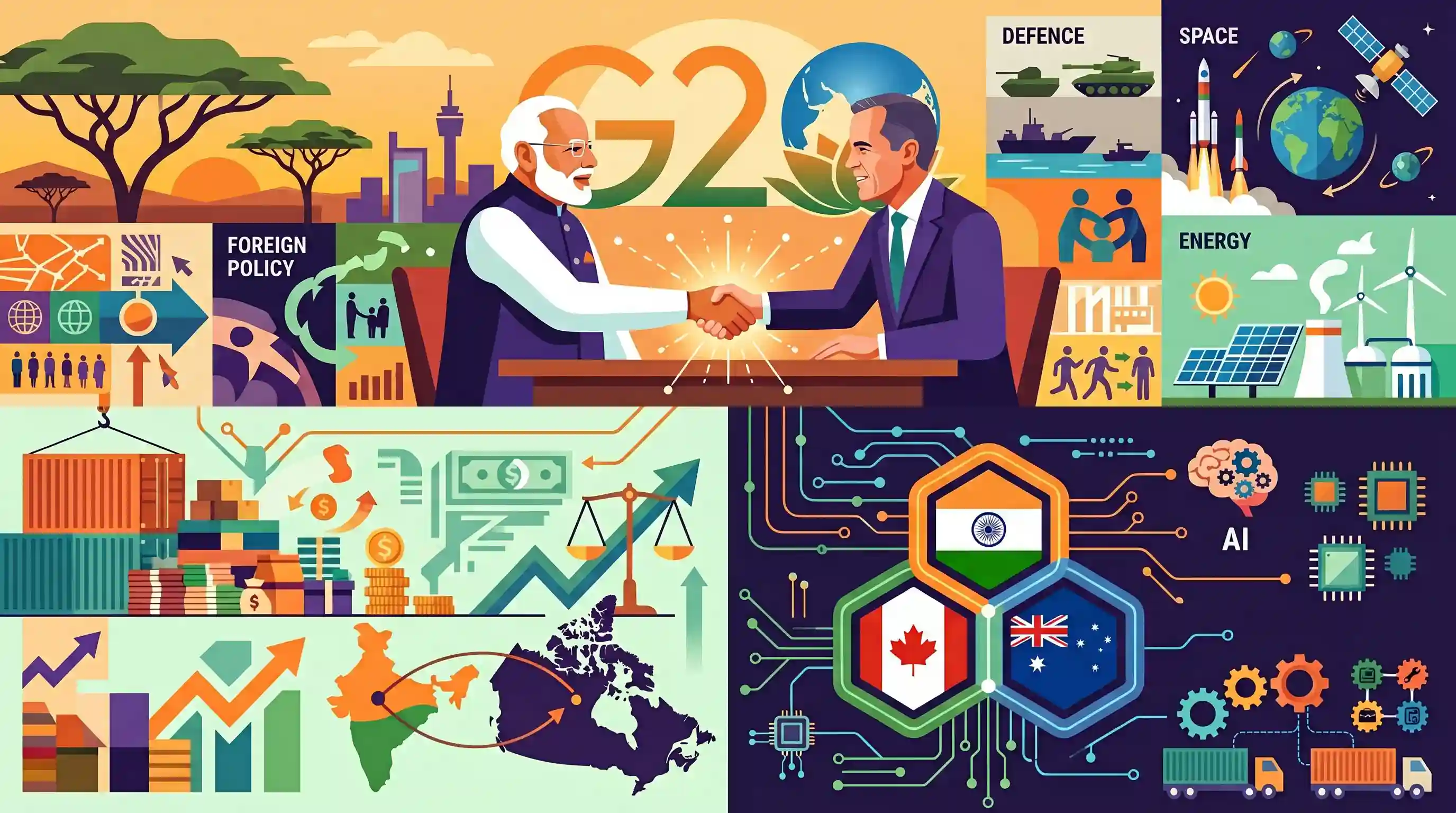
Prime Minister Narendra Modi and Canadian Prime Minister Mark Carney held a pivotal bilateral meeting on the sidelines of the G20 Summit in Johannesburg, marking a significant reset in India-Canada relations. Overcoming the recent diplomatic freeze triggered by the Hardeep Singh Nijjar controversy under the Trudeau administration, the two leaders agreed to expand cooperation across defence, space, trade, and energy. Key highlights include resuming negotiations for a Comprehensive Economic Partnership Agreement (CEPA) to reach a $50 billion trade target by 2030, and the launch of the Australia-Canada-India Technology and Innovation (ACITI) Partnership to collaborate on critical technologies, AI, and resilient supply chains.
Key Points
- Prime Minister Narendra Modi and Canadian Prime Minister Mark Carney held a bilateral meeting on the sidelines of the G20 Summit in Johannesburg.
- The meeting signifies a normalization of India-Canada diplomatic relations, moving past the tensions caused by allegations from former PM Justin Trudeau regarding the Hardeep Singh Nijjar case.
- The leaders agreed to deepen cooperation in defence, space, technology, and energy, with a goal of achieving $50 billion in bilateral trade by 2030.
- Negotiations will resume for a high-ambition Comprehensive Economic Partnership Agreement (CEPA).
- A trilateral Australia-Canada-India Technology and Innovation (ACITI) Partnership was established to foster cooperation in critical technologies, supply chains, nuclear energy, and Artificial Intelligence.
Important Terms
Australia-Canada-India Technology and Innovation (ACITI) Partnership

A trilateral initiative launched in 2025 focusing on critical minerals, artificial intelligence, and resilient supply chains to reduce dependencies and accelerate green energy innovation.
UPSC context
GS Paper II (International Relations). Tests knowledge of mini-lateral groupings and technology diplomacy in the Indo-Pacific.
Comprehensive Economic Partnership Agreement (CEPA)
A comprehensive bilateral trade pact covering goods, services, investment, and regulatory issues, aimed at significantly boosting trade volume and economic integration between two nations.
UPSC context
GS Paper II (Bilateral Relations) and GS Paper III (Economy). Tests understanding of India's trade architecture and economic diplomacy.
G20 (Group of Twenty)
A premier international forum for economic cooperation comprising 19 countries, the European Union, and the African Union, representing the world's major economies.
UPSC context
GS Paper II (International Groupings). Tests knowledge of global governance forums and India's role in the Global South.
Critical Minerals
Natural resources like lithium and cobalt essential for high-tech industries and green energy; they are strategic assets for national security and economic transition.
UPSC context
GS Paper III (Energy/Infrastructure). Tests awareness of resource security and its impact on strategic international partnerships.
Defence Dialogue
A formal institutional mechanism established between nations to enhance strategic trust, maritime domain awareness, and collaboration in defense-industrial production and military exchanges.
UPSC context
GS Paper II (Bilateral Relations). Tests understanding of strategic security frameworks and defense diplomacy.
Space Cooperation
Collaborative efforts between national agencies (e.g., ISRO and CSA) for satellite technology, atmospheric research, and exploration, often serving as a pillar of high-tech diplomacy.
UPSC context
GS Paper III (Science and Technology). Tests knowledge of India's space achievements and international technical alliances.
Prelims Trap
The ACITI Partnership is a bilateral technology framework signed exclusively between India and Canada.
ACITI is a trilateral partnership involving Australia, Canada, and India. Aspirants might assume it is purely bilateral since it was launched at a bilateral meet.
Static Concepts Connected
How does a CEPA differ from standard FTAs and CECAs?
- Standard FTA: Focuses primarily on tariff reduction or elimination for trade in physical goods.
- CECA: Broader than an FTA, covering goods, services, and investment, but often serves as a stepping stone to deeper agreements.
- CEPA: The most comprehensive pact; encompasses goods, services, investments, intellectual property rights, government procurement, and deep regulatory cooperation.
How do diaspora factions shape bilateral foreign policy dynamics?
- Electoral Lobbying: Concentrated diaspora populations act as crucial voting blocs, pressuring host-country politicians to adopt stances that cater to their domestic grievances.
- Economic Bridges: They facilitate high bilateral trade, FDI, and remittances, acting as human bridges and catalysts for comprehensive economic agreements.
- Security Frictions: Radical fringe elements within diasporas can harbor separatism, utilizing host-nation freedoms to create severe diplomatic and security tensions.
Cross-Topic Patterns
Rise of Tech-focused Minilaterals
ACITI mirrors recent groupings like iCET and Quad, showing a shift from broad multilateral pacts to issue-specific coalitions aiming to secure critical tech, AI, and resilient supply chains.
Diaspora as Asset and Friction Point
The Trudeau-era diplomatic freeze illustrates how domestic electoral compulsions tied to diaspora voting blocs can temporarily override deep structural and strategic synergies in foreign policy.

Expect a multi-statement Prelims question matching emerging tech-minilaterals (ACITI, iCET, TTC) with their exact participating nations.
Linked PYQs · 3
Linked PYQs · 3
- 2023MainsGS2
Indian diaspora has scaled new heights in the West. Describe its economic and political benefits for India.
- 2020MainsGS2
Indian diaspora has a decisive role to play in the politics and economy of America and European Countries'. Comment with examples.
- 2021MainsGS2
The newly tri-nation partnership AUKUS is aimed at countering China's ambitions in the Indo-Pacific region. Is it going to supersede the existing partnerships in the region? Discuss the strength and impact of AUKUS in the present scenario.
