India Reaffirms Multilateral Diplomacy and Dialogue at BRICS Meet
Source:The Hindu ↗
Why It Matters
The continued expansion of BRICS signifies a shift in global multilateralism. Understanding BRICS' demographic and economic weight, along with India's leadership role amidst active conflicts (Ukraine, West Asia), is crucial for GS-2 (International Relations) and GS-3 (Energy Security).
Summary
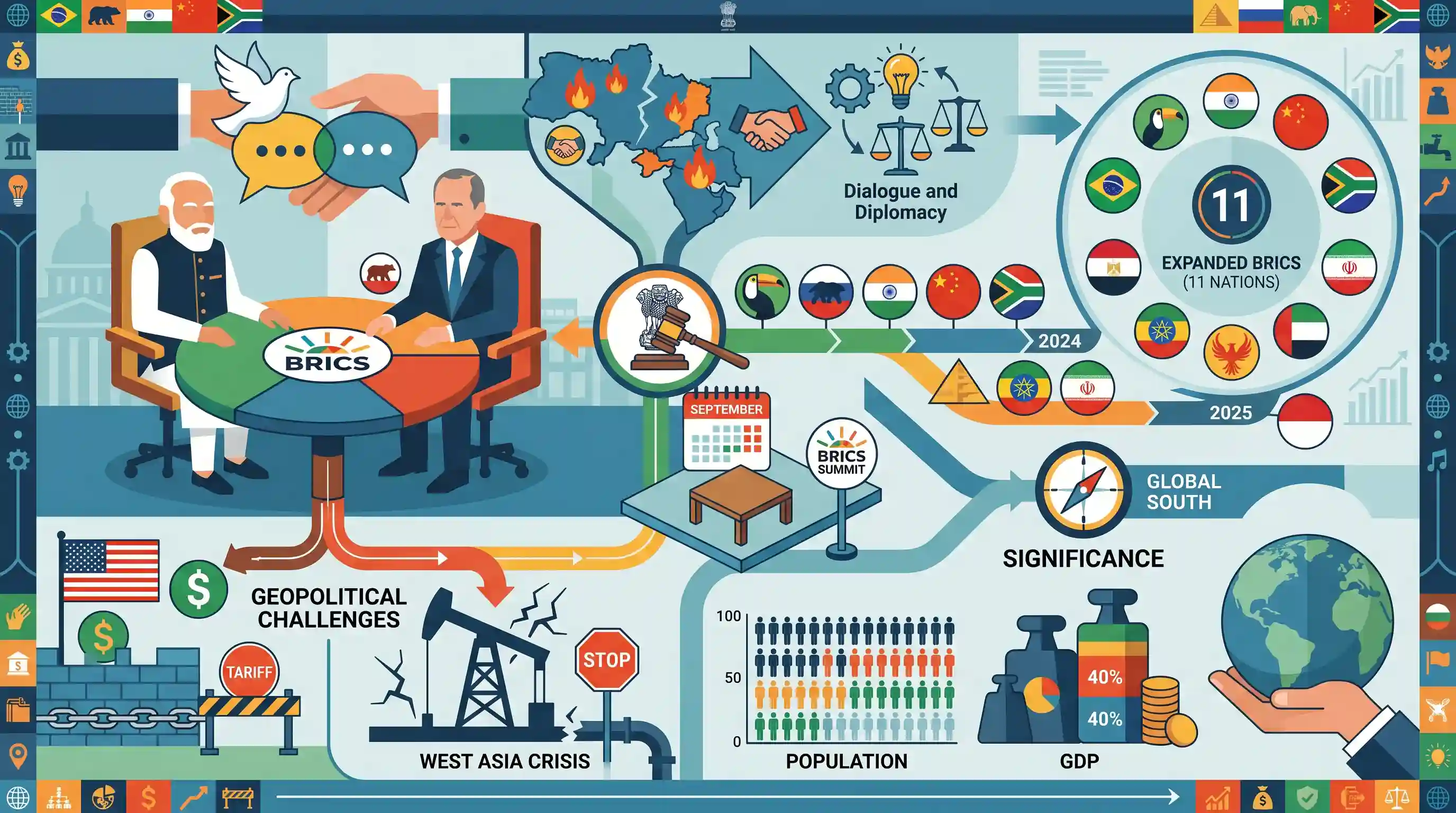
Prime Minister Narendra Modi met with BRICS Foreign Ministers, including Russian FM Sergey Lavrov, emphasizing India's ongoing commitment to dialogue and diplomacy for resolving global conflicts such as those in Ukraine and West Asia. India currently chairs BRICS, preparing for its annual summit in September amidst an evolving geopolitical landscape impacted by US trade policies and energy supply disruptions stemming from the West Asian crisis. The expanded BRICS (adding Egypt, Ethiopia, Iran, UAE in 2024 and Indonesia in 2025) now encompasses 11 nations, roughly half the global population, and 40% of its GDP, reinforcing its significance as a multilateral platform for the Global South.
Key Points
- PM Modi reaffirmed India's stance favoring dialogue and diplomacy to resolve conflicts in Ukraine and West Asia during a meeting with BRICS Foreign Ministers.
- The BRICS Foreign Ministers' meeting in New Delhi sets the stage for the main summit in September under India's chairmanship.
- BRICS expanded in 2024 (adding Egypt, Ethiopia, Iran, UAE) and again in 2025 (adding Indonesia), transforming into an 11-member bloc.
- The expanded BRICS now represents approximately 49.5% of the global population, 40% of global GDP, and 26% of global trade.
- The West Asia crisis and subsequent energy supply chain disruptions have underscored the strategic necessity of coordination among BRICS nations.
Important Terms
BRICS

An informal intergovernmental grouping of major emerging economies, originally comprising Brazil, Russia, India, China, and South Africa, focused on economic cooperation and reforming global governance.
UPSC context
GS Paper II: International Relations. Relevant for understanding India's role in multipolar groupings and its balancing of global interests.
Global South
A term referring collectively to developing, less-developed, or emerging nations primarily in Africa, Asia, and Latin America, sharing histories of colonialism and seeking equitable global systems.
UPSC context
GS Paper II: India's Foreign Policy. Tests India’s leadership role and solidarity with developing nations in international forums.
Energy Security
The uninterrupted availability of energy sources at an affordable, reliable, and sustainable price, critical for national economic stability and strategic autonomy.
UPSC context
GS Paper III: Infrastructure/Energy. Analyzes how geopolitical conflicts (e.g., West Asia) impact domestic resource availability and economic growth.
Multilateralism
A system of international relations where three or more states coordinate and cooperate based on shared norms, rules, and institutions to address global issues.
UPSC context
GS Paper II: International Institutions. Examines the effectiveness of global platforms like BRICS versus traditional Western-led institutions.
New Development Bank (NDB)
A multilateral development bank established by BRICS nations in 2014 to mobilize resources for infrastructure and sustainable development projects in emerging and developing economies.
UPSC context
GS Paper II: Important International Institutions. Focuses on alternative financial architectures led by emerging economies.
BRICS+
An outreach mechanism and expansion framework of BRICS, facilitating the inclusion of new members like Egypt, Ethiopia, Iran, UAE, and Indonesia to enhance global influence.
UPSC context
GS Paper II: Regional and Global Groupings. Tests knowledge of the evolving membership and strategic depth of the BRICS bloc.
Prelims Trap
Argentina was part of the recent BRICS expansion alongside Egypt, Ethiopia, Iran, and the UAE.
Argentina officially declined the BRICS invitation following a change in government. Aspirants often erroneously memorize the original 6-nation invitation list from the 2023 Johannesburg summit instead of actual acceding members.
Static Concepts Connected
What are the core financial mechanisms established by BRICS?
- New Development Bank: Established at the 2014 Fortaleza Summit to mobilize resources for infrastructure and sustainable development projects in BRICS and other emerging economies.
- Expanded Membership: Unlike the core bloc, the NDB is open to all UN members and expanded early by admitting Bangladesh, UAE, Uruguay, and Egypt.
- Contingent Reserve Arrangement: A currency swap framework providing short-term liquidity support to member nations facing sudden balance of payments pressures or currency volatility.
How does the 'Global South' concept relate to the expanded BRICS?
- Definition: Refers broadly to developing, emerging, or non-aligned nations, largely located in the Southern Hemisphere, seeking alternatives to Western-dominated multilateralism.
- Geopolitical Heft: With 11 members, roughly half the global population, and 40% of global GDP, BRICS serves as the primary geopolitical counterweight to the G7 and Bretton Woods institutions.
Cross-Topic Patterns
BRICS Expansion + Energy Security
Adding major oil exporters (Iran, UAE) to BRICS bolsters India's strategic ability to secure energy supply chains and negotiate local-currency trade amid Western sanctions and West Asian crises.
De-dollarization & INR Internationalization
The expanded bloc commands 26% of global trade, accelerating multilateral discussions on local currency settlements. This provides a direct geopolitical tailwind to the RBI's ongoing push for Rupee-denominated trade.

Expect a 2026 Prelims multi-statement question testing the exact final membership of the expanded BRICS and its combined GDP/trade metrics.
Linked PYQs · 4
Linked PYQs · 4
- 2025PrelimsGS1
Consider the following statements with regard to BRICS : I. 16th BRICS Summit was held under the Chairship of Russia in Kazan. II. Indonesia has become a full member of BRICS. III. The theme of the 16th BRICS Summit was Strengthening Multiculturalism for Just Global Development and Security. Which of the statements given above is/are correct?
- 2014PrelimsGS1
With reference to a grouping of countries known as BRICS, consider the following statements: 1. The First Summit of BRICS was held in Rio de Janeiro in 2009. 2. South Africa was the last to join the BRICS grouping. Which of the statements given above is/are correct?
- 2012MainsGS2
Compare the significance of IBSA and BRICS in the context of India's multilateral diplomacy.
- 2017MainsGS2
The question of India's Energy Security constitutes the most important part of India's economic progress. Analyze India's energy policy cooperation with West Asian countries.
