Prime Minister Advocates Citizen Choices to Shield Economy from Shocks
Source:Indian Express ↗
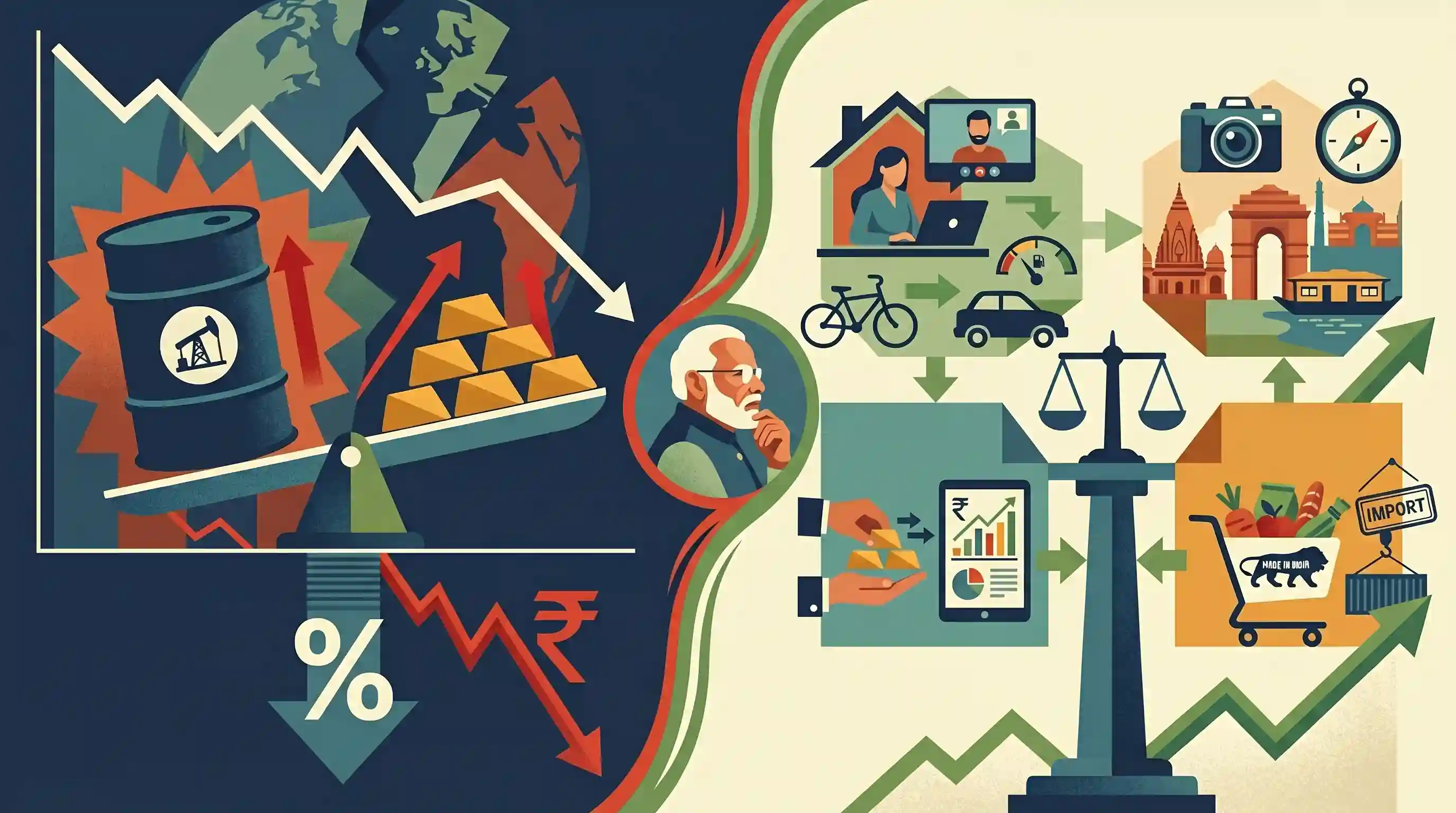
Why It Matters
Understanding the micro-foundations of macroeconomics is essential for GS3. The article perfectly illustrates how citizen-led behavioral changes (e.g., domestic tourism, fuel conservation, financialization of savings) directly influence large-scale indicators like the Current Account Deficit, Balance of Payments, and the exchange rate.
Summary
The article highlights the vulnerability of India's macroeconomy to global geopolitical risks and commodity price shocks, particularly due to massive import bills for crude oil and gold. With the current account deficit (CAD) potentially crossing 2% of GDP, macroeconomic stability relies not just on institutional interventions but on everyday household decisions. Prime Minister Modi’s appeal for behavioral shifts—such as choosing domestic tourism, embracing work-from-home policies, reducing avoidable fuel usage, and investing in financial assets over physical gold—is framed as "intelligent substitution" rather than austerity. This citizen-level "economic patriotism" can significantly curb foreign exchange outflows, thereby shielding the rupee and strengthening India's economic resilience.
Key Points
- India's heavy reliance on imported crude oil (87% of requirement) and high gold imports ($72 billion in FY26) expose its economy to global geopolitical shocks like West Asian volatility.
- High oil and gold import bills threaten to push the current account deficit (CAD) beyond 2% of GDP, which directly impacts households through imported inflation and currency depreciation.
- Rather than strict austerity, "intelligent substitution" is needed—shifting to domestic tourism, investing in financial instruments instead of physical gold, and adopting electric vehicles (EVs).
- Millions of small behavioral adjustments by citizens and corporates, such as institutionalizing work-from-home and utilizing public transport, act as 'economic patriotism' that collectively defends the value of the rupee.
Important Terms
Current Account Deficit (CAD)

A trade measurement where the total value of imported goods, services, and transfers exceeds the value of exports.
UPSC context
GS Paper 3: Balance of Payments. Tests understanding of external sector stability and rupee volatility.
EAC-PM
An independent, non-statutory body constituted to provide neutral economic advice and analyze macroeconomic trends specifically for the Prime Minister.
UPSC context
GS Paper 3: Institutional framework. Tests knowledge of advisory bodies and policy formulation processes.
Macroeconomic Stability
A condition of low inflation, sustainable fiscal/current account deficits, and stable growth, minimizing vulnerability to external shocks.
UPSC context
GS Paper 3: Growth and Development. Evaluates ability to link global geopolitics with domestic economic health.
Behavioral Economics
The use of psychological insights to influence citizen decisions toward desirable behaviors, such as domestic tourism or financial saving.
UPSC context
GS Paper 3: Policy Implementation. Relevant for 'Nudge Theory' applications in schemes like Swachh Bharat.
Energy Security
Ensuring the uninterrupted availability of energy sources at an affordable price while reducing dependence on volatile foreign imports.
UPSC context
GS Paper 3: Infrastructure and Energy. Focuses on import bills and strategic autonomy.
Import Substitution
A strategy aimed at replacing foreign imports with domestic production to strengthen local industry and preserve foreign exchange reserves.
UPSC context
GS Paper 3: Industrial Policy. Central to the 'Atmanirbhar Bharat' and 'Make in India' themes.
Prelims Trap
"Import of physical gold is recorded under the Capital Account of India's Balance of Payments."
Import of physical gold is treated as merchandise trade (import of goods) and falls under the Current Account, NOT the Capital Account, despite its popular perception as a wealth asset.
Static Concepts Connected
What are the primary components of India's Current Account?
- Trade in Goods: Exports and imports of physical merchandise. India usually runs a massive deficit here, heavily driven by crude oil and gold imports.
- Trade in Services: Includes IT services, business consulting, and tourism. India generally maintains a strong surplus in this segment.
- Income & Transfers: Inward remittances from the diaspora, grants, alongside outflows like dividends and interest payments on foreign investments.
How does a widening Current Account Deficit cause 'imported inflation'?
- Currency Depreciation: A high CAD increases demand for foreign currency, causing the domestic Rupee to depreciate against the Dollar.
- Import Cost Spike: A weaker Rupee makes inelastic imports like crude oil more expensive in domestic terms, directly raising fuel prices.
- Pass-through Effect: Higher fuel and transport costs cascade through the economy, inflating the prices of everyday goods and services.
Cross-Topic Patterns
Gold monetization + Capital formation
High physical gold imports drain forex and remain "dead assets." Transitioning to financial instruments like Sovereign Gold Bonds (SGBs) curbs the CAD and channels household savings into productive domestic capital.
Nudge Theory + Public Policy
The PM's appeal mirrors past behavior-change campaigns (Swachh Bharat, GiveItUp for LPG). UPSC frequently tests 'Nudge theory' as a soft-policy tool to achieve macroeconomic and governance goals without strict mandates.

Expect a multi-statement prelims question linking physical gold imports to CAD components, imported inflation, and Rupee depreciation.
Linked PYQs · 4
Linked PYQs · 4
- 2015MainsGS3
Craze for gold in Indians has led to a surge in import of gold in recent years and put pressure on balance of payments and external value of rupee. In view of this, examine the merits of the Gold Monetization Scheme.
- 2017MainsGS2
The question of India's Energy Security constitutes the most important part of India's economic progress. Analyze India's energy policy cooperation with West Asian countries.
- 2023MainsGS3
The adoption of electric vehicles is rapidly growing worldwide. How do electric vehicles contribute to reducing carbon emissions and what are the key benefits they offer compared to traditional combustion engine vehicles?
- 2025MainsGS2
"Energy security constitutes the dominant kingpin of India's foreign policy, and is linked with India's overarching influence in Middle Eastern countries.” How would you integrate energy security with India's foreign policy trajectories in the coming years?
