PM Modi arrives in France for bilateral visit and G7 summit
Source:The Hindu ↗
Why It Matters
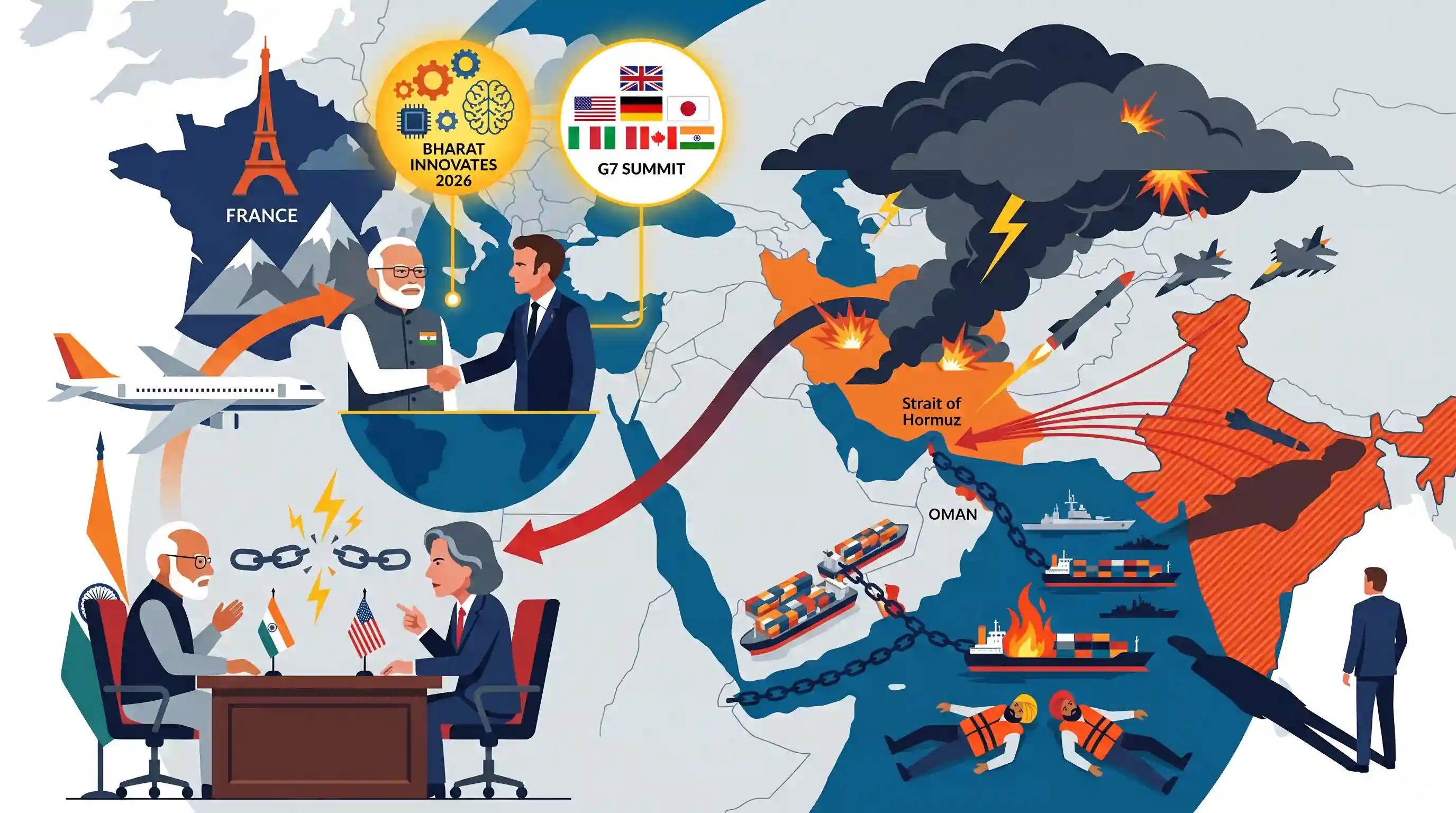
This visit highlights India's tightrope diplomacy. On one side, it pursues cutting-edge technological and strategic ties with Europe (France) and engages with global governance platforms (G7). On the other, it faces acute challenges to its energy security and diaspora safety due to aggressive unilateral moves by major powers (US blockade in the Strait of Hormuz), demanding nuanced responses in International Relations.
Summary
Prime Minister Narendra Modi has arrived in France to launch the 'Bharat Innovates 2026' tech summit in Nice and subsequently attend the G7 Summit in Évian-les-Bains as an outreach partner. The visit underscores the deepening Indo-French 'Special Global Strategic Partnership', focusing heavily on AI and deep-tech collaborations. However, the diplomatic agenda is significantly overshadowed by the escalating US-Iran-Israel conflict. A heavy US blockade in the Strait of Hormuz and a recent attack by US forces that killed three Indian seafarers near Oman have spiked regional volatility and strained India-US ties, prompting direct dialogue between the US Secretary of State and India's External Affairs Minister.
Key Points
- Prime Minister Narendra Modi visits France and Slovakia, participating in the G7 Summit in Évian-les-Bains as an outreach partner and the Bharat Innovates 2026 summit in Nice.
- India and France's relationship was elevated to a 'Special Global Strategic Partnership' in February 2026, designating 2026 as the India-France Year of Innovation with India serving as the AI Country Partner at VivaTech.
- Geopolitical tensions are high due to the US-Iran-Israel conflict, prompting a US blockade in the strategic Strait of Hormuz.
- India-US diplomatic frictions have escalated following an attack by US forces that killed three Indian seafarers off the coast of Oman.
Important Terms
Special Global Strategic Partnership

The elevated status of Indo-French relations (since Feb 2026), expanding beyond traditional defense/nuclear sectors into deep-tech, AI, and Indo-Pacific security.
UPSC context
GS Paper II (International Relations); evaluates strategic autonomy and India's 'all-weather' partnership with France.
Bharat Innovates 2026
A flagship 2026 tech conclave in Nice connecting 120+ Indian deep-tech startups and universities with European investors to foster technology transfer and co-development.
UPSC context
GS Paper III (S&T/Economy); focuses on India's startup ecosystem and global innovation diplomacy.
India-France Year of Innovation 2026
A bilateral framework (2026) aimed at synchronizing innovation ecosystems through joint research in AI, semiconductors, quantum computing, and clean energy.
UPSC context
GS Paper II/III; marks the transition toward technology-led strategic partnerships with Western nations.
G7 (Group of Seven)
An intergovernmental forum of seven advanced economies; India attends as a regular outreach partner, representing Global South interests in global governance.
UPSC context
GS Paper II (Global Groupings); tests India’s role as a 'bridging power' in global rule-setting.
Strait of Hormuz
The world's most critical energy chokepoint between the Persian Gulf and Gulf of Oman, currently experiencing high volatility due to US-Iran tensions.
UPSC context
GS Paper II (Geopolitics); critical for India’s energy security and the safety of its massive seafarer workforce.
Prelims Trap
"The Strait of Hormuz connects the Red Sea to the Gulf of Aden."
Aspirants often confuse Hormuz with Bab-el-Mandeb due to simultaneous Middle East crisis mappings. Hormuz links the Persian Gulf to the Gulf of Oman.
Static Concepts Connected
Which major water bodies does the Strait of Hormuz connect?
- Persian Gulf: Located to the northwest, bordered by major oil-producing GCC states and Iran.
- Gulf of Oman: Located to the southeast, serving as the gateway to the Arabian Sea and the Indian Ocean.
- Global Chokepoint: Serves as a critical transit route for roughly a quarter of global seaborne oil and 20% of LNG exports.
What is the composition and organizational structure of the G7?
- Core Membership: US, UK, France, Germany, Italy, Japan, Canada, and the EU. India attends only as an invited outreach partner.
- Informal Structure: Operates without a formal treaty, charter, or permanent secretariat, relying on rotating presidencies for annual agenda-setting.
- Historical Shift: Expanded to the G8 with Russia in 1998, but reverted to the G7 following Russia's annexation of Crimea in 2014.
Cross-Topic Patterns
Energy security meets diaspora evacuation
Blockades in Hormuz threaten both India's LNG supply and trigger potential mass evacuation protocols (like Operation Raahat) for the 9 million-plus Indian diaspora in the GCC.
Tech diplomacy replacing traditional defense
The India-France strategic partnership is pivoting from traditional nuclear and defense pillars to deep-tech and AI, reflecting a broader trend of securing 'critical technologies' through bilateral pacts.

Expect a map-based Prelims question integrating the Strait of Hormuz, Persian Gulf states, and recent maritime conflict zones in 2026.
Linked PYQs · 3
Linked PYQs · 3
- 2022MainsGS2
Critically examine the procedures through which the Presidents of India and France are elected.
- 2024PrelimsGS1
Consider the following statements : Statement-I : Sumed pipeline is a strategic route for Persian Gulf oil and natural gas shipments to Europe. Statement-II : Sumed pipeline connects the Red Sea with the Mediterranean Sea. Which one of the following is correct in respect of the above statements?
- 2022PrelimsGS1
The term "Levant" often heard in the news roughly corresponds to which of the following regions?
