India Announces Sudarshan Chakra Project for Indigenous Air Defence
Source:The Hindu ↗
Why It Matters
It highlights India's strategic push for self-reliance (Aatmanirbhar Bharat) in high-tech defence capabilities. As aerial threats from UAVs and missiles increase, transitioning from foreign imports like the S-400 to indigenous systems like Sudarshan Chakra is critical for long-term national security and sovereignty.
Summary
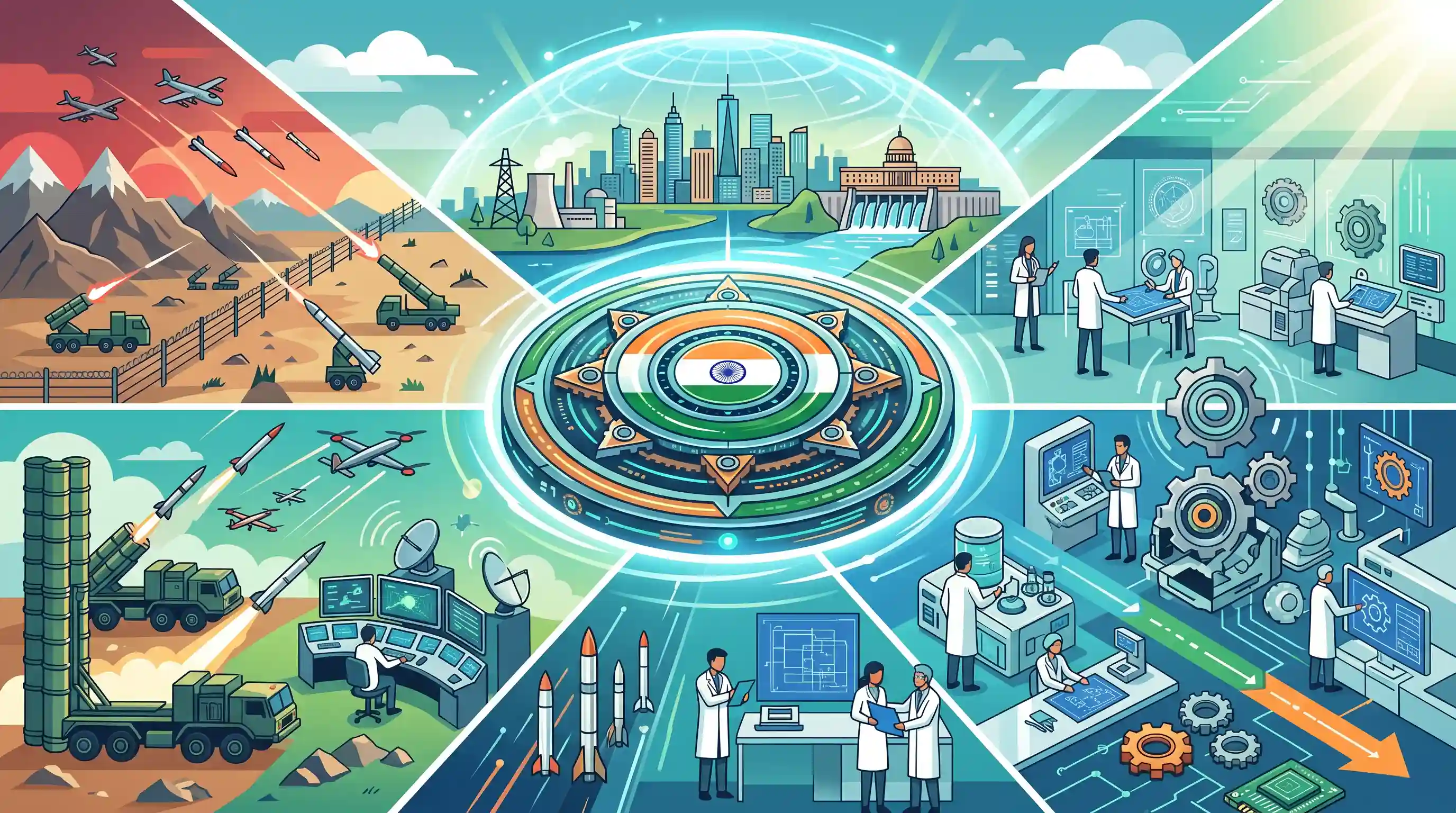
Prime Minister Narendra Modi announced 'Mission Sudarshan Chakra' during his Independence Day address, an ambitious project to develop an indigenous aerial defence system by 2035. Named after Lord Krishna's mythological shield, the system aims to protect strategic and civilian targets from enemy attacks and enhance retaliatory capabilities. The initiative comes in the wake of 'Operation Sindoor', where India relied on Russian-supplied S-400 systems and its own Integrated Air Command and Control System (IACCS) to successfully neutralise incoming drones and missiles from Pakistan. The mission underscores India's strategic shift toward defence indigenisation and self-reliance.
Key Points
- Prime Minister Narendra Modi announced 'Mission Sudarshan Chakra' to develop an indigenous aerial defence system by 2035.
- The system is designed to provide comprehensive security cover to both strategic and civilian areas, including hospitals and railways.
- India currently operates three Russian-developed S-400 missile defence systems.
- During the recent 'Operation Sindoor', the S-400 systems and India's Integrated Air Command and Control System (IACCS) played a crucial role in intercepting Pakistani drones and missiles.
- The project marks a significant step towards defence indigenisation and self-reliance in advanced military technology.
Important Terms
Mission Sudarshan Chakra

A decade-long national initiative launched in 2025 to build an indigenous, multi-layered aerial defence shield by 2035. It protects strategic and civilian sites while enhancing India's retaliatory precision-strike capabilities.
UPSC context
GS III: Defence Indigenisation and Security; evaluates understanding of self-reliance (Atmanirbharta) in high-tech military systems.
Operation Sindoor
A swift 2025 Indian military operation involving precision strikes and extensive drone warfare against terror bases in Pakistan. It showcased India's tactical shift toward proactive deterrence and integrated air defence.
UPSC context
GS III: Border Security and Internal Security; tests knowledge of cross-border operations and management of contemporary security threats.
Integrated Air Command and Control System (IACCS)
An automated, net-centric IAF system that unifies data from ground, airborne, and civilian sensors into a Recognized Air Situation Picture. It facilitates rapid threat assessment and coordinated multi-service responses.
UPSC context
GS III: Science and Technology; focuses on military modernization, network-centric warfare, and inter-service coordination.
Project Kusha
An indigenous DRDO project to develop a long-range surface-to-air missile system (LR-SAM) capable of intercepting threats up to 350km. It forms the outer-tier backbone of India’s layered air defence umbrella.
UPSC context
GS III: Defence Technology; tests knowledge of indigenous missile development and the evolution of long-range air defence capabilities.
Akashteer
An air defence control and reporting system for the Indian Army that digitises and integrates ground-based assets. It links army sensors with the IAF’s IACCS for enhanced situational awareness.
UPSC context
GS III: Internal Security and Science & Tech; assesses understanding of inter-service jointness and automation in air defence.
Prelims Trap
Mission Sudarshan Chakra has completely replaced the S-400 system for India's immediate air defence needs.
Sudarshan Chakra is a future target (2035). India currently relies heavily on Russian S-400 systems while indigenous alternatives are under development.
Static Concepts Connected
What are the core components of India's multi-tiered Ballistic Missile Defence (BMD)?
- Exo-atmospheric (PAD): Prithvi Air Defence (PAD) is designed for high-altitude, exo-atmospheric interception of incoming ballistic missiles.
- Endo-atmospheric (AAD): Advanced Air Defence (AAD/Ashwin) handles low-altitude, endo-atmospheric interception.
- Akash & MRSAM: Indigenous medium and short-range surface-to-air missile systems deployed for tactical point defence.
What is the Integrated Air Command and Control System (IACCS)?
- Data Fusion: Integrates multiple radar and sensor inputs from military and civilian domains into a single comprehensive grid.
- Real-time Response: Enables automated, rapid threat detection and assigns the nearest weapon systems for swift interception.
- Indigenous Build: Developed by Bharat Electronics Limited (BEL), ensuring sovereign control over India's critical airspace data.
Cross-Topic Patterns
AI in Network-Centric Warfare
Sudarshan Chakra's reliance on AI-enabled, multi-layered shields bridges core Science & Technology (AI algorithms) with Defense Security (rapid threat neutralization in network-centric warfare).
Defence Imports vs Strategic Autonomy
Shifting from the Russian S-400 to indigenous systems mitigates future CAATSA-like sanction risks and insulates India's security from global supply chain disruptions.

Sudarshan Chakra, Project Kusha, and S-400 likely to form a matched-pair or chronological multi-statement question on India's air defence.
Linked PYQs · 4
Linked PYQs · 4
- 2021MainsGS3
How is S-400 air defence system technically superior to any other system presently available in the world?
- 2023MainsGS3
The use of unmanned aerial vehicles (UAVs) by our adversaries across the borders to ferry arms/ammunitions, drugs, etc., is a serious threat to the internal security. Comment on the measures being taken to tackle this threat.
- 2014MainsGS3
Foreign Direct Investment (FDI) in the defence sector is now set to be liberalized. What influence this is expected to have on Indian defence and economy in the short and long run?
- 2014MainsGS3
International civil aviation laws provide all countries complete and exclusive sovereignty over the airspace above their territory. What do you understand by 'airspace'? What are the implications of these laws on the space above this airspace? Discuss the challenges which this poses and suggest ways to contain the threat.
