Open source artificial intelligence governance and global public goods
Source:Indian Express ↗
Why It Matters
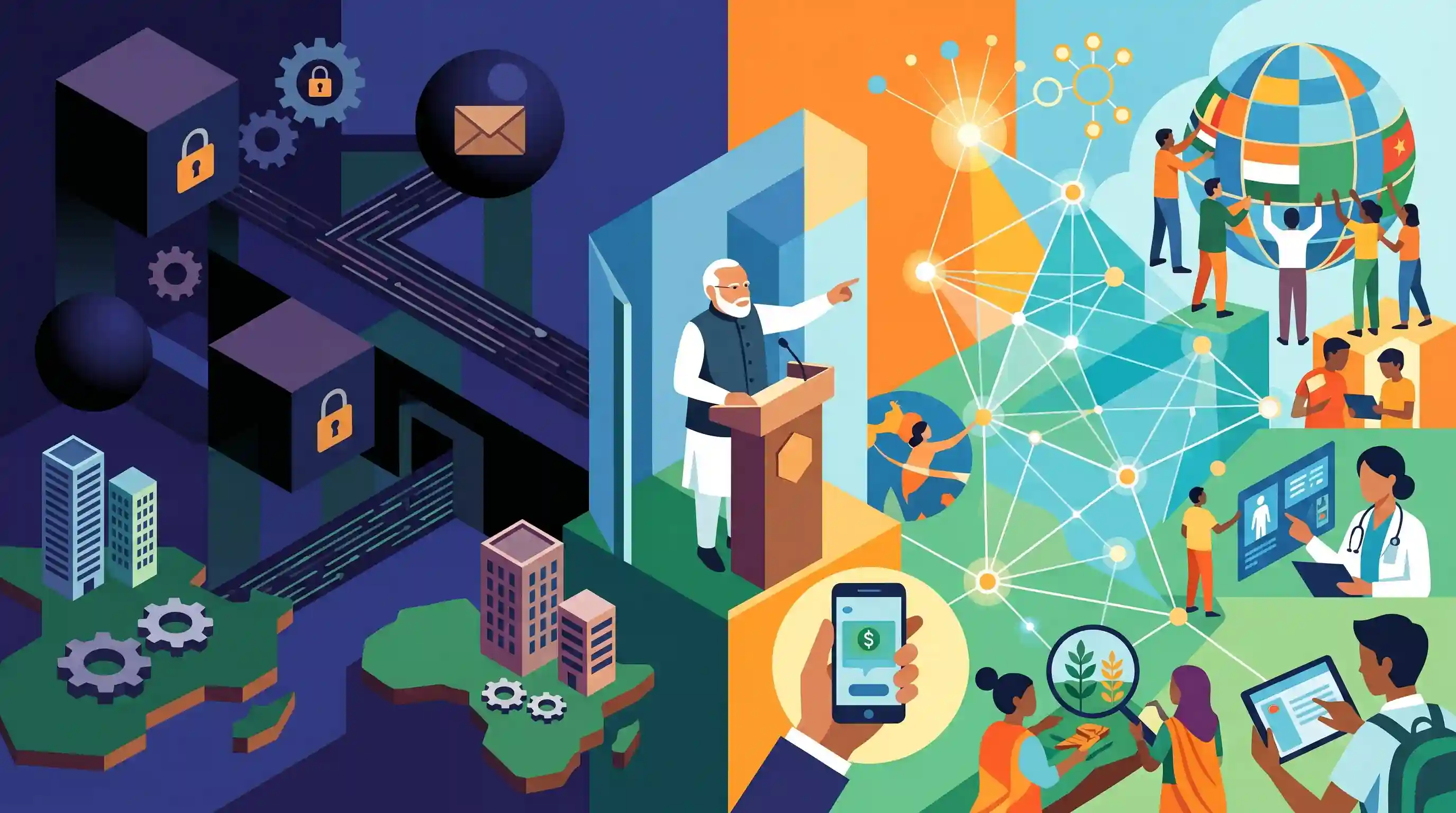
The debate between open-source and closed-source AI is at the forefront of global tech diplomacy. India's stance of treating AI development with the same openness as its Digital Public Infrastructure (DPI) highlights its geopolitical strategy to lead the Global South and push for inclusive, ethical global regulations.
Summary
Speaking at an AI summit in New Delhi, Prime Minister Narendra Modi championed the need for openness and transparency in Artificial Intelligence (AI) development. He criticized tech conglomerates and certain nations for developing AI 'confidentially', warning that opaque models pose accountability risks and threaten global trust. Reaffirming India's commitment to democratizing technology—akin to its success with open-source Digital Public Infrastructure (DPI)—PM Modi urged for a collaborative global framework. He emphasized that AI must be inclusive, ethical, and designed to address the needs of the Global South rather than serving as a monopolistic tool for a few.
Key Points
- PM Modi strongly advocated for an open-source approach to Artificial Intelligence, criticizing countries and major tech firms that develop AI models in secrecy.
- He highlighted the risks of opaque, 'black box' AI models, stressing that lack of transparency undermines accountability and global trust.
- India envisions AI as a tool for inclusive growth, urging the global community to ensure that AI advancements benefit the Global South and do not widen the digital divide.
- The Prime Minister reiterated the need for a collaborative, international framework for AI governance that prioritizes ethics, openness, and the public good over corporate monopolies.
Important Terms
Global Partnership on Artificial Intelligence (GPAI)

An international multi-stakeholder initiative of 29 members (including India) guiding the responsible development of AI based on human rights and democratic values.
UPSC context
GS Paper 3 (Science & Tech) and GS Paper 2 (IR). Tests global tech governance and India’s leadership roles.
Digital Public Infrastructure (DPI)
Foundational digital platforms (like UPI and Aadhaar) built on open standards that enable society-wide service delivery and digital inclusion.
UPSC context
GS Paper 3 (Economy/IT). Key for questions on digital transformation, financial inclusion, and India’s 'India Stack' model.
Global South
Developing and underdeveloped nations primarily in the Southern Hemisphere, for whom India advocates regarding equitable access to technology and resources.
UPSC context
GS Paper 2 (International Relations). Tests understanding of global power dynamics and India’s role as a bridge-builder.
Open-source Technology
Software with publicly accessible source code, championed by India to prevent tech monopolies and ensure transparency in AI algorithms.
UPSC context
GS Paper 3 (Science & Tech). Relevant for ending digital monopolies and enhancing technological sovereignty.
Responsible AI
The ethical framework ensuring AI is fair, transparent, and accountable, often linked to PM Modi’s 'MANAV' (Moral, Accountable, National, Accessible, Valid) vision.
UPSC context
GS Paper 4 (Ethics) and GS Paper 3 (Tech). Focuses on balancing innovation with societal safety and accountability.
New Delhi Declaration (GPAI)
A 2023 consensus agreement by GPAI members to prioritize safe, trustworthy AI and foster innovation in healthcare, agriculture, and sustainability.
UPSC context
GS Paper 3 (Science & Tech). Tests specific knowledge of international tech diplomacy outcomes and India’s chairmanship.
Prelims Trap
India's MANAV vision mandates that all private AI models must be open-source to operate legally.
India advocates for open-source AI as a global public good to counter monopolies, but it has not legally banned proprietary or private 'black box' AI models from operating in the country.
Static Concepts Connected
What is a 'Black Box' AI model?
- Definition: An AI system where the internal decision-making processes, algorithms, and training data are hidden from users and auditors.
- Explainability Deficit: They lack explainability, making it nearly impossible to trace how a specific output was generated, complicating accountability.
- Governance Risks: These models are prone to unchecked algorithmic bias, privacy violations, and ethical breaches, threatening public trust.
What defines Digital Public Infrastructure (DPI)?
- Core Infrastructure: Open-source, interoperable, and scalable digital networks built as public utilities (e.g., Aadhaar, UPI).
- Three Pillars: Identity systems, real-time payment gateways, and secure data exchange platforms.
- Objective: DPI aims to democratize tech access, eliminate silos, and drive financial and social inclusion on a population scale.
Cross-Topic Patterns
Tech diplomacy and Global South leadership
India leverages its open-source AI advocacy and DPI exports to position itself as the diplomatic champion of the Global South, countering Western tech monopolies.
Data imperialism vs. Data Sovereignty
The critique of Western 'data imperialism' directly aligns with India's Digital Personal Data Protection (DPDP) Act, which asserts data sovereignty and regulates cross-border data flows.

Expect a 2026 GS-3 or Prelims question merging AI ethics (black-box risks), India’s MANAV vision, and the GPAI framework.
Linked PYQs · 4
Linked PYQs · 4
- 2023MainsGS3
Introduce the concept of Artificial Intelligence (AI). How does Al help clinical diagnosis? Do you perceive any threat to privacy of the individual in the use of Al in healthcare?
- 2025PrelimsGS1
Consider the following statements regarding AI Action Summit held in Grand Palais, Paris in February 2025 : I. Co-chaired with India, the event builds on the advances made at the Bletchley Park Summit held in 2023 and the Seoul Summit held in 2024. II. Along with other countries, US and UK also signed the declaration on inclusive and sustainable AI. Which of the statements given above is/are correct?
- 2022PrelimsGS1
Consider the following : 1. Aarogya Setu 2. CoWIN 3. DigiLocker 4. DIKSHA Which of the above are built on top of open-source digital platforms?
- 2024MainsGS4
The application of Artificial Intelligence as a dependable source of input for administrative rational decision-making is a debatable issue. Critically examine the statement from the ethical point of view.
