Semicon India Strategic Vision and Manufacturing Growth
Source:The Hindu ↗
Why It Matters
Semiconductors are a critical strategic sector for technological sovereignty and economic growth. Initiatives like the India Semiconductor Mission and DLI/PLI schemes are central to India's industrial policy and are heavily tested in GS3 Mains and Prelims.
Summary
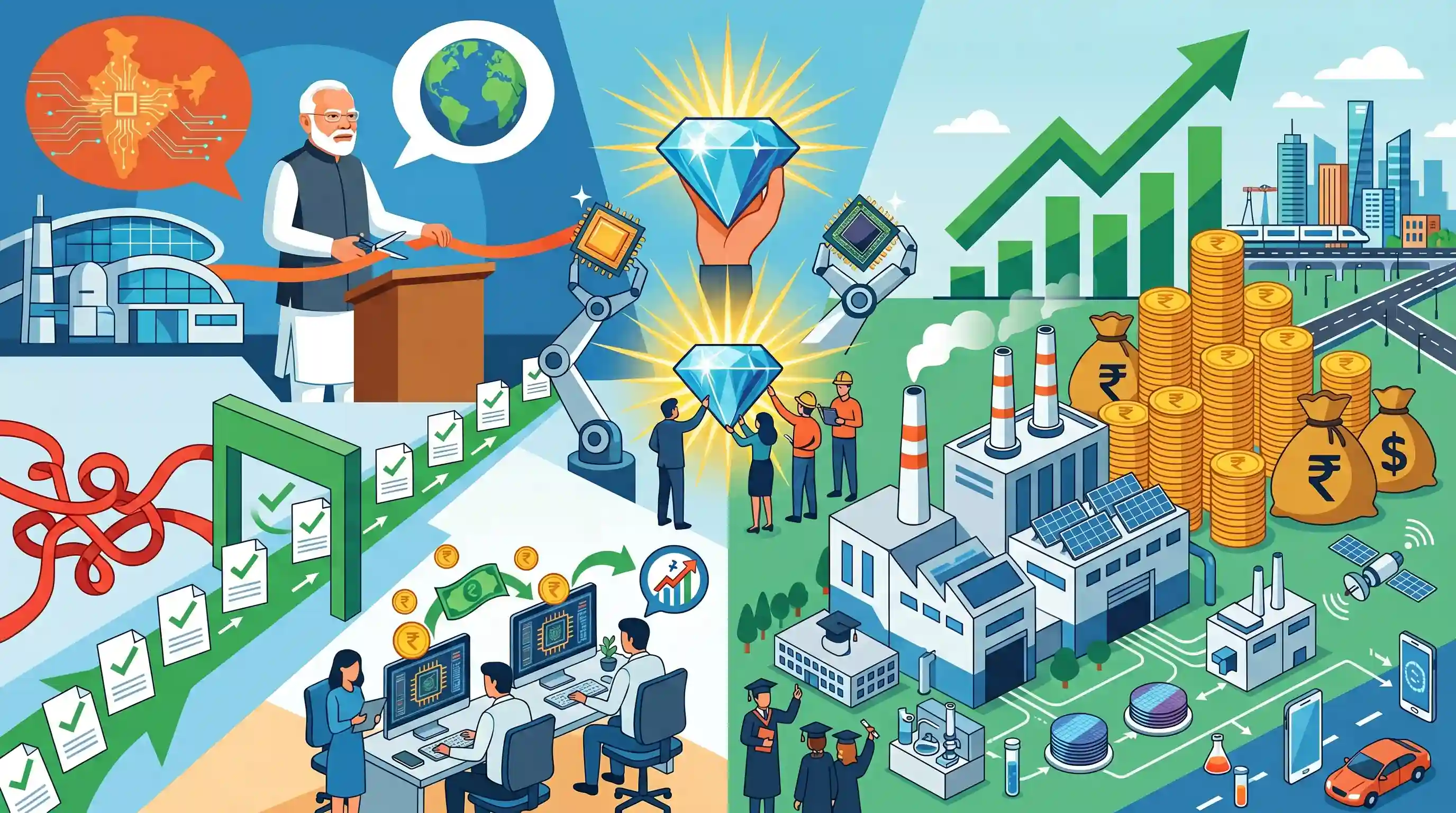
Prime Minister Narendra Modi inaugurated Semicon India 2025, outlining India's strategic vision to become a major player in the global semiconductor industry. Describing semiconductor chips as the "digital diamonds" of the 21st century, he highlighted the government's commitment to facilitating manufacturing through a National Single Window System that expedites project approvals. PM Modi announced the forthcoming next phase of the India Semiconductor Mission, which will feature an upgraded Design Linked Incentive (DLI) scheme to support domestic innovation. With 10 major semiconductor manufacturing projects cleared—amounting to $18 billion in investments—India is rapidly building its domestic ecosystem, supported by robust economic indicators such as a 7.8% GDP growth in the first quarter.
Key Points
- PM Modi addressed Semicon India 2025, emphasizing India's goal to capture a substantial share of the projected $1 trillion global semiconductor market.
- The government announced the upcoming next phase of the India Semiconductor Mission and an upgraded Design Linked Incentive (DLI) scheme.
- A National Single Window System has been established to accelerate approvals for semiconductor manufacturing plants, improving the ease of doing business.
- India has cleared 10 major semiconductor projects to date, representing a cumulative investment of approximately $18 billion (₹1.5 lakh crore).
- PM Modi underscored India's strong macroeconomic fundamentals, noting a GDP growth rate of 7.8% in the first quarter of the current financial year.
Important Terms
India Semiconductor Mission (ISM)

A specialized nodal agency under the Ministry of Electronics and IT tasked with developing a sustainable semiconductor and display ecosystem through financial incentives and strategic partnerships.
UPSC context
GS Paper III: Indigenization of Technology; tests understanding of industrial policy and high-tech self-reliance strategies.
Design Linked Incentive (DLI) scheme
A specific component of the India Semiconductor Mission that provides financial and infrastructure support to domestic firms and startups for designing Integrated Circuits and chipsets.
UPSC context
GS Paper III: Science & Technology and Industrial Policy; tests knowledge of sector-specific incentive models.
National Single Window System (NSWS)
A digital 'one-stop shop' for investors to secure all necessary regulatory approvals across central and state departments, aimed at improving the ease of doing business.
UPSC context
GS Paper II: Governance; GS Paper III: Investment Models; tests knowledge of administrative reforms for economic growth.
ISM 2.0
The strategic second phase of the national mission focused on indigenous intellectual property (IP) creation, equipment manufacturing, and expanding incentive eligibility to include larger domestic corporates.
UPSC context
GS Paper III: Economic Growth and Industrial Policy; tests awareness of evolving government strategies in high-tech manufacturing.
Semicon India
India's flagship high-level conference designed to showcase the national semiconductor roadmap, foster global industry partnerships, and position the country as a trusted global supply chain partner.
UPSC context
GS Paper III: Investment Models; tests knowledge of major industry-specific diplomatic and economic initiatives.
Prelims Trap
"The Design Linked Incentive (DLI) scheme offers financial support to large foreign multinational companies designing chips in India."
Unlike capital subsidies under ISM (which foreign giants like Micron claim), the DLI scheme specifically targets domestic Indian startups and MSMEs to build local intellectual property.
Static Concepts Connected
What are the key stages of the semiconductor manufacturing value chain?
- Fabless Model: Companies that design chips and hold Intellectual Property (IP) but outsource the highly capital-intensive physical manufacturing.
- Foundry / Fab: The physical fabrication plants that manufacture silicon wafers into chips based on designs provided by fabless companies.
- ATMP / OSAT: Assembly, Testing, Marking, and Packaging facilities that cut and package the manufactured silicon wafers into usable microchips.
What is the institutional framework behind the India Semiconductor Mission (ISM)?
- Nodal Agency: ISM operates as an independent business division within the Digital India Corporation, under the Ministry of Electronics and IT (MeitY).
- Capital Subsidy: Provides flat 50% fiscal support pari-passu for setting up semiconductor fabs, display fabs, and ATMP packaging facilities.
- DLI Implementation: The Centre for Development of Advanced Computing (C-DAC) serves as the nodal agency specifically for implementing the Design Linked Incentive.
Cross-Topic Patterns
Critical Minerals & Supply Chains
Semiconductor manufacturing heavily relies on critical minerals like Gallium and Germanium. UPSC will likely connect India's fab push to the Mines & Minerals (Amendment) Act and the Quad's supply-chain resilience initiatives.
IP Rights vs Physical Manufacturing
The push for a domestic 'fabless' ecosystem via the DLI scheme links to India's National IPR Policy, emphasizing value capture through intellectual property and chip design over mere physical assembly.

Expect a complex 2026 Prelims question mixing ISM's capital subsidies for foreign fabs vs DLI limits for domestic startups and C-DAC's role.
Linked PYQs · 4
Linked PYQs · 4
- 2025MainsGS3
India aims to become a semiconductor manufacturing hub. What are the challenges faced by the semiconductor industry in India? Mention the salient features of the India Semiconductor Mission.
- 2025MainsGS3
Discuss the rationale of the Production Linked Incentive (PLI) scheme. What are its achievements? In what way can the functioning and outcomes of the scheme be improved?
- 2023MainsGS3
Faster economic growth requires increased share of the manufacturing sector in GDP, particularly of MSMEs. Comment on the present policies of the Government in this regard.
- 2023PrelimsGS1
Consider the following statements: Statement-I: India accounts for 3.2% of global export of goods. Statement-II: Many local companies and some foreign companies operating in India have taken advantage of India's 'Production-linked Incentive' scheme. Which one of the following is correct in respect of the above statements?
