India and Trinidad and Tobago Bilateral Relations and Diaspora
Source:The Hindu ↗
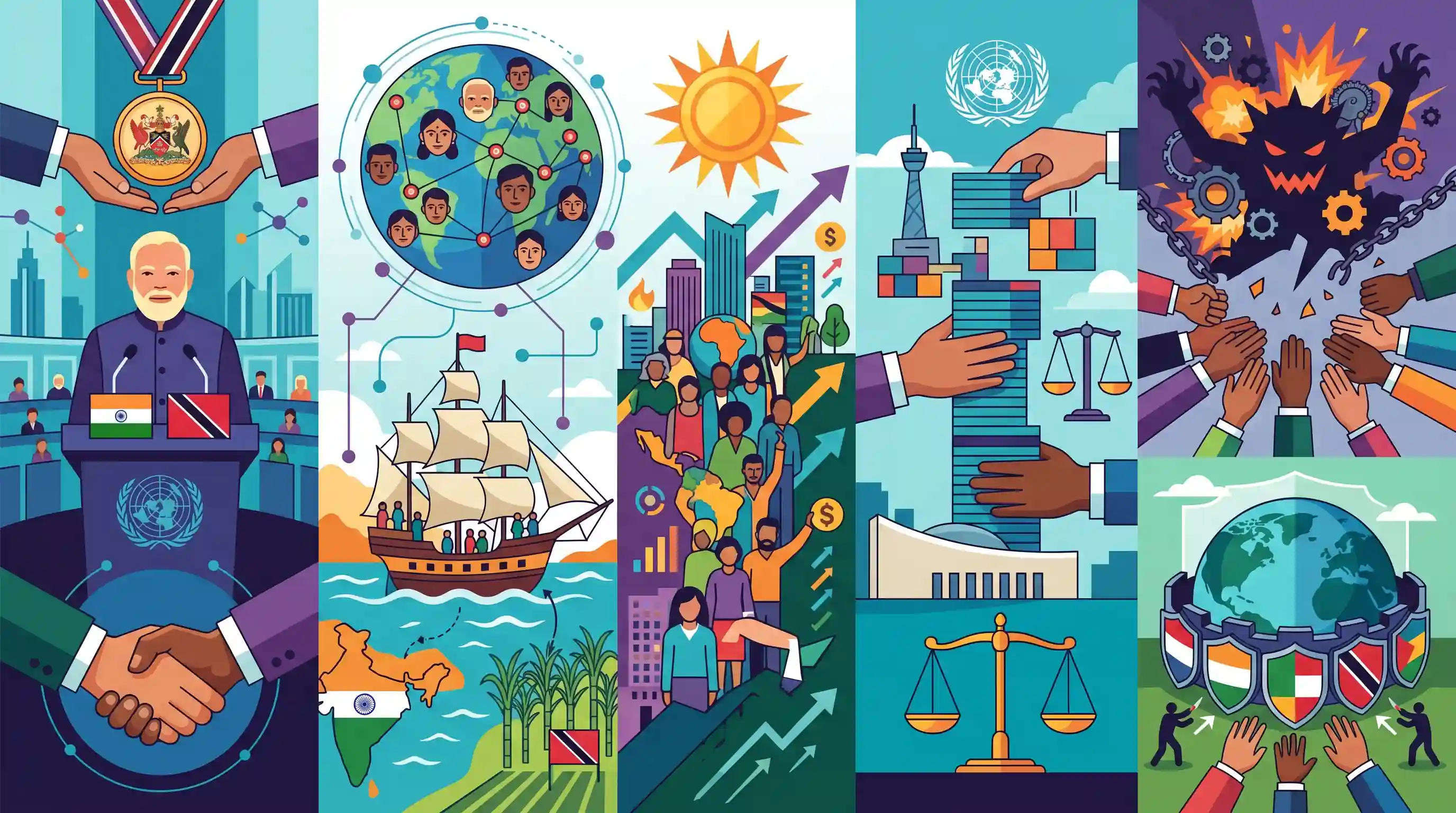
Why It Matters
The Prime Minister's address reflects India's deepening diplomatic footprint in the Caribbean and its broader strategy of leading the Global South. Themes such as leveraging the Indian diaspora for soft power, pushing for UN structural reforms, and forging global counter-terrorism coalitions are highly relevant for UPSC GS2 (International Relations) and GS3 (Internal Security). Awareness of historical links, such as indentured labour migration, also enriches answers on diaspora contributions.
Summary
Prime Minister Narendra Modi addressed a joint session of the Parliament of Trinidad and Tobago, emphasizing that the Caribbean nation will remain a priority partner for India. During the historic visit—where he was conferred with the country's highest civilian honour—PM Modi highlighted deep cultural and historical bonds, including the legacy of 19th-century Bhojpuri migration that forms part of the 35 million-strong Indian diaspora. He underscored the rising influence of the Global South, calling for urgent reforms to the United Nations to create a fairer world order. Furthermore, he strongly condemned terrorism as an enemy of humanity, urging a united international front to deny it any shelter or space.
Key Points
- PM Modi addressed the joint session of the Parliament of Trinidad and Tobago at the iconic Red House, becoming the first Indian Prime Minister to do so.
- Declared Trinidad and Tobago a priority nation for India and received the Caribbean nation's highest civilian honour.
- Highlighted the deep historical ties rooted in the Bhojpuri migration in the 1800s, celebrating the 35 million-strong global Indian diaspora.
- Noted the symbolic Speaker's Chair gifted by India to Trinidad and Tobago in 1968 as a token of enduring friendship.
- Advocated for the rising Global South and called for long-pending reforms at the United Nations to establish a fairer world order.
- Emphasized the need for a united global stand against terrorism, urging nations to deny it any shelter or space.
Important Terms
Global South

A geopolitical concept representing developing and less-developed nations primarily in Asia, Africa, and Latin America. It emphasizes shared histories of colonialism and a push for a fairer global economic and political order.
UPSC context
GS Paper II: International Relations. India's leadership role in representing developing nations and advocating for multipolarity.
Indian Diaspora (Girmitiyas)
Derived from 'Girmit' (agreement), it refers to the 19th-century system of indentured labor where Indians migrated to British colonies like Trinidad. They significantly influenced the culture, economy, and demographics of host nations.
UPSC context
GS Paper II: Effect of policies and politics of developed and developing countries on India's interests, specifically the Indian diaspora.
Order of the Republic of Trinidad and Tobago
The highest national award of Trinidad and Tobago. It is conferred for distinguished and outstanding service to the nation or for statesmanship that significantly impacts the country.
UPSC context
Prelims: International awards and recognition conferred upon the Indian Prime Minister, reflecting bilateral diplomatic depth.
United Nations Reforms
Proposals to modify the UN's structure—specifically the Security Council (UNSC)—to reflect current geopolitical realities. India advocates for permanent membership and greater representation for the Global South to ensure institutional legitimacy.
UPSC context
GS Paper II: Important International institutions, agencies and fora—their structure, mandate, and the need for reform.
Overseas Citizen of India (OCI)
A status granted to foreign citizens of Indian origin (except from Pakistan and Bangladesh) allowing them to live, work, and stay in India indefinitely. Recent policies extend this to later diaspora generations.
UPSC context
GS Paper II: Indian Constitution (Citizenship) and Diaspora. Tests understanding of legal frameworks for connecting with the diaspora.
Parliament of Trinidad and Tobago
Known as the 'Red House' in Port of Spain, it is the seat of the bicameral legislature. It symbolizes the nation's democratic journey and historical struggles against colonial rule and internal threats.
UPSC context
GS Paper II: Bilateral relations and parliamentary diplomacy. Highlights India's engagement with key Caribbean democratic institutions.
Prelims Trap
OCI cards are uniformly restricted to a maximum of the fourth generation of Indian-origin individuals worldwide.
India specifically extended OCI eligibility up to the sixth generation for Indian-origin citizens in Trinidad and Tobago, honoring their 19th-century 'Girmitiya' roots.
Static Concepts Connected
What was the 'Girmitiya' labor system that shaped the Caribbean diaspora?
- Abolition trigger: Introduced by the British to replace enslaved labor after the 1833 Slavery Abolition Act, primarily for sugarcane plantations.
- Girmit agreements: Workers signed 5-year contracts (corrupted to 'Girmit' from 'agreement') to work in colonies like Fiji, Mauritius, and Trinidad.
- Source regions: The vast majority of laborers were recruited from the Bhojpuri-speaking districts of Bihar and Eastern Uttar Pradesh.
What are the key rights of Overseas Citizens of India (OCI)?
- Lifelong visa: OCI cardholders enjoy a multiple-entry, multi-purpose, lifelong visa to visit India without needing to register with local police.
- Parity with NRIs: They have parity with Non-Resident Indians (NRIs) in financial, economic, and educational fields, except for acquiring agricultural land.
- No political rights: Unlike NRIs, OCI cardholders cannot vote, hold constitutional posts, or seek employment in the government.
Cross-Topic Patterns
Digital Public Goods as Foreign Policy
Trinidad and Tobago adopting UPI highlights India's strategy of using Digital Public Infrastructure (DPI) to foster economic integration and soft power across the Global South.
Girmitiya Legacy meets UN Reforms
India actively leverages its historical diaspora—comprising 40% of Trinidad's population—to consolidate CARICOM support for its broader geopolitical aims, including multipolarity and UN Security Council expansion.

Expect a multi-statement question linking 19th-century Girmitiya migration patterns to recent OCI rule exceptions and Caribbean UPI diplomacy.
Linked PYQs · 4
Linked PYQs · 4
- 2020MainsGS2
Indian diaspora has a decisive role to play in the politics and economy of America and European Countries'. Comment with examples.
- 2025MainsGS2
"The reform process in the United Nations remains unresolved, because of the delicate imbalance of East and West and entanglement of the USA vs. Russo-Chinese alliance.” Examine and critically evaluate the East-West policy confrontations in this regard.
- 2021MainsGS3
Analyse the complexity and intensity of terrorism, its causes, linkages and obnoxious nexus. Also suggest measures required to be taken to eradicate the menace of terrorism.
- 2025MainsGS3
Terrorism is a global scourge. How has it manifested in India? Elaborate with contemporary examples. What are the counter measures adopted by the State? Explain.
