Lok Sabha Defeats Constitution Amendment Bill on Women Reservation
Source:The Hindu ↗
Why It Matters
The defeat of a Constitutional Amendment Bill is a rare parliamentary event that provides a practical case study of Article 368 procedures (Special Majority). It also intersects heavily with federalism concerns (Southern states' representation during delimitation) and the ongoing socio-political push for women's reservation in legislative bodies.
Summary
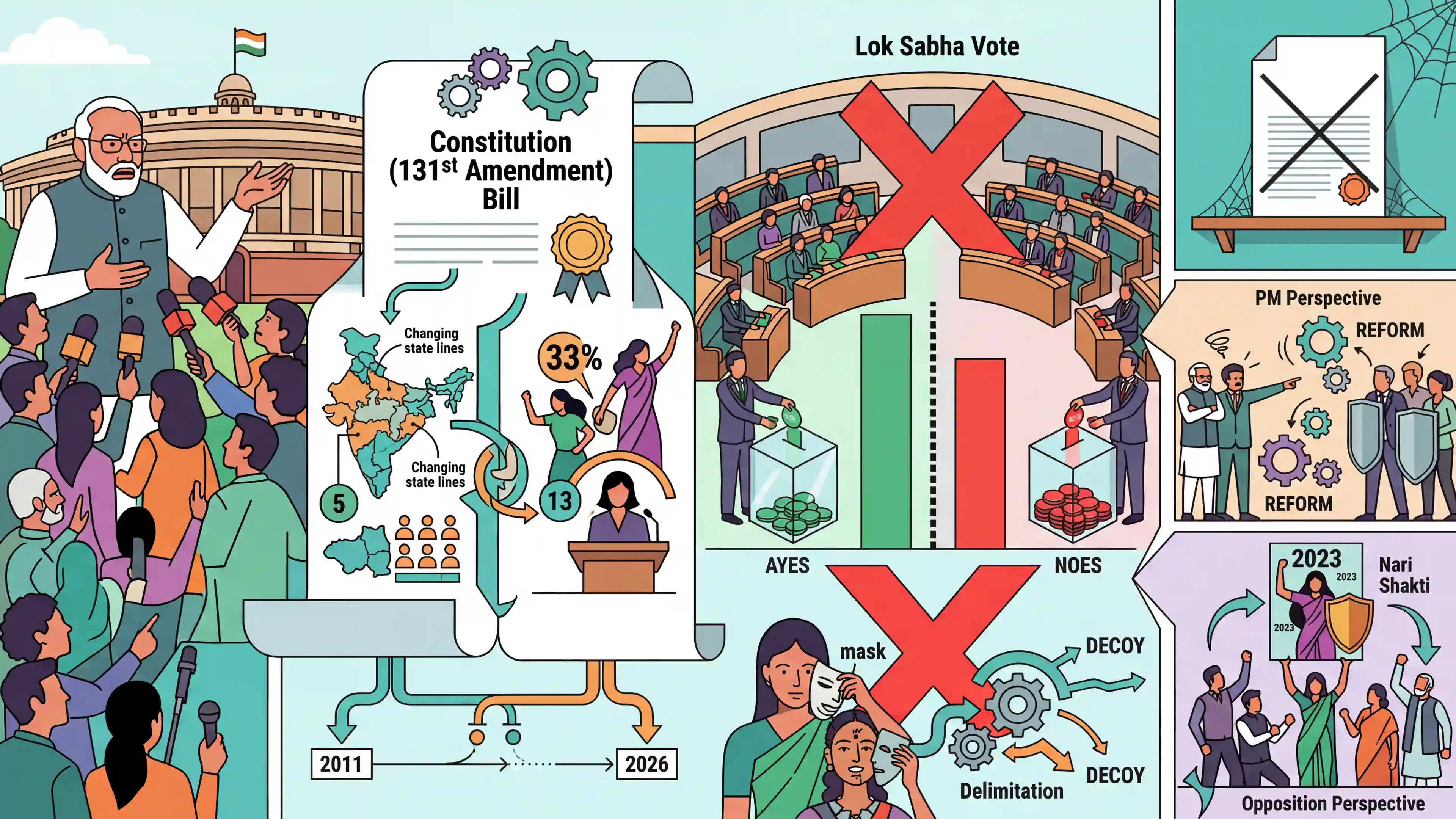
Prime Minister Narendra Modi addressed the nation following the Lok Sabha's defeat of the Constitution (131st Amendment) Bill, 2026. The Bill, part of a broader 'delimitation package,' aimed to redistribute Lok Sabha seats based on the 2011 Census and concurrently implement 33% reservation for women. It failed to achieve the special majority required for constitutional amendments, securing 298 votes in favor and 230 against, short of the requisite two-thirds of members present and voting. Consequently, the companion Delimitation Bill was also shelved. While the PM blamed the Opposition for anti-reform politics, Opposition leaders accused the government of using women's reservation as a decoy to push through a controversial delimitation exercise, noting that the previously passed 2023 Nari Shakti Vandan Adhiniyam could be implemented without it.
Key Points
- The Constitution (131st Amendment) Bill, 2026, which tied 33% women's reservation to a new delimitation exercise based on the 2011 Census, was defeated in the Lok Sabha.
- The Bill failed to secure the necessary special majority under Article 368, receiving 298 votes in favour and 230 against (falling short of the required two-thirds of members present and voting).
- Prime Minister Narendra Modi addressed the nation, criticizing the Opposition for obstructing women's political empowerment while reaffirming the government's commitment to the cause.
- Opposition parties argued that the 2023 Nari Shakti Vandan Adhiniyam could be implemented immediately without waiting for a controversial delimitation process, accusing the government of using women's quota as a 'decoy'.
- Following the amendment's defeat, the companion Delimitation Bill and Union Territories Laws (Amendment) Bill were also shelved by the government.
Important Terms
Constitution (131st Amendment) Bill, 2026

A failed 2026 proposal to fast-track women's reservation by linking it to a 2011 Census-based delimitation and increasing Lok Sabha seats to 850.
UPSC context
GS Paper II: Constitutional Amendments. Tests understanding of legislative attempts to balance representation and federalism.
Nari Shakti Vandan Adhiniyam (2023)
The 106th Constitutional Amendment Act, 2023, providing 33% reservation for women in Lok Sabha and State Assemblies, currently contingent on future census and delimitation.
UPSC context
GS Paper II: Social Justice/Governance. Key reform for gender-inclusive governance and political empowerment.
Delimitation
The process of redrawing boundaries of territorial constituencies to reflect population changes, governed by Articles 82 and 170 of the Constitution.
UPSC context
GS Paper II: Elections/Federalism. Essential for understanding the 'one person, one vote' principle and regional representation concerns.
Special Majority
Requirement under Article 368: a majority of the House's total membership and two-thirds of those present and voting to pass constitutional amendments.
UPSC context
GS Paper II: Parliament. Tests knowledge of procedural safeguards for modifying the Constitution.
Delimitation Bill, 2026
A statutory bill proposed in 2026 to provide the legal framework for redrawing constituency boundaries, shelved after the 131st Amendment's defeat.
UPSC context
GS Paper II: Governance. Relevant for understanding the relationship between constitutional amendments and enabling statutory laws.
Union Territories Laws (Amendment) Bill, 2026
A proposed law to adjust representation in Union Territories, withdrawn in 2026 alongside the failed 131st Amendment and Delimitation Bill.
UPSC context
GS Paper II: Federalism/UTs. Highlights the legislative package approach to comprehensive electoral reforms.
Prelims Trap
"The 106th Amendment Act (Women's Reservation) came into immediate effect upon receiving the President's assent."
The 106th CAA explicitly states that the reservation will only come into effect after a delimitation exercise is conducted based on the first census published post-2026. It is not immediate.
Static Concepts Connected
What are the conditions for a Special Majority under Article 368?
- Total Membership: Requires an absolute majority of the total membership of the House (more than 50% of total seats).
- Present & Voting: Requires a majority of not less than two-thirds of the members present and voting to support the bill.
- State Ratification: Amendments affecting federal representation (like redistributing Lok Sabha seats) require ratification by at least half of the State Legislatures.
What are the powers and limitations of the Delimitation Commission?
- Constitutional Basis: Established under Article 82, which empowers Parliament to enact a Delimitation Act after every census.
- Judicial Immunity: Its orders have the force of law and cannot be challenged or questioned in any court.
- No Modifications: Parliament and State Assemblies cannot modify the Commission's orders once they are laid before them.
Cross-Topic Patterns
Delimitation vs. Southern Federalism
Redrawing Lok Sabha seats based on recent census data threatens the political weight of Southern states, directly conflicting with their demographic stabilization achievements and sparking federal friction.
Quotas within Quotas
Women's reservation under the 106th CAA operates vertically (including SC/ST women), but lacks an OBC sub-quota, frequently tying this topic to Article 340 and the Rohini Commission.

The constitutional freeze on delimitation (84th Amendment) clashing with the 106th CAA implementation trigger is prime 2026 Prelims material.
Linked PYQs · 4
Linked PYQs · 4
- 2023MainsGS2
Discuss the contribution of civil society groups for women's effective and meaningful participation and representation in state legislatures in India.
- 2019MainsGS2
“The reservation of seats for women in the institutions of local self-government has had a limited impact on the patriarchal character of the Indian Political Process.” Comment.
- 2024PrelimsGS1
As per Article 368 of the Constitution of India, the Parliament may amend any provision of the Constitution by way of : 1. Addition 2. Variation 3. Repeal Select the correct answer using the code given below:
- 2022PrelimsGS1
Consider the following statements: 1. A bill amending the Constitution requires a prior recommendation of the President of India. 2. When a Constitution Amendment Bill is presented to the President of India, it is obligatory for the President of India to give his/her assent. 3. A Constitution Amendment Bill must be passed by both the Lok Sabha and the Rajya Sabha by a special majority and there is no provision for joint sitting. Which of the statements given above are correct?
