Delimitation Exercise and Political Representation Debates
Source:The Hindu ↗
Why It Matters
The article touches on crucial GS-2 themes: federalism (demographic shifts affecting North-South political balance), constitutional mechanisms (delimitation and parliamentary seat adjustments), and social justice (women's reservation and the demand for a caste census for OBC representation).
Summary
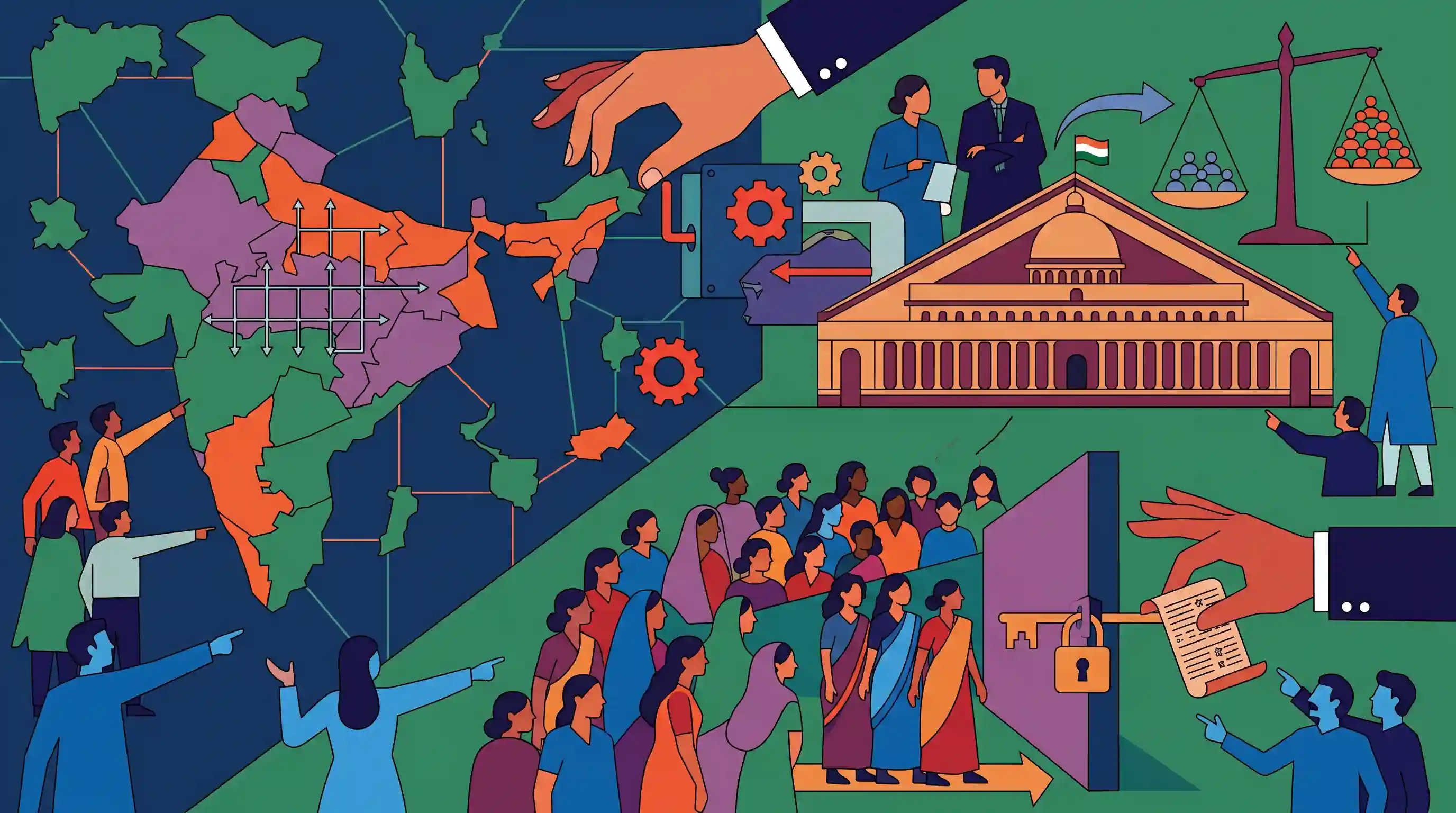
The Congress party has strongly criticized the Central government's draft Bills proposing a fresh delimitation exercise and the implementation of the Nari Shakti Vandan Adhiniyam (women's reservation law). Congress alleges that the proposed delimitation, which aims to increase Lok Sabha seats to 850 based on the 2011 census, will disproportionately reduce the political representation of southern States. Additionally, the opposition accuses the government of evading a much-needed caste census, thereby denying equitable representation and sub-quotas to OBC women within the new reservation framework.
Key Points
- The Centre has circulated draft Bills ahead of a special parliamentary session to implement the Nari Shakti Vandan Adhiniyam (women's reservation) alongside a fresh delimitation exercise.
- The draft proposals aim to increase the strength of the Lok Sabha from 543 to up to 850 seats based on the last published census, and to expand State Assemblies to accommodate the 33% women's quota.
- Congress has accused the government of deceit, warning that the delimitation will disproportionately reduce the electoral representation and political weight of southern States.
- The opposition also alleges that the government is deliberately avoiding a caste census, which would prevent equitable sub-quotas for OBC women under the new reservation framework.
Important Terms
Nari Shakti Vandan Adhiniyam

Formally the 106th Constitutional Amendment Act (2023), reserving one-third of seats for women in Lok Sabha and State Assemblies, contingent on a future census and delimitation.
UPSC context
GS Paper II: Governance/Welfare. Tests knowledge of gender parity reforms and constitutional implementation hurdles.
Delimitation
The process of redrawing boundaries of electoral constituencies to ensure proportional representation, governed by an independent commission under Articles 82 and 170.
UPSC context
GS Paper II: Polity/Elections. Tests understanding of federal representation and the political impact of demographic changes.
Caste Census
A data collection exercise to enumerate caste-wise population, specifically OBCs, to inform reservation sub-quotas and ensure socio-economic justice.
UPSC context
GS Paper I/II: Society/Social Justice. Tests ability to analyze data-driven policy-making and affirmative action debates.
Federal Structure
The constitutional power-sharing between Union and States, currently stressed by potential regional imbalances in parliamentary representation due to population-based seat redistribution.
UPSC context
GS Paper II: Federalism. Tests ability to evaluate the impact of population-based seat allocation on national unity.
Lok Sabha
The lower house of India’s bicameral Parliament, representing the people, with seats currently frozen until 2026 based on the 1971 census.
UPSC context
GS Paper II: Parliament. Tests knowledge of parliamentary composition and constitutional amendments regarding seat allocation.
Prelims Trap
The Nari Shakti Vandan Adhiniyam mandates a 33% reservation for women across SC, ST, and OBC categories.
The 106th CAA provides sub-quotas for SC and ST women within their respective reserved seats, but it does NOT contain any provision for an OBC sub-quota.
Static Concepts Connected
What are the constitutional powers and limitations of the Delimitation Commission?
- Statutory backing: Established under Article 82 by Parliament. It is a high-power body whose orders have the force of law.
- Judicial immunity: Its orders cannot be challenged in any court, ensuring the electoral process is not indefinitely held up by litigation.
- 2026 Freeze: The 84th CAA (2001) froze the total number of Lok Sabha seats until the first Census taken after 2026 to protect states with successful family planning.
What are the key provisions of the 106th CAA (Nari Shakti Vandan Adhiniyam)?
- New Articles: Introduced Articles 330A and 332A, mandating 33% reservation for women in the Lok Sabha and State Legislative Assemblies.
- Condition precedent: The reservation will come into effect only after a delimitation exercise is undertaken based on the first Census published after the Act's commencement.
- Sunset clause: The reservation is initially valid for a period of 15 years, acting as a sunset clause unless extended by Parliament.
Cross-Topic Patterns
Delimitation vs. Finance Commission criteria
Both delimitation and Finance Commission awards grapple with the 'demographic penalty'. The 15th FC mitigated this for Southern states by introducing a 'Demographic Performance' criterion to reward effective population control.
OBC quotas in PRIs vs. Parliament
Article 243D allows states to reserve Panchayat seats for backward classes. However, no parallel constitutional mandate exists for OBC reservations (or OBC women sub-quotas) in Parliament or State Assemblies.

Expect a multi-statement Prelims question testing the interplay between the 84th CAA (seat freeze), Article 82, and 106th CAA conditions.
Linked PYQs · 3
Linked PYQs · 3
- 2023MainsGS2
Discuss the contribution of civil society groups for women's effective and meaningful participation and representation in state legislatures in India.
- 2024PrelimsGS1
How many Delimitation Commissions have been constituted by the Government of India till December 2023?
- 2022MainsGS2
Discuss the role of the National Commission for Backward Classes in the wake of its transformation from a statutory body to a constitutional body.
