India-Malaysia Bilateral Cooperation and Act East Policy Dynamics
Source:Indian Express ↗
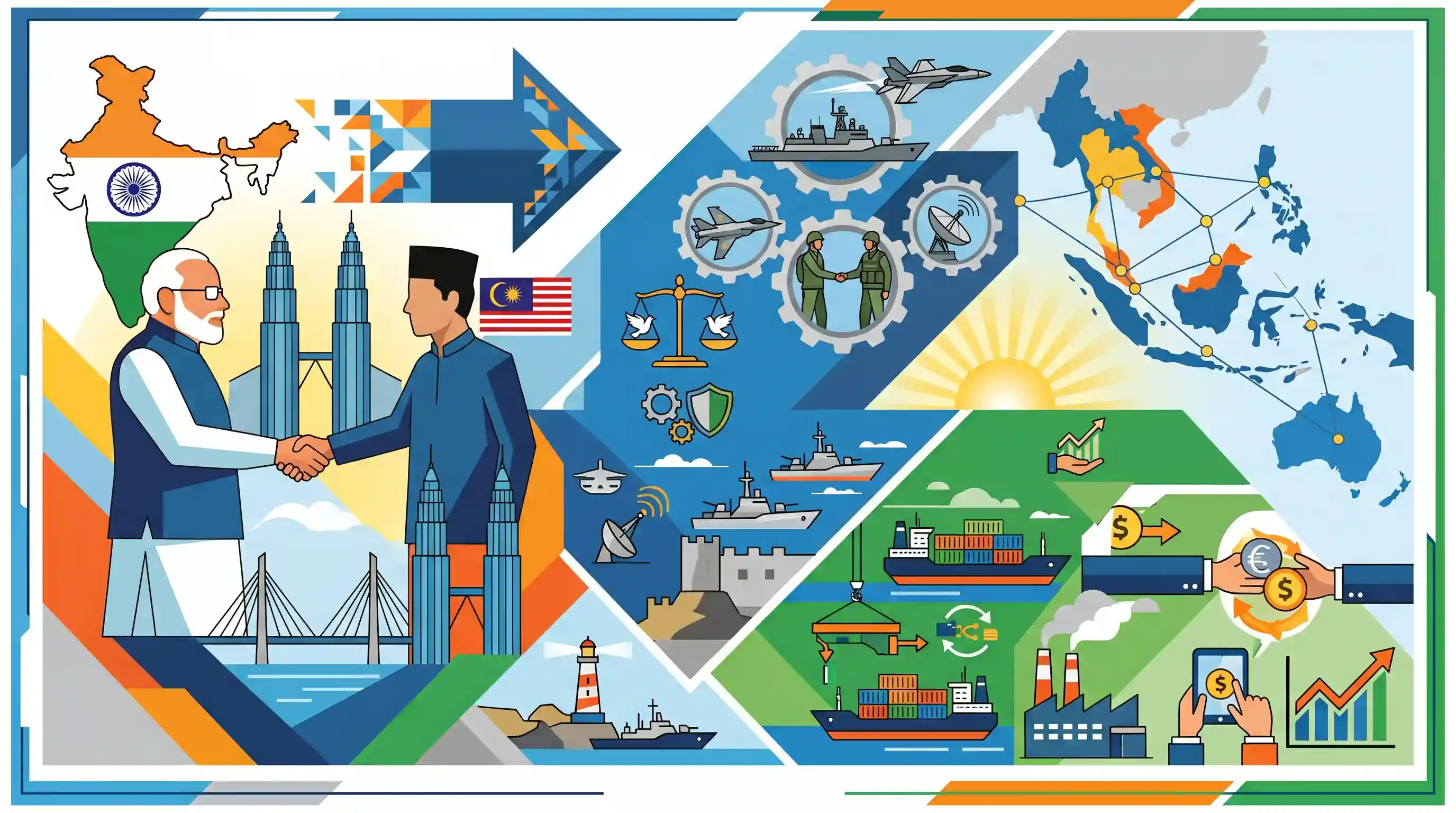
Why It Matters
Malaysia is a prominent ASEAN member and a vital strategic partner in India's Act East Policy. Enhancing bilateral defence and economic cooperation is essential for ensuring maritime security in the Indo-Pacific, diversifying trade partnerships, and maintaining regional geopolitical balance.
Summary
Prime Minister Narendra Modi's two-day visit to Malaysia underscores India's strategic intent to bolster its 'Act East Policy'. The diplomatic visit primarily focuses on deepening bilateral engagements across two major domains: defence cooperation and economic ties. This aligns with India's broader geopolitical goals of fostering stability, maritime security, and economic integration within the Southeast Asian region (ASEAN) and the broader Indo-Pacific.
Key Points
- Prime Minister Narendra Modi commenced a two-day official visit to Malaysia aimed at reinforcing bilateral relations.
- The primary focus of the diplomatic engagement is on deepening strategic defence cooperation and enhancing mutual economic and trade ties.
- This visit is a significant step in advancing India's 'Act East Policy', which seeks to strengthen strategic and economic integration with ASEAN nations.
- Closer India-Malaysia ties contribute to the broader goals of regional stability, maritime security, and a free and open Indo-Pacific.
Important Terms
Act East Policy

A proactive diplomatic strategy launched in 2014 to strengthen economic, cultural, and strategic relations with the Indo-Pacific region, evolving from the earlier 'Look East Policy'.
UPSC context
GS Paper II: International Relations. Tests understanding of India’s shift toward active strategic and economic engagement in Southeast Asia.
ASEAN
The Association of Southeast Asian Nations; a 10-member regional bloc that serves as the 'central pillar' of India's Act East Policy.
UPSC context
GS Paper II: Regional groupings. Key for questions on economic integration, maritime security, and counterbalancing regional influence.
Comprehensive Strategic Partnership (CSP)
An elevated diplomatic framework reflecting deep mutual trust; India and Malaysia upgraded their ties to this level in 2024 to enhance defense, trade, and technology cooperation.
UPSC context
GS Paper II: Bilateral relations. Crucial for discussing high-level diplomatic milestones and defense-economic synergies with key partners.
SAGAR
'Security and Growth for All in the Region'; India's maritime vision for the Indian Ocean and Indo-Pacific, emphasizing cooperation, transparency, and respect for international law.
UPSC context
GS Paper II: International Relations. Essential for questions on maritime security and India's role as a net security provider.
Strait of Malacca
A critical maritime chokepoint between the Malay Peninsula and Sumatra, vital for India's energy security and its eastward trade toward ASEAN and East Asia.
UPSC context
GS Paper I & II: Geography and Geopolitics. Tests knowledge of strategic maritime routes and their impact on national security.
Prelims Trap
"Harimau Shakti is a bilateral military exercise conducted between India and Indonesia."
Aspirants frequently confuse 'Harimau Shakti' (Malaysia) with similarly named exercises involving Indonesia ('Garuda Shakti' or 'Samudra Shakti').
Static Concepts Connected
What are the core pillars and evolution of India's Act East Policy?
- Evolution: Upgraded from the 1992 'Look East' policy in 2014 to emphasize proactive, action-oriented strategic engagement over mere economic ties.
- The 4Cs: Anchored on the '4Cs': Culture, Commerce, Connectivity, and Capacity Building.
- Geographic Scope: Expanded the geographic and strategic focus beyond just ASEAN nations to encompass the broader Indo-Pacific architecture and maritime security.
What are the key bilateral mechanisms connecting India and Malaysia?
- Economic Framework: The Comprehensive Economic Cooperation Agreement (CECA) signed in 2011, covering trade in goods, services, and investments.
- Defence Exercises: Joint military exercises including 'Harimau Shakti' (Army), 'Samudra Laksamana' (Navy), and 'Udarashakti' (Air Force).
- Strategic Upgrade: Bilateral ties were officially upgraded to a 'Comprehensive Strategic Partnership' in August 2024.
Cross-Topic Patterns
Rupee Internationalization & Act East
Allowing INR trade settlements with Malaysia bridges RBI's macro-economic currency internationalization drive (Special Rupee Vostro Accounts) with Act East diplomatic goals.
Malacca Chokepoint & Naval Diplomacy
Joint naval exercises like Samudra Laksamana directly link to India's maritime security strategy and choke-point control along the vulnerable Malacca Strait.
Diaspora Diplomacy & Historical Migration
Malaysia's 2.75 million-strong Person of Indian Origin (PIO) community acts as a 'living bridge', connecting historical diaspora migration to modern soft-power diplomacy.

Expect a multi-statement 2026 Prelims question mixing ASEAN bilateral exercises (Harimau Shakti) with INR trade settlements.
Linked PYQs · 1
Linked PYQs · 1
- 2016MainsGS2
Evaluate the economic and strategic dimensions of India's Look East Policy in the context of the post Cold War international scenario.
