Grassroots Innovation and Quality Standards in Manufacturing
Source:The Hindu ↗
Why It Matters
Mann Ki Baat addresses serve as a rich repository of case studies and grassroots examples that are highly useful for GS Paper 2 (Governance), GS Paper 4 (Ethics), and Essay papers. The specific mentions of 'Zero Defect Zero Effect', diaspora contributions, and community-led environmental and social reforms provide concrete illustrations of citizen participation in nation-building and self-reliance (Viksit Bharat).
Summary
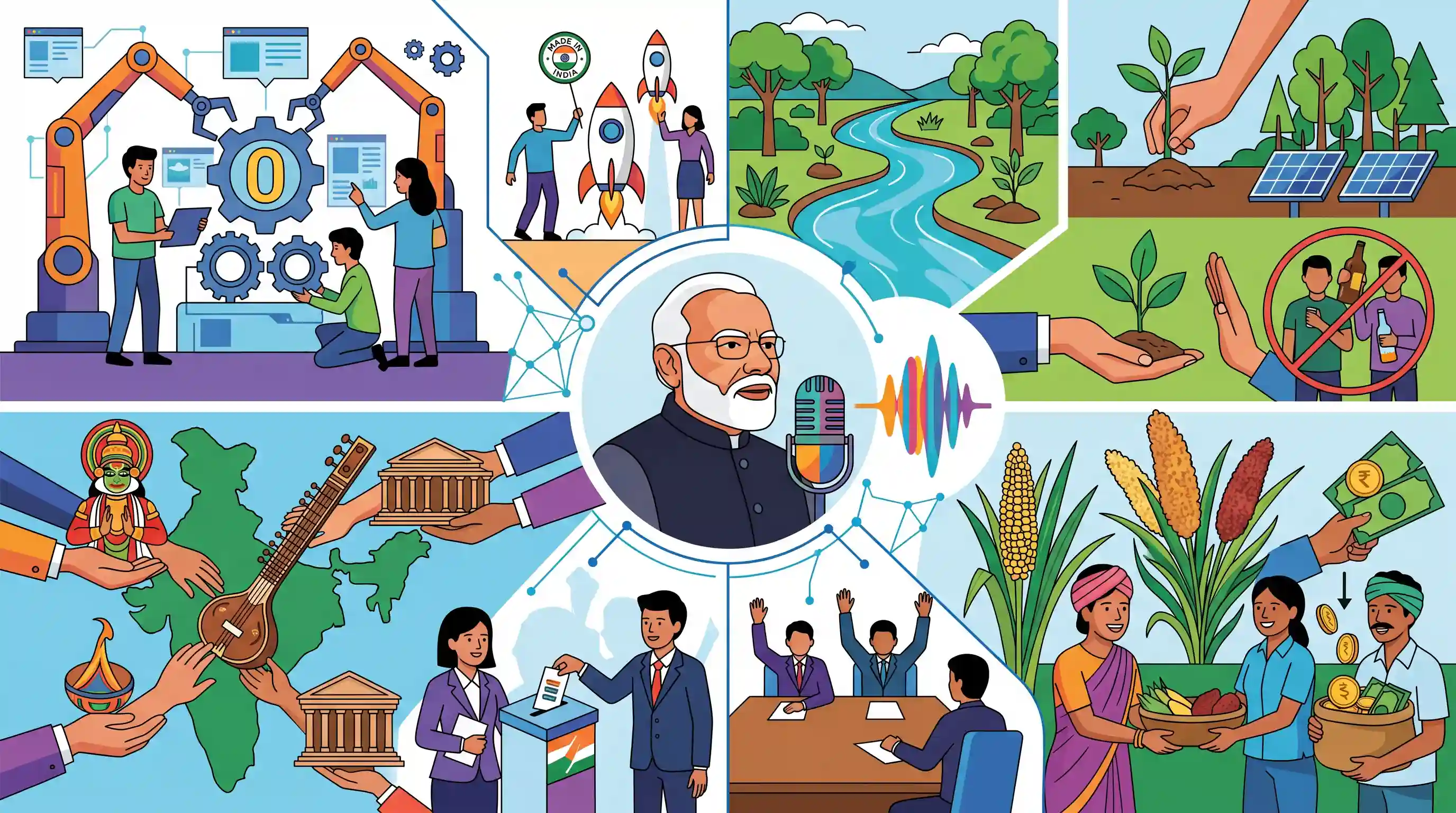
In his 130th Mann Ki Baat address, Prime Minister Narendra Modi underscored the importance of high-quality indigenous manufacturing, urging Indian startups to adopt a 'Zero Defect Zero Effect' approach to make 'Made-in-India' products globally competitive. He highlighted diverse grassroots initiatives driving national progress, from environmental conservation efforts like rejuvenating the Tamsa river and afforestation drives to social reforms like making villages drug-free. The Prime Minister also celebrated the role of the Indian diaspora in promoting cultural heritage abroad, emphasized the importance of youth participation in the democratic process on National Voters' Day, and lauded the economic empowerment of farmers through millet-focused Farmer Producer Companies.
Key Points
- PM Modi emphasized the 'Zero Defect Zero Effect' principle for Indian manufacturing, urging startups to produce high-quality 'Made-in-India' goods for the global market.
- Grassroots environmental efforts were highlighted, including the rejuvenation of the Tamsa river in Azamgarh, reservoir revival in Ananthapur, and the 'Ek Ped Maa Ke Naam' tree plantation drive.
- The address noted the significant cultural contributions of the Indian diaspora, specifically mentioning the Malaysia India Heritage Society and the UAE's 'Year of the Family' celebrations.
- Youth participation in democracy was encouraged on National Voters' Day, reflecting on the crucial role of new voters in shaping the country's future.
- Community-led social reforms and agricultural advancements were praised, such as a drug-free campaign in Kashmir's Sheikhgund village and the success of millet-based Farmer Producer Companies in Tamil Nadu and Rajasthan.
Important Terms
Zero Defect Zero Effect (ZED)

A certification scheme by the Ministry of MSME aiming to eliminate product defects and environmental impact. It enhances global competitiveness for small businesses by promoting high-quality, sustainable manufacturing processes under the 'Make in India' initiative.
UPSC context
GS3: Economy/Industry. Tests knowledge of MSME policy, quality standards, and sustainable manufacturing strategies for global trade.
Viksit Bharat
The government's roadmap to transform India into a developed nation by 2047. It focuses on economic growth, social advancement, and governance, centered on four key pillars: youth, poor, women, and farmers.
UPSC context
GS2/GS3: Governance/Economy. Tests understanding of long-term development targets, inclusive growth, and the vision for a 'New India'.
Make in India
A flagship national program launched in 2014 to transform India into a global manufacturing hub. It encourages domestic and foreign investment to boost the manufacturing sector's contribution to GDP and create employment.
UPSC context
GS3: Economy. Tests understanding of industrial policy, FDI reforms, and strategies to improve the ease of doing business.
Farmer Producer Company (FPC)
A hybrid entity of primary producers (farmers) registered under the Companies Act. It allows smallholders to achieve economies of scale, gain better bargaining power, and access professional management and direct markets.
UPSC context
GS3: Agriculture. Tests knowledge of institutional reforms, collective farming, and measures to enhance rural income and food security.
National Voters' Day
Observed annually on January 25th since 2011 to mark the founding of the Election Commission of India (1950). It aims to maximize voter registration and promote participation in the democratic process.
UPSC context
GS2: Polity/Elections. Tests awareness of voter education (SVEEP), electoral participation, and the history of India's democratic institutions.
Election Commission of India (ECI)
An autonomous constitutional authority (Article 324) responsible for administering elections to the Parliament, State Legislatures, and the offices of the President and Vice-President of India.
UPSC context
GS2: Polity. Tests knowledge of constitutional bodies, election management, and the legal framework for free and fair polls.
Ek Ped Maa Ke Naam
A mass afforestation campaign launched on World Environment Day 2024. It encourages citizens to plant a tree in honor of their mothers, linking personal values with national environmental conservation and climate action.
UPSC context
GS3: Environment. Tests knowledge of community-led conservation, afforestation targets, and India's commitment to climate change mitigation.
Prelims Trap
"The 'Zero Effect' principle mandates achieving net-zero carbon emissions by 2070 for Indian startups."
ZED is an MSME certification scheme targeting product quality and manufacturing ecology, not India's macro Net-Zero carbon emissions target under the UNFCCC.
Static Concepts Connected
What are the core pillars of the ZED (Zero Defect Zero Effect) certification scheme?
- Zero Defect: Focuses on zero non-conformance, ensuring products are globally competitive without requiring re-work or causing wastage.
- Zero Effect: Focuses on zero air/water/soil pollution and zero wastage of natural resources during the manufacturing process.
- Target Beneficiaries: It provides financial assistance to Micro, Small and Medium Enterprises (MSMEs) to adopt quality and environmental standards.
What is the geographical profile of the Tamsa (Tons) River?
- Origin: It rises in the Kaimur Range (Madhya Pradesh) and flows through the Rewa Plateau.
- Drainage: It is a right-bank tributary of the Ganges, joining it just downstream of Prayagraj (Sirsa).
- Key Feature: Creates significant waterfalls (e.g., Purwa Falls, Chachai Falls) as it descends from the plateau.
Cross-Topic Patterns
FPCs + Climate Resilient Agriculture
Farmer Producer Companies (FPCs) linked with millet production address two UPSC themes simultaneously: doubling farmers' income through economies of scale, and promoting climate-resilient agriculture (Shree Anna).
Cultural Diplomacy via Diaspora
Mentions of the Malaysia India Heritage Society highlight how India uses soft power and its diaspora (Act East policy) to strengthen cultural ties beyond traditional statecraft.

Expect a multi-statement Prelims question mixing ZED's MSME criteria, ONDC's role in FPCs, and millet cultivation benefits.
Linked PYQs · 4
Linked PYQs · 4
- 2015MainsGS3
Success of 'Make in India' programme depends on the success of 'Skill India' programme and radical labour reforms." Discuss with logical arguments.
- 2017MainsGS2
Indian diaspora has an important role to play in South-East Asian countries' economy and society. Appraise the role of Indian diaspora in South-East Asia in this context.
- 2022MainsGS2
Discuss the role of the Election Commission of India in the light of the evolution of the Model Code of Conduct.
- 2022PrelimsGS1
The "Miyawaki method" is well known for the:
