India Protects Domestic Agriculture in Bilateral Trade Negotiations
Source:The Hindu ↗
Why It Matters
It illustrates the persistent tension between international trade liberalization and the necessity to protect vulnerable domestic sectors, specifically agriculture and livestock. This is highly relevant for GS3 (Economics of animal-rearing, agricultural subsidies, trade barriers) and GS2 (Bilateral relations).
Summary
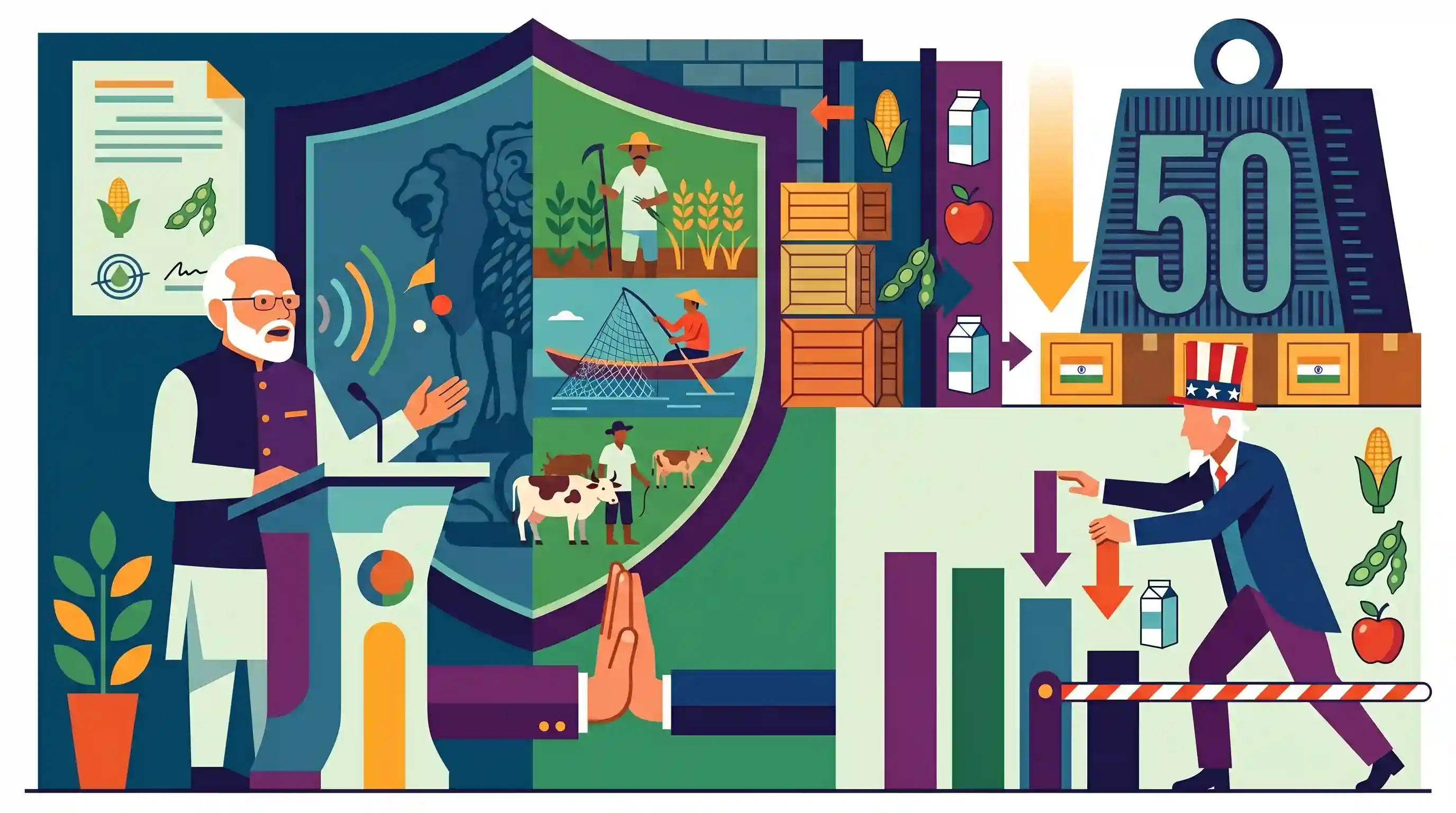
In his 79th Independence Day address, Prime Minister Narendra Modi declared that India will not compromise on policies intended to protect its farmers, fishermen, and cattle rearers. The assertion comes against the backdrop of contentious Bilateral Trade Agreement (BTA) negotiations with the United States. The US is pressing India for duty concessions on agricultural products (like corn, soybeans, and apples) and greater access for its dairy sector, while simultaneously imposing steep tariffs—up to 50%—on Indian goods. New Delhi firmly opposes these demands, arguing that reducing tariffs would expose domestic agricultural and allied sectors to cheap imports, jeopardizing local livelihoods. This aligns with India's long-standing policy of excluding agriculture from duty concessions in its Free Trade Agreements.
Key Points
- In his 79th Independence Day speech, PM Modi emphasized that India will stand firm against any trade policies detrimental to its farmers, fishermen, and cattle rearers.
- The US is demanding significant duty concessions on agricultural goods (corn, soybeans, apples, etc.) and dairy products in ongoing Bilateral Trade Agreement (BTA) negotiations.
- Trade tensions have escalated with the US imposing steep tariffs of up to 50% on certain Indian exports, effective August 27.
- India continues to refuse duty concessions in agriculture and allied sectors to protect domestic livelihoods, a consistent stance observed even in its trade agreements with Australia and Switzerland.
Important Terms
Bilateral Trade Agreement (BTA)

A formal trade pact between two nations aimed at reducing or eliminating tariffs, quotas, and other trade barriers to encourage mutual economic cooperation and exchange of goods and services.
UPSC context
GS Paper 2 (International Relations) and GS Paper 3 (Economy); tests knowledge of trade diplomacy and bilateral economic frameworks.
Tariff Barriers
Taxes or duties imposed by a government on imported goods at the border, designed to protect domestic industries from foreign competition by making imports more expensive.
UPSC context
GS Paper 3 (Economy); critical for understanding protectionism, WTO negotiations, and domestic agricultural sensitivity.
Non-Tariff Barriers (NTB)
Regulatory measures other than customs duties—such as quotas, licensing, sanitary standards, or bans (e.g., on GM crops)—that restrict or impede the international flow of goods.
UPSC context
GS Paper 3 (Economy); highlights subtle trade restrictions and technical standards used in modern trade wars.
Market Access
The degree to which a country allows foreign goods and services to enter its market, often determined by the reduction of trade barriers during negotiations.
UPSC context
GS Paper 2/3; central to India-US trade disputes regarding dairy and agricultural exports.
Agricultural Dumping
The practice of exporting goods to another country at a price lower than the cost of production, often enabled by high domestic subsidies, threatening the host country's domestic producers.
UPSC context
GS Paper 3 (Agriculture/Economy); examines threats to rural livelihoods and the necessity of Anti-Dumping Duties.
Most Favoured Nation (MFN)
A fundamental WTO principle requiring a country to provide the same trade concessions to all member nations, preventing discriminatory trade favors unless part of a formal FTA.
UPSC context
GS Paper 3 (International Trade); essential for understanding global trade rules and Indian compliance with WTO standards.
Prelims Trap
"India's recent Free Trade Agreements mandate a phased elimination of tariffs on all agricultural and dairy imports."
India specifically maintains sensitive agricultural and dairy products on strict "exclusion lists" in its FTAs (including with Australia and EFTA) to protect domestic farmers.
Static Concepts Connected
What are Sanitary and Phytosanitary (SPS) measures under the WTO?
- Definition: Rules allowing nations to set standards protecting human, animal, or plant health from pests, diseases, or toxins.
- Scientific Basis: Must be justified by scientific evidence and not used arbitrarily as disguised protectionist trade barriers.
- Dairy Context: India’s mandate that imported dairy be sourced from animals fed a strictly vegetarian diet is an SPS measure contested by the US.
What is an 'Exclusion List' in a Free Trade Agreement (FTA)?
- Mechanism: A negotiated schedule of sensitive goods that are explicitly kept out of tariff reduction or elimination commitments in a trade pact.
- Objective: To shield vulnerable domestic sectors, such as landless dairy farmers and marginal agricultural workers, from abrupt surges in cheap foreign imports.
Cross-Topic Patterns
WTO SPS Agreement + Domestic Cultural Norms
India's use of veterinary health certificates requiring vegetarian-fed dairy bridges international trade law (SPS measures) with domestic cultural sensitivities and rural livelihood protection.
Agri-Subsidy Debates + FTA Negotiations
The US demand for duty concessions on highly subsidized agricultural goods highlights the structural friction seen in WTO's Agreement on Agriculture regarding unfair export competition.

Expect a 2026 Prelims question linking WTO SPS measures, India's FTA exclusion lists, and non-tariff barriers in the dairy sector.
Linked PYQs · 3
Linked PYQs · 3
- 2023MainsGS3
What are the direct and indirect subsidies provided to farm sector in India? Discuss the issues raised by the World Trade Organization (WTO) in relation to agricultural subsidies.
- 2015MainsGS3
Livestock rearing has a big potential for providing non-farm employment and income in rural areas. Discuss suggesting suitable measures to promote this sector in India.
- 2016MainsGS2
The broader aims and objectives of WTO are to manage and promote international trade in the era of globalization. But the Doha round of negotiations seem doomed due to differences between the developed and the developing countries." Discuss in the Indian perspective.
