Nationwide HPV Vaccination Campaign and Preventive Health
Source:Indian Express ↗
Why It Matters
The introduction of the HPV vaccine in national campaigns addresses cervical cancer, one of the leading causes of cancer mortality among Indian women. It exemplifies the intersection of public health policy, preventive medicine, and administrative ethics (parental consent). Students must link this to the Universal Immunization Programme and broader health governance issues.
Summary
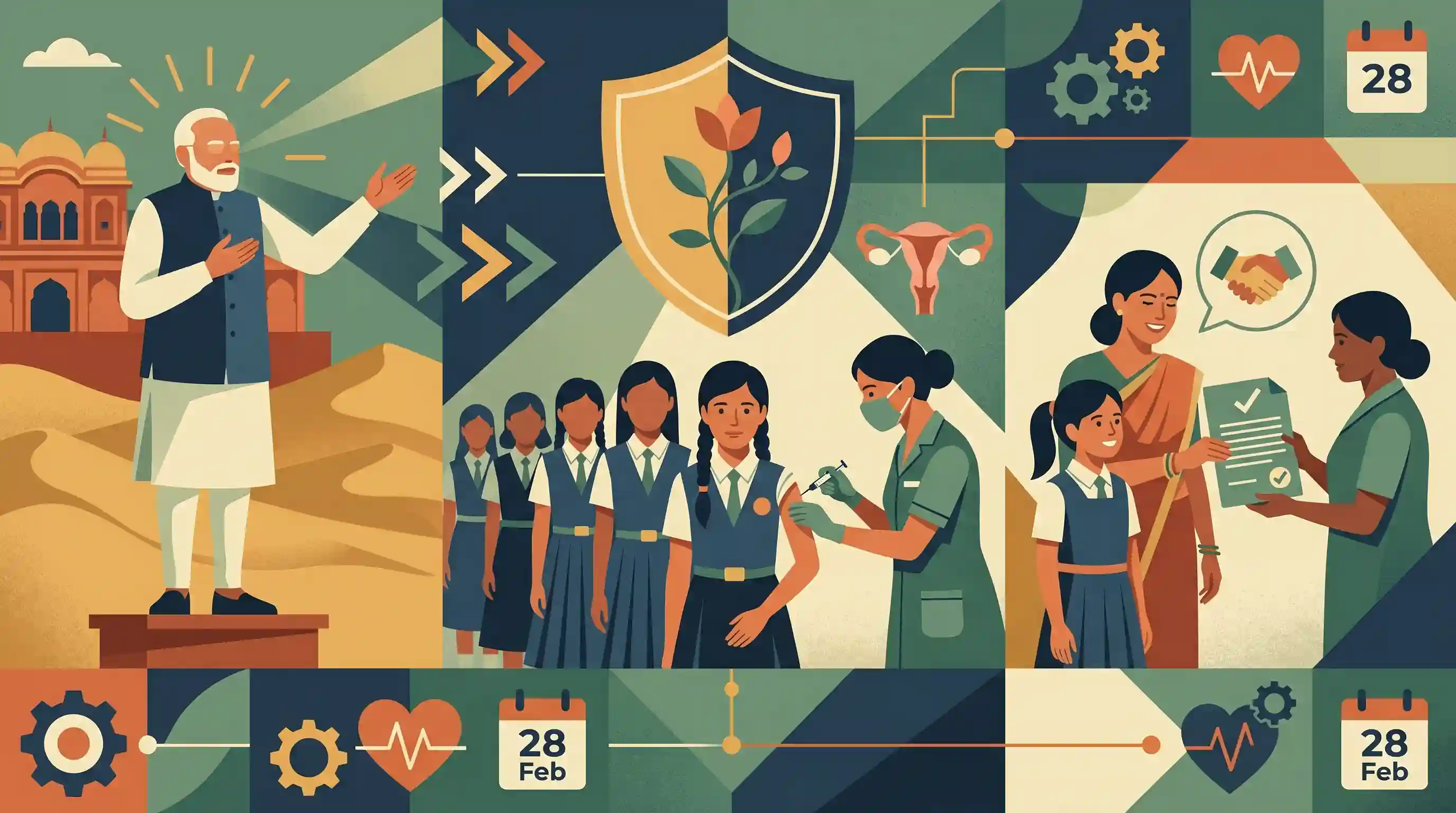
The Prime Minister is scheduled to launch a nationwide Human Papillomavirus (HPV) vaccination campaign from Rajasthan on February 28. Designed to combat the high prevalence of cervical cancer among Indian women, the campaign focuses on immunizing adolescent girls. Notably, the administration has made parental consent mandatory for the vaccination. This initiative reflects a significant expansion of India's preventive healthcare and immunization efforts targeted specifically at women's health.
Key Points
- The Prime Minister will inaugurate a nationwide HPV vaccine campaign from Rajasthan on February 28.
- The primary objective of the campaign is the prevention of cervical cancer among women.
- Parental consent has been made mandatory for administering the vaccine to adolescent girls.
- The roll-out highlights a significant step in preventive healthcare and women's health within India's public health policy.
Important Terms
Human Papillomavirus (HPV)

A common group of viruses; high-risk strains (specifically types 16 and 18) are responsible for approximately 70-80% of cervical cancer cases globally and in India.
UPSC context
GS Paper II (Health) and GS Paper III (Science & Technology); critical for understanding preventable viral diseases.
Universal Immunization Programme (UIP)
A major government health initiative providing free vaccines against several diseases to children and pregnant women. It is one of the world's largest public health programs.
UPSC context
GS Paper II (Government Policies/Health); a core pillar of India's social sector infrastructure.
Cervavac
India’s first indigenously developed quadrivalent Human Papillomavirus vaccine, produced by the Serum Institute of India in collaboration with the Department of Biotechnology to provide affordable cancer prevention.
UPSC context
GS Paper III (Indigenization of Technology/Make in India); showcases domestic biotech capabilities in healthcare.
Cervical Cancer
The second most common cancer among Indian women, primarily caused by persistent HPV infection. It is one of the only cancers that is largely preventable through vaccination.
UPSC context
GS Paper II (Issues related to Women/Health); represents a significant disease burden in India’s public health.
National Technical Advisory Group on Immunization (NTAGI)
The apex technical body in India that provides evidence-based recommendations on vaccine introduction and immunization policy to the Union Ministry of Health and Family Welfare.
UPSC context
GS Paper II (Statutory/Regulatory Bodies); important for health governance and decision-making processes.
U-WIN Platform
A digital platform designed to digitize India’s Universal Immunization Programme, enabling real-time tracking of vaccination status, registrations, and appointments for beneficiaries nationwide.
UPSC context
GS Paper II (e-Governance/Health); represents the digital transformation of public service delivery.
Prelims Trap
CERVAVAC is a live-attenuated vaccine used to treat early-stage cervical cancer in adult women.
HPV vaccines are preventive (prophylactic), not therapeutic. Additionally, CERVAVAC uses Virus-Like Particles (VLP) technology, meaning it is a recombinant vaccine containing no live virus.
Static Concepts Connected
What is Virus-Like Particle (VLP) vaccine technology?
- Mimics structure: VLPs externally resemble the actual virus to trigger a strong immune response, but completely lack viral genetic material (DNA/RNA).
- Infectious inability: Because they lack genetic material, they cannot replicate or cause the disease, making them highly safe for mass administration.
- Key examples: Both the Hepatitis B vaccine and the new HPV vaccines (including India's indigenous CERVAVAC) utilize this recombinant technology.
How does the Universal Immunization Programme (UIP) operate?
- Broad coverage: It is one of the largest public health programs globally, providing free vaccines against 12 vaccine-preventable diseases.
- NCD prevention shift: Adding the HPV vaccine represents a paradigm shift for UIP—using traditional immunization frameworks to prevent a non-communicable disease (cancer).
Cross-Topic Patterns
Indigenization of Biotechnology
Developing CERVAVAC domestically via DBT-SII collaboration slashes procurement costs, fitting perfectly into the Atmanirbhar Bharat framework for critical bio-manufacturing and import substitution.
Bioethics and Medical Consent
The mandatory parental consent clause touches upon GS4/GS2 themes of bioethics, minor autonomy, and state paternalism in large-scale public health drives.

Expect a multi-statement question in 2026 testing the VLP biotechnology behind CERVAVAC alongside India's cervical cancer disease burden.
Linked PYQs · 4
Linked PYQs · 4
- 2019PrelimsGS1
Which one of the following statements is not correct?
- 2016PrelimsGS1
'Mission Indradhanush' launched by the Government of India pertains to
- 2020MainsGS2
In order to enhance the prospects of social development, sound and adequate health care policies are needed particularly in the fields of geriatric and maternal health care. Discuss.
- 2024MainsGS2
In a crucial domain like the public healthcare system the Indian State should play a vital role to contain the adverse impact of marketisation of the system. Suggest some measures through which the State can enhance the reach of public healthcare at the grassroots level.
