Prime Minister criticizes opposition absence during key bill debates
Source:The Hindu ↗
Why It Matters
The article highlights the recurrent issue of legislative disruptions and the declining quality of parliamentary debates, a core concern for Indian polity. It also introduces the Promotion and Regulation of Online Gaming Bill, an important legislative intervention in regulating the digital economy.
Summary
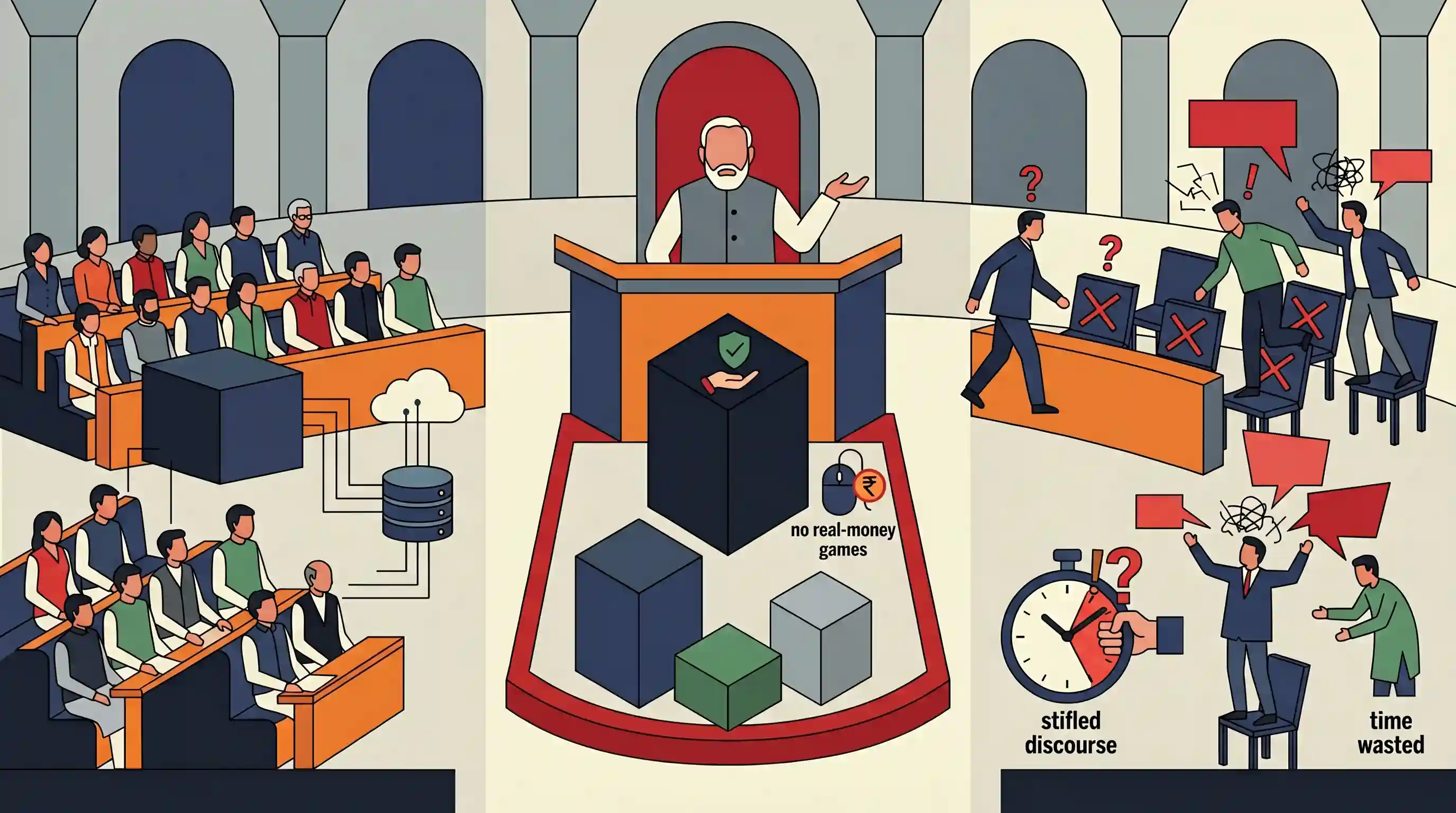
During the conclusion of the Monsoon Session, Prime Minister Narendra Modi expressed disappointment over the Opposition's continuous disruptions and absence during debates on crucial legislation. He specifically highlighted the 'Promotion and Regulation of Online Gaming Bill'—which bans all real-money games—as a significant law passed without constructive discussion. The PM criticized the Congress leadership, asserting that their 'insecurity' stifles the participation of young MPs and thereby degrades the quality of parliamentary discourse.
Key Points
- PM Modi criticized the Opposition for frequent disruptions and their absence during the Monsoon Session, which led to significant bills being passed without debate.
- The Promotion and Regulation of Online Gaming Bill, which completely bans real-money games, was notably passed in both Houses amidst the din without constructive discussion.
- The Prime Minister argued that the insecurity of the Congress leadership actively prevents its bright, young MPs from participating in parliamentary discourse.
- Parliamentary Affairs Minister Kiren Rijiju observed that despite arriving at understandings regarding House functioning, Congress floor leaders are often unable to implement them due to internal constraints.
Important Terms
Promotion and Regulation of Online Gaming Act, 2025

A 2025 legislation that centralizes the regulation of India's digital gaming sector. It specifically prohibits 'online money games' (real-money wagering) while promoting e-sports and social games under a central Online Gaming Authority.
UPSC context
GS II: Government Policies and Interventions. Tests understanding of digital governance, regulatory frameworks, and social impacts of technology.
Role of the Opposition
A core pillar of parliamentary democracy responsible for questioning the executive, offering alternative policy proposals, and ensuring government accountability during the legislative process to maintain deliberative democracy.
UPSC context
GS II: Parliament and State Legislatures. Essential for discussing legislative productivity, accountability, and the health of democratic institutions.
Monsoon Session
One of the three annual sittings of the Indian Parliament, generally held between July and September. It is a key period for the introduction and passage of significant bills.
UPSC context
GS II: Structure and Functioning of Parliament. Tests knowledge of parliamentary calendar, legislative cycles, and session-specific developments.
Rules of Procedure and Conduct of Business
Internal regulations formulated under Article 118 of the Constitution that govern how debates, voting, and administrative matters are handled within the Lok Sabha and Rajya Sabha.
UPSC context
GS II: Functioning of Parliament. Relevant for questions on legislative delays, disruptions, and the Speaker's powers to maintain order.
Leader of the Opposition (LoP)
A statutory position (Salaries and Allowances Act, 1977) held by the leader of the largest opposition party with at least 10% of total seats. Participates in high-level selection committees.
UPSC context
GS II: Constitutional and Statutory Bodies. Significant for topics concerning checks and balances and parliamentary appointments.
Prelims Trap
Parliament has exclusive legislative competence over all forms of betting and gambling.
Betting and gambling fall under the State List (Entry 34). Central regulation of online gaming relies on the IT Act (Union List) or Article 252 (consent of states).
Static Concepts Connected
What is the 'Guillotine' in parliamentary proceedings?
- Definition: Putting undiscussed demands for grants to vote alongside discussed ones on the last allotted day, bypassing further debate.
- Consequence: It severely erodes financial accountability by allowing the executive to secure budget funds without legislative scrutiny.
Can Parliament validly pass bills despite an Opposition walkout?
- Quorum rule: Article 100(3) requires at least one-tenth of the total members of the House to be present to constitute a meeting.
- Legal validity: As long as the quorum is met and the required majority votes in favor, bills passed 'in the din' are legally valid.
Cross-Topic Patterns
Online Gaming + PMLA + Hawala
Real-money gaming bans address digital hawala and cryptocurrency laundering, directly linking this legislative action to GS-3 internal security and Prevention of Money Laundering Act (PMLA) frameworks.
Legislative Decline + DRSC Scrutiny
Routinely passing bills 'in the din' prevents scrutiny by Departmentally Related Standing Committees (DRSCs), accelerating a broader GS-2 trend of executive dominance and legislative decline.

A GS-2 Mains question linking the decline in parliamentary debates to the bypassing of DRSCs and executive dominance is highly likely in 2026.
Linked PYQs · 2
Linked PYQs · 2
- 2019MainsGS2
Individual Parliamentarian's role as the national law maker is on a decline, which in turn, has adversely impacted the quality of debates and their outcome. Discuss.
- 2024MainsGS2
“The growth of cabinet system has practically resulted in the marginalisation of the parliamentary supremacy.” Elucidate.
