PM E-Bus Service Launch and Urban Green Mobility in Madhya Pradesh
Source:freepressjournal.in ↗
Why It Matters
The PM-eBus Sewa initiative in Madhya Pradesh is a critical development in green public infrastructure, aligning with India's Net Zero emissions target, sustainable urban planning (SDG 11), and climate action (SDG 13). Understanding its regional implementation and digital ticketing systems (like the Chalo App) is highly relevant for state-level and national governance exams.
Summary
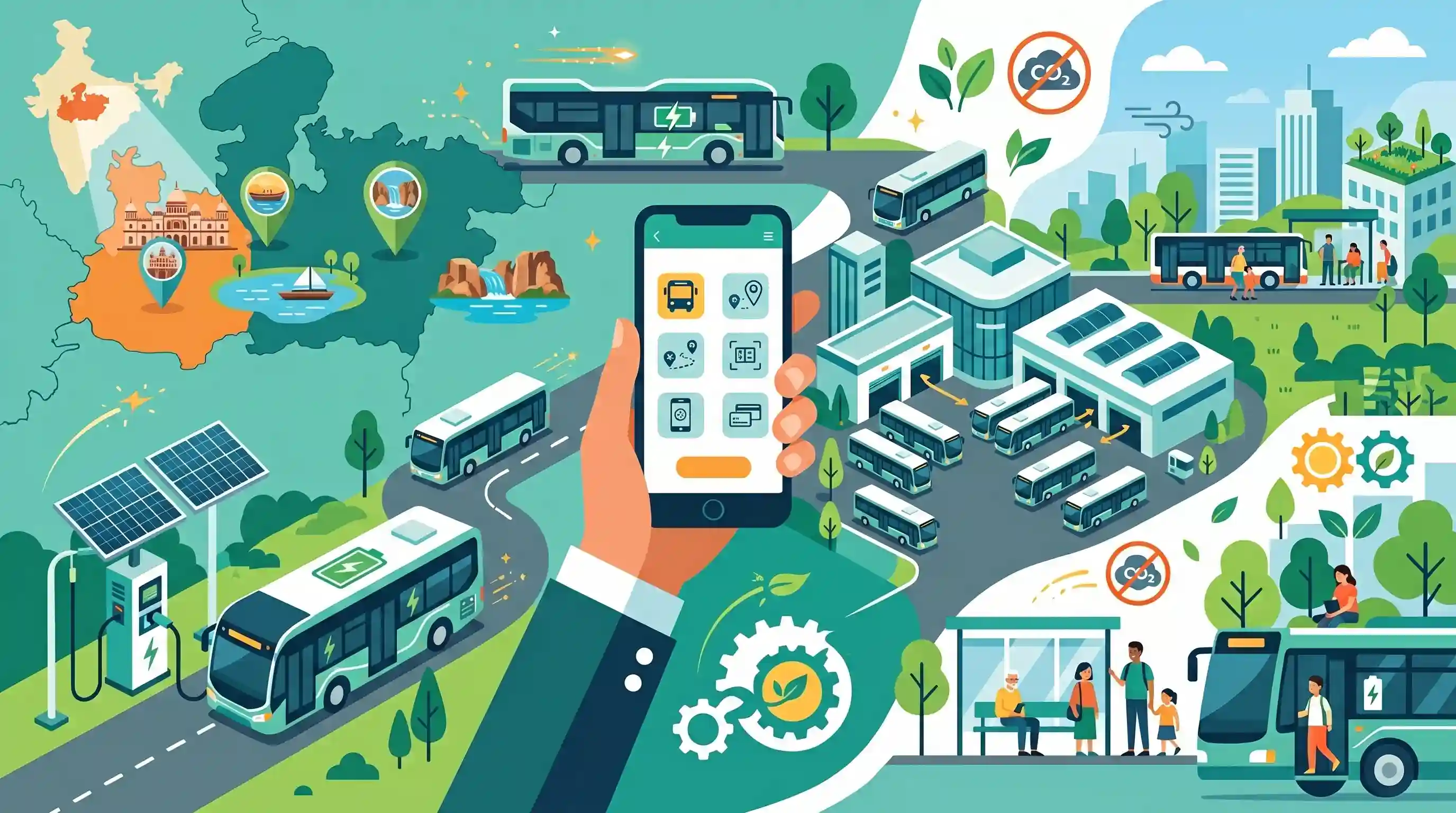
Madhya Pradesh is launching the PM E-Bus Service from July, aiming to revamp urban public transport with 582 electric AC buses across six cities. The first phase begins in Indore, Bhopal, and Jabalpur, utilizing the 'Chalo App' for digital ticketing and supported by a robust network of modern depots and charging stations. This green mobility initiative supports the state's sustainable infrastructure and climate goals.
Key Points
- Madhya Pradesh will launch the PM E-Bus Service in July, beginning with Indore, followed by Bhopal and Jabalpur. The first phase will operationalize 350 AC electric buses.
- A total of 582 electric AC buses will be introduced across 6 major cities in Madhya Pradesh under this central government-sponsored scheme.
- Phase 1 will allocate 150 buses (8 routes) to Indore, 100 buses (10 routes) to Bhopal, and 100 buses to Jabalpur. Phase 2 will expand the service to Gwalior, Sagar, and Ujjain.
- Nine modern bus depots will be developed: 2 in Bhopal (Bairagarh and Kasturba Nagar), 2 in Indore (Nayta Mundla and Chandan Nagar), 2 in Gwalior, and 1 each in Jabalpur, Sagar, and Ujjain.
- Charging infrastructure includes 2 charging stations each in Indore, Bhopal, and Gwalior, and 1 each in Jabalpur, Sagar, and Ujjain. Around 41 km of high-tension power lines will be laid to ensure uninterrupted electricity.
- Digital ticketing and travel pass booking will be managed through the mobile-based Chalo App.
- In Indore, the longest route is Rangwasa to Depalpur (52.30 km), and the busiest route is Mhow Naka to Sanwer (running 50 buses). In Bhopal, the longest route is Sehore to Ratapani (68.5 km).
- The initial transit fare is proposed at ₹1.50 per kilometer, with a proposal under consideration to increase it to ₹2 per kilometer.
Important Terms
PM-eBus Sewa Scheme

A central scheme to deploy 10,000 electric buses in 169 Indian cities on a Public-Private Partnership (PPP) model, prioritizing cities lacking organized public transport.
UPSC context
GS Paper III (Infrastructure); tests understanding of sustainable urban transport models and green infrastructure initiatives.
Green Urban Mobility Initiatives (GUMI)
A component under the PM-eBus Sewa scheme that funds eco-friendly urban initiatives, including charging stations, bus priority corridors, and digital ticketing solutions.
UPSC context
GS Paper III (Environment and Infrastructure); tests strategies for reducing urban emissions and enhancing modern public transit.
Gross Cost Contract (GCC) Model
A service-delivery contract model where a private partner owns, operates, and maintains assets (like electric buses) in exchange for a fixed, distance-based payment from the government.
UPSC context
GS Paper III (Investment Models); tests knowledge of risk-allocation and financing mechanisms in public transport procurement.
Payment Security Mechanism (PSM)
A government-backed financial buffer that guarantees timely payments to private electric bus operators, minimizing default risk from state transit undertakings and boosting private investment.
UPSC context
GS Paper III (Infrastructure and Investment); tests economic interventions designed to derisk and promote private participation in green mobility.
Prelims Trap
The PM-eBus Sewa scheme covers all Indian cities, prioritising mega-metropolises with populations exceeding 1 crore to maximize immediate carbon reduction.
The scheme specifically excludes mega-metropolises with populations exceeding 1 crore, focusing instead on Tier-II/III cities, UT capitals, and hill states.
Static Concepts Connected
What is the Gross Cost Contract (GCC) model in public transport PPPs?
- Model Mechanics: Private operators procure, run, and maintain fleets, while the public transit authority determines routes and retains absolute scheduling control.
- Revenue Risk: The public authority collects fares and absorbs all demand risk, paying the private operator on a pre-determined per-kilometer basis.
- Asset Ownership: Enhances capital efficiency by allowing public agencies to deploy large electric fleets without incurring high upfront capital procurement expenditures.
What distinguishes a Centrally Sponsored Scheme (CSS) from a Central Sector Scheme?
- Funding Share: Centrally Sponsored Schemes involve cost-sharing between Center and States, while Central Sector Schemes are entirely funded by the Union Government.
- Execution Agency: CSS are implemented by State Government agencies, whereas Central Sector Schemes are executed directly by Central Ministries or their departments.
Cross-Topic Patterns
EV transition + credit risk mitigation
The financial fragility of State Transport Undertakings deters private PPP participation; central payment security mechanisms act as critical credit-enhancement tools for green transition.
Urban planning + Tier-II demographics
Excluding mega-cities from PM-eBus Sewa shifts infrastructure focus to Tier-II/III cities, targeting missing mid-tier urban transit networks before rapid private motorization sets in.

PM-eBus Sewa's exclusion of mega-cities, GCC model, and Payment Security Mechanism (PSM) will likely feature in a 2026 scheme-based MCQ.
Linked PYQs · 2
Linked PYQs · 2
- 2025MPPSC_PRELIMSGS1
What was Madhya Pradesh's composite SDG (Sustainable Development Goals) score in the SDG India Index 3.0 in 2020?
- 2023MPPSC_PRELIMSGS1
Which of the following is not an E–procurement portal?
