Opposition attacks government over defense and trade policies
Source:Indian Express ↗
Why It Matters
The article connects domestic political rhetoric with critical UPSC themes such as military recruitment reforms, border security management, and international trade policy. It emphasizes the importance of evaluating government policies against the backdrop of strategic autonomy, global protectionism, and national security imperatives.
Summary
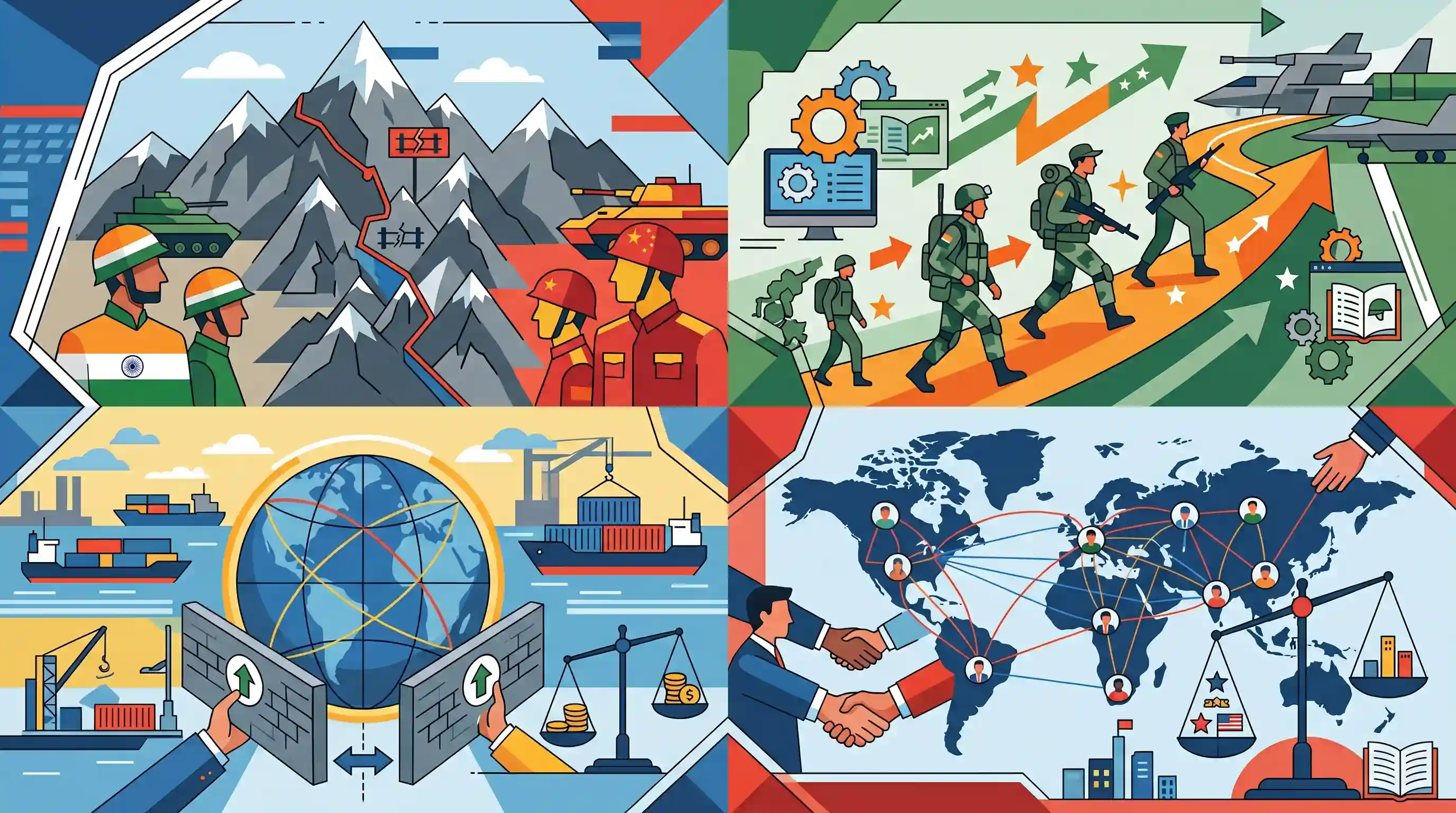
Rahul Gandhi launched a political attack on the Prime Minister, claiming he is "compromised" on critical national issues. The allegations stem from three primary points: revelations in former Army Chief Gen MM Naravane's memoir regarding the Agnipath scheme and India-China border management, a recent "tariff surrender" involving trade concessions amidst global protectionism, and rhetorical references to international leverage (invoking the Epstein scandal). This political discourse highlights significant underlying policy debates concerning India's defense recruitment reforms, territorial integrity at the LAC, and economic sovereignty in international trade negotiations.
Key Points
- Rahul Gandhi alleged the Prime Minister is "compromised," citing defense and trade policy decisions as evidence of yielding to external and internal pressures.
- The political attack referenced former Army Chief Gen MM Naravane's memoir, which allegedly raises concerns about the sudden implementation of the Agnipath scheme and the handling of the India-China border standoff.
- The opposition also criticized the government for a "tariff surrender," indicating yielding to international trade pressures (likely from the US) amid rising global protectionism.
- These allegations underscore the ongoing domestic political debate over national security transparency, military modernization, and strategic autonomy in economic diplomacy.
Important Terms
Agnipath Scheme

A military recruitment model where youth (Agniveers) serve a four-year tenure in the Indian Armed Forces, with 25% potentially retained for permanent service. It aims to lower the military's average age profile.
UPSC context
GS Paper 3: Security; tests understanding of defense reforms, manpower planning, and fiscal implications of pension bills.
Line of Actual Control (LAC)
The 3,488 km long de facto border between India and China, divided into Western (Ladakh), Middle (Himachal/Uttarakhand), and Eastern (Arunachal) sectors. It remains a site of frequent standoffs.
UPSC context
GS Paper 2: International Relations; crucial for questions on India-China relations, border management, and territorial integrity.
World Trade Organization (WTO)
An international body governing global trade rules. It promotes free trade through agreements like GATT and GATS, while handling dispute settlements between member nations.
UPSC context
GS Paper 3: Economy; tests knowledge of multilateral trade negotiations, subsidies (Amber/Blue/Green boxes), and India's trade policy.
Strategic Autonomy
The ability of a nation to pursue its national interests and adopt foreign policy choices without being constrained by other states or international pressures.
UPSC context
GS Paper 2: International Relations; core concept in India's non-alignment/multi-alignment strategy and independent decision-making in global crises.
Economic Sovereignty
A country's independent power to manage its economy, including control over trade, currency, and investment policies without external dictation. Highlights tensions between global trade deals and domestic interests.
UPSC context
GS Paper 3: Economy; relevant to debates on Free Trade Agreements (FTAs), protectionism, and the 'Aatmanirbhar Bharat' initiative.
Data Sovereignty
The right of a nation to exercise control over the collection, storage, and processing of data generated within its borders, ensuring it is governed by national laws.
UPSC context
GS Paper 3: Science and Tech/Economy; critical for understanding the Digital Personal Data Protection Act and global digital trade negotiations.
Prelims Trap
"Exiting Agniveers receive a pro-rata pension along with their lump-sum financial package."
Exiting Agniveers receive a tax-free 'Seva Nidhi' package of approximately ₹11.71 lakh, but are strictly ineligible for regular pensions, gratuity, or Ex-Servicemen Contributory Health Scheme benefits.
Static Concepts Connected
What are the core features of the Agnipath military recruitment scheme?
- Tenure & Retention: Personnel serve a 4-year short-term tenure across the Armed Forces, after which only a maximum of 25% are retained for a permanent commission.
- Financial Package: Exiting Agniveers receive a tax-free 'Seva Nidhi' package (approx. ₹11.71 lakh), comprising their own contributions plus matching government funds.
- Post-Service Benefits: Exiting soldiers do not receive pensions or gratuity, though several state police forces and Central Armed Police Forces (CAPFs) offer future recruitment quotas.
How do bilateral tariff negotiations operate under WTO rules?
- MFN Principle: Under the WTO's Most-Favored-Nation (MFN) rule, granting a tariff concession to one country normally requires extending it equally to all WTO members.
- Allowed Exceptions: Countries can bypass MFN constraints through formal Free Trade Agreements (FTAs) or by altering 'applied' tariff rates globally, provided they remain below committed 'bound rates'.
Cross-Topic Patterns
Agnipath and Defense Capital Procurement
Reducing the armed forces' escalating pension bills aims to free up the defense budget's capital expenditure for urgent modernization, indigenous defense manufacturing, and technology upgrades.
Bilateral Trade vs. WTO Multilateralism
Reciprocal tariff cuts with the US reflect India's tactical shift toward transactional 'mini-trade deals' outside the WTO framework, adapting to an era of rising global protectionism.

2026 prelims will likely test Agnipath specifics (Seva Nidhi, 25% quota) paired with the fiscal rationale for military modernization.
Linked PYQs · 3
Linked PYQs · 3
- 2025MainsGS3
What are the challenges before the Indian economy when the world is moving away from free trade and multilateralism to protectionism and bilateralism? How can these challenges be met?
- 2012MainsGS2
Do you think that China's emergence as one of the largest trading partners of India has adversely affected the settlement of the outstanding border problem?
- 2024MainsGS2
‘The West is fostering India as an alternative to reduce dependence on China's supply chain and as a strategic ally to counter China's political and economic dominance.’ Explain this statement with examples.
