Forest Rights Act Safeguards for PM Awas Housing
Source:Indian Express ↗
Why It Matters
This issue demonstrates the practical and legal challenges of harmonizing social justice initiatives (like rural housing for PVTGs) with environmental conservation laws. It provides crucial insights into the functional convergence of the Forest Rights Act and the Forest Conservation Act, making it highly relevant for questions on governance, tribal rights, and sustainable development.
Summary
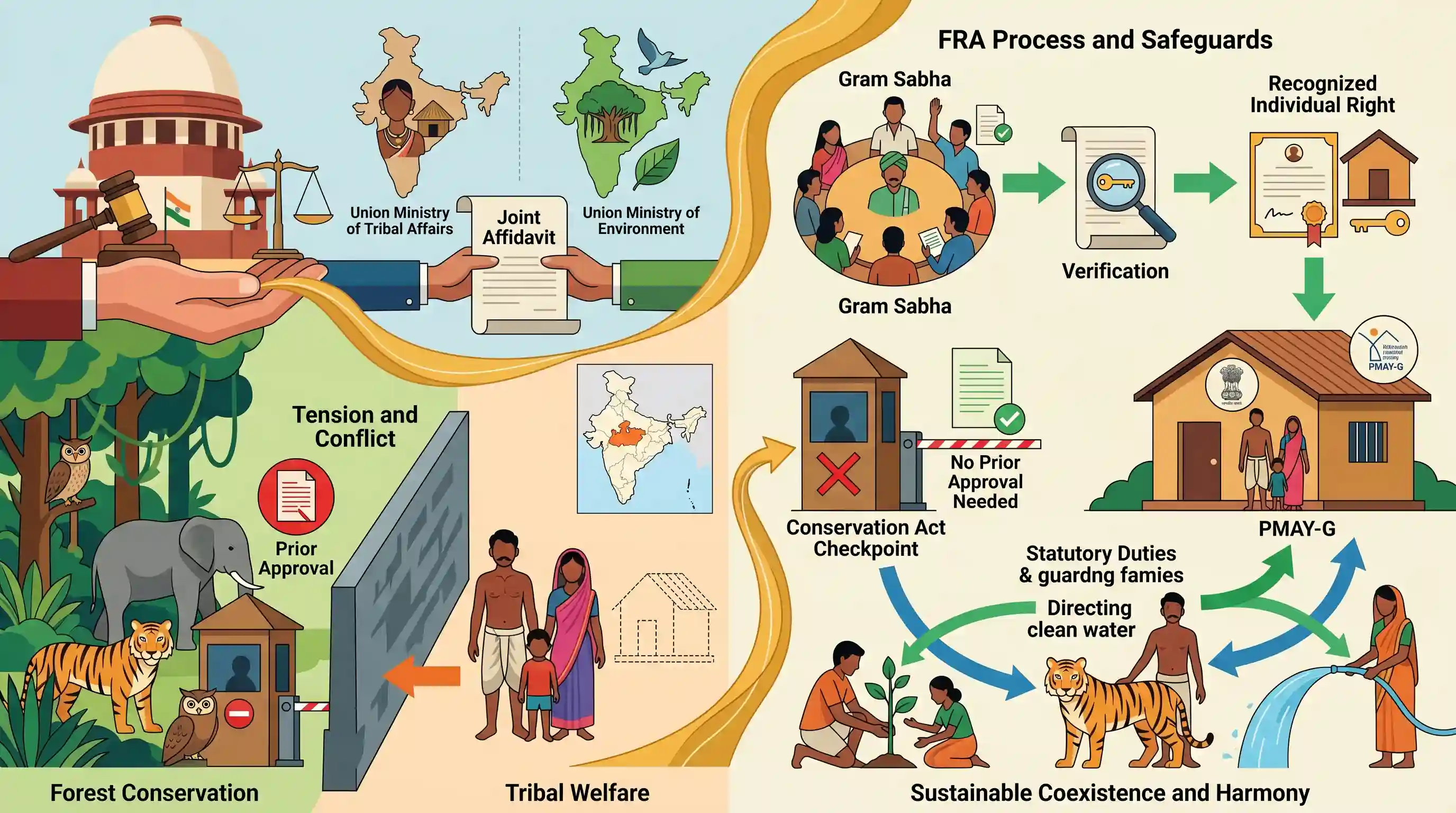
The Union Ministries of Tribal Affairs and Environment have filed a joint affidavit in the Supreme Court detailing safeguards under the Forest Rights Act (FRA), 2006, regarding the construction of houses on forest land under the Pradhan Mantri Awas Yojana-Gramin (PMAY-G). Arising from a dispute over housing for the vulnerable Sahariya tribe in Madhya Pradesh, the case highlights the tension between forest conservation and tribal welfare. The Centre asserted that once individual rights are recognized under the FRA, prior approval under the Forest (Conservation) Act is unnecessary. It also outlined strict FRA safeguards, including Gram Sabha-led verification and the statutory duties of rights-holders to protect biodiversity, arguing that the two laws must be interpreted harmoniously.
Key Points
- The Supreme Court is examining the convergence of the Forest Rights Act (FRA), 2006, and the Forest Conservation Act (FCA), 1980, concerning PMAY-G house constructions on forest land for the Sahariya tribe in Madhya Pradesh.
- The Centre submitted a joint affidavit from the Tribal Affairs and Environment Ministries emphasizing the harmonious interpretation of both laws to balance social justice with forest conservation.
- The Centre clarified that once individual forest rights are officially recognized under the FRA, prior approval under the FCA is not required for housing construction.
- Safeguards under the FRA include a three-tier verification process led by the Gram Sabha, mandatory on-site physical verification by forest and revenue officials, and non-transferability of titles.
- The FRA mandates corresponding duties on rights-holders and Gram Sabhas to protect wildlife, forests, and biodiversity, ensuring that tribal welfare does not compromise ecological integrity.
Important Terms
Forest Rights Act (FRA), 2006

A landmark 2006 law recognizing the land and resource rights of forest-dwelling Scheduled Tribes and other traditional dwellers to correct historical injustices in forest governance.
UPSC context
GS Paper II & III: Evaluates the conflict between tribal livelihood rights and environmental conservation policies.
Van (Sanrakshan Evam Samvardhan) Adhiniyam, 1980
The renamed 1980 Act that regulates the diversion of forest land for non-forest purposes, requiring central approval and ensuring compensatory afforestation.
UPSC context
GS Paper III: Tests knowledge of the regulatory framework for environmental clearances and sustainable development.
Pradhan Mantri Awas Yojana-Gramin (PMAY-G)
A flagship centrally sponsored scheme providing financial assistance to rural poor for constructing permanent (pucca) houses with basic amenities like water and sanitation.
UPSC context
GS Paper II: Focuses on welfare schemes for vulnerable sections and 'Housing for All' targets.
Gram Sabha
The statutory village assembly empowered under FRA to initiate the process of determining individual and community forest rights through claim verification.
UPSC context
GS Paper II: Essential for questions on decentralized governance, PESA Act, and grassroots democracy in tribal areas.
Sahariya Tribe
A Particularly Vulnerable Tribal Group (PVTG) primarily located in Madhya Pradesh and Rajasthan, characterized by extreme poverty, malnutrition, and landlessness.
UPSC context
GS Paper II: Relevant to tribal welfare, PVTG-specific schemes (PM-JANMAN), and socio-economic challenges of marginalized groups.
Prelims Trap
"Construction of PMAY-G houses on forest land strictly requires prior clearance under the Forest Conservation Act."
Once Individual Forest Rights (IFR) are formally recognized under the FRA, prior approval under the FCA is legally bypassed for basic amenities.
Static Concepts Connected
What is the statutory role of the Gram Sabha under the FRA, 2006?
- Initiation: Designated as the absolute authority to initiate the process for determining the extent of Individual and Community Forest Rights.
- Statutory Duties: Empowered and obligated under Section 5 to protect wildlife, biodiversity, and adjoining catchments from destructive practices.
- Verification: Conducts the mandatory primary verification of tribal claims before they advance to Sub-Divisional and District Level Committees.
What defines a Particularly Vulnerable Tribal Group (PVTG)?
- Core Criteria: Characterized by pre-agricultural technology, a stagnant or declining population, extremely low literacy, and a subsistence-level economy.
- Demographics: 75 groups are officially categorized as PVTGs out of 705 Scheduled Tribes, with Odisha housing the highest number.
- Sahariya Tribe: A designated PVTG primarily found in the Gwalior and Chambal divisions of Madhya Pradesh and parts of Rajasthan.
Cross-Topic Patterns
PM-JANMAN & Forest Clearance Convergence
The PM-JANMAN scheme aggressively targets PVTG housing. This SC affidavit provides the legal mechanism to bypass FCA clearance bottlenecks, accelerating infrastructure delivery to vulnerable tribes.
Statutory Duties of Rights-holders
UPSC frequently tests fundamental duties. The FRA explicitly imposes statutory conservation duties on Gram Sabhas alongside forest rights, perfectly blending ecological conservation with grassroots polity.

Expect a 2026 multi-statement question merging FRA Gram Sabha duties, MoTA's nodal role, and FCA clearance exemptions for PVTG housing.
Linked PYQs · 3
Linked PYQs · 3
- 2013PrelimsGS1
Under the Scheduled Tribes and Other Traditional Forest Dwellers (Recognition of Forest Rights) Act, 2006, who shall be the authority to initiate the process for determining the nature and extent of individual or community forest rights or both?
- 2021PrelimsGS1
At the national level, which ministry is the nodal agency to ensure effective implementation of the Scheduled Tribes and Other Traditional Forest Dwellers (Recognition of Forest Rights) Act, 2006?
- 2018PrelimsGS1
Consider the following statements: 1. The definition of "Critical Wildlife Habitat" is incorporated in the Forest Rights Act, 2006. 2. For the first time in India, Baigas have been given Habitat Rights. 3. Union Ministry of Environment, Forest and Climate Change officially decides and declares Habitat Rights for Primitive and Vulnerable Tribal Groups in any part of India. Which of the statements given above is/are correct?
