PM urges secretaries to focus on ease of living and self-reliance
Source:The Hindu ↗
Why It Matters
Provides crucial insights into the evolving administrative priorities of the Union government, highlighting structural governance reforms, the push for a whole-of-government approach, and the central role of the PM GatiShakti initiative in national infrastructure planning. Important for answers on institutional mechanisms, civil services, and economic growth strategies.
Summary
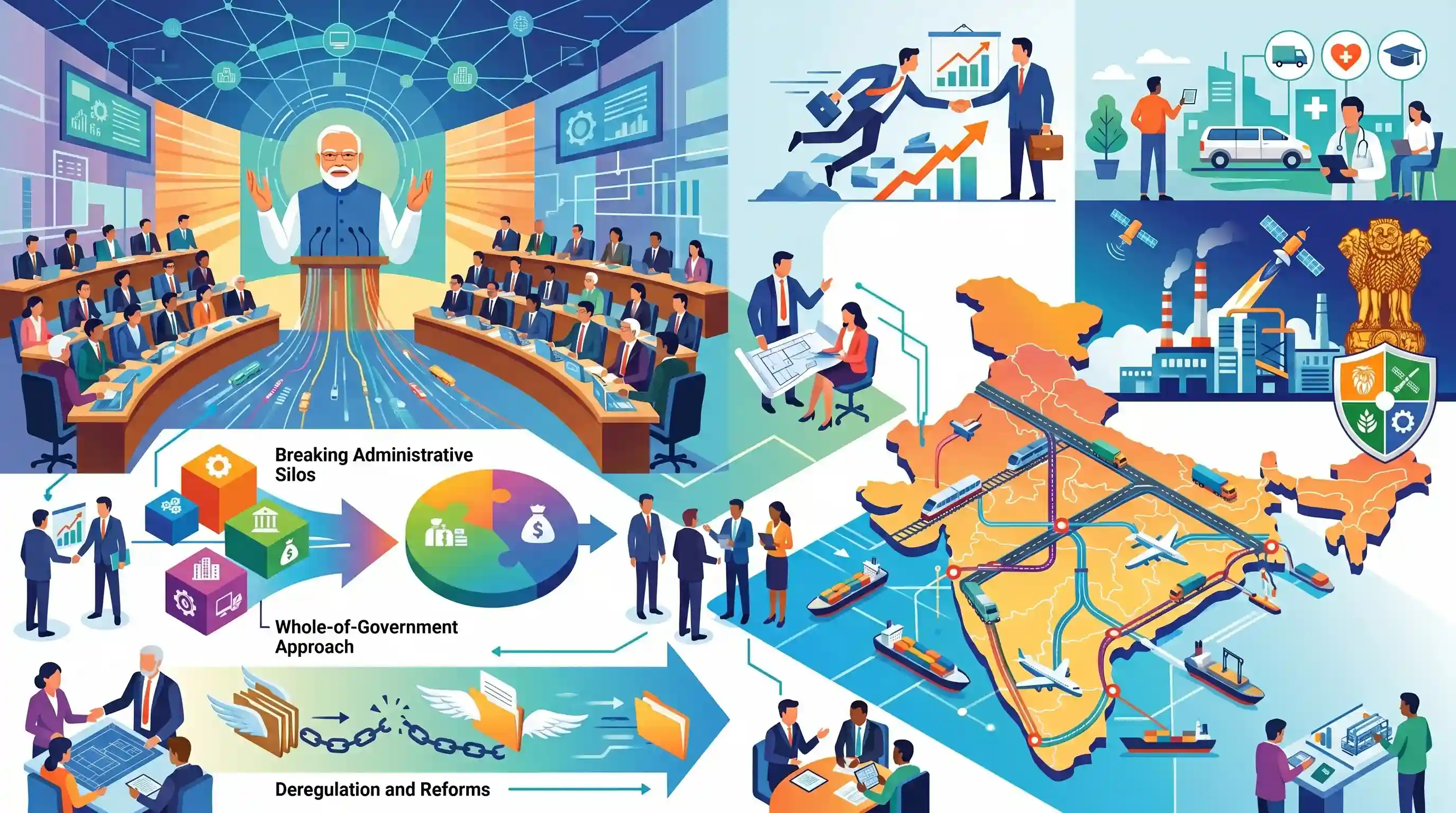
Prime Minister Narendra Modi recently addressed nearly 80 Union Secretaries, emphasizing the critical need for a "whole-of-government" approach to break administrative silos and improve inter-departmental coordination. Central to his message were the themes of enhancing the "ease of doing business," improving the "ease of living," and achieving "Atmanirbharta" (self-reliance) through sustained deregulation and targeted reforms. A major focal point of the meeting was the wider utilization of the PM GatiShakti National Master Plan to facilitate holistic infrastructure planning and integrated multi-modal connectivity. During the session, Secretaries outlined future strategies and ongoing reform progress aimed at translating this macro vision into tangible governance and service delivery outcomes for the public.
Key Points
- PM Modi directed Union Secretaries to adopt a whole-of-government approach to eliminate departmental silos and foster inter-ministerial coordination.
- The administration\'s policy priorities remain centered on three core pillars: ease of doing business, ease of living, and Atmanirbharta (self-reliance).
- The PM GatiShakti National Master Plan was highlighted as a crucial technological and planning platform for holistic infrastructure development and multi-modal connectivity.
- Secretaries presented updates on deregulation, sectoral reform measures, and future strategies aimed at translating the Prime Minister\'s vision into tangible public service delivery outcomes.
Important Terms
PM GatiShakti National Master Plan

A GIS-based digital platform launched in 2021 to integrate infrastructure planning across 16+ ministries, ensuring multi-modal connectivity and reducing logistics costs through data-driven coordination.
UPSC context
GS III: Infrastructure/Logistics. Tests knowledge of integrated infrastructure planning, multi-modal transport, and cost-efficiency in economic growth.
Whole-of-Government Approach
A collaborative governance model where multiple departments coordinate horizontally and vertically to address complex challenges, breaking administrative silos to deliver integrated public services.
UPSC context
GS II: Governance. Important for understanding administrative reforms, inter-departmental synergy, and the evolution of citizen-centric service delivery.
Atmanirbharta (Self-Reliance)
India's national vision for self-reliance, focusing on domestic manufacturing, reducing import dependency, and global economic integration through five pillars: Economy, Infrastructure, Systems, Demography, and Demand.
UPSC context
GS III: Indian Economy. Relevant for questions on industrial policy, manufacturing (PLI schemes), and self-sufficiency in strategic sectors.
Ease of Doing Business
A measure of the simplicity and efficiency of the regulatory environment for businesses to start, operate, and exit, focusing on reducing compliance burdens and transaction costs.
UPSC context
GS III: Economic Development. Tests awareness of regulatory reforms, investment climate, and India's transition to global benchmarks like 'Business Ready'.
Ease of Living
An assessment tool and policy goal aimed at improving the quality of life for citizens by enhancing service delivery, safety, and sustainable urban development.
UPSC context
GS II: Governance/Social Justice. Evaluates understanding of citizen-centric governance and metrics used to judge the impact of urban reforms.
Administrative Silos
A governance challenge where departments work in isolation without coordination, often resulting in duplicated efforts, communication gaps, and delays in project execution.
UPSC context
GS II: Governance. Tests ability to identify bureaucratic bottlenecks and explain the need for institutional mechanisms that foster coordination.
Prelims Trap
"PM GatiShakti is an umbrella scheme providing direct capital funding for new highway and railway projects."
PM GatiShakti is purely a GIS-based digital platform for synchronized planning among ministries, not a funding vehicle or financial allocation scheme.
Static Concepts Connected
What are the core institutional components of the PM GatiShakti framework?
- EGoS: The Empowered Group of Secretaries acts as the apex decision-making body to review, monitor, and amend the master plan's implementation.
- Network Planning Group: Comprises heads of network planning divisions from infrastructure ministries to ensure integrated multi-modal project design and avoid administrative duplication.
- TSU: A Technical Support Unit provides domain expertise in various transport and logistics sectors to evaluate complex infrastructural project viabilities.
How does India administratively execute and measure Ease of Doing Business?
- BRAP Framework: The Business Reforms Action Plan (BRAP) ranks Indian states and UTs based on their successful implementation of designated regulatory reform parameters.
- Decriminalization: Legislative tools like the Jan Vishwas Act reduce administrative compliance burdens by decriminalizing minor, procedural business offenses.
- Single Window Systems: The National Single Window System (NSWS) acts as a unified digital portal for domestic and foreign investors to obtain necessary regulatory approvals.
Cross-Topic Patterns
GatiShakti + National Logistics Policy
GatiShakti provides the structural GIS mapping (hardware), while the National Logistics Policy streamlines administrative processes (software) to collectively reduce India's logistics costs to 8% of GDP.
Governance + Digital Public Infrastructure
GatiShakti’s Unified Logistics Interface Platform (ULIP) highlights how India leverages open digital network architectures to break inter-departmental silos and ensure data-driven, cross-sectoral decision making.

A 2026 prelims question will likely test the functional difference between PM GatiShakti (GIS planning) and the NIP (capital funding).
Linked PYQs · 3
Linked PYQs · 3
- 2024MainsGS2
e-governance is not just about the routine application of digital technology in service delivery process. It is as much about multifarious interactions for ensuring transparency and accountability. In this context evaluate the role of the 'Interactive Service Model' of e-governance.
- 2021MainsGS3
“Investment in infrastructure is essential for more rapid and inclusive economic growth.” Discuss in the light of India's experience.
- 2016PrelimsGS1
India's ranking in the 'Ease of Doing Business Index' is sometimes seen in the news. Which of the following has declared that ranking?
