Supreme Court Pleas Allege Illegal Police Detentions
Source:The Hindu ↗
આ શા માટે મહત્વનું છે
The article provides concrete current affairs examples of alleged violations of constitutional safeguards regarding arrests. It brings up the application of the newly enacted BNSS, 2023, alongside foundational principles like Article 21, Article 22, and the historic D.K. Basu guidelines. This is crucial for GS2 questions on human rights, police reforms, constitutional protections, and the evolving criminal justice framework.
સારાંશ
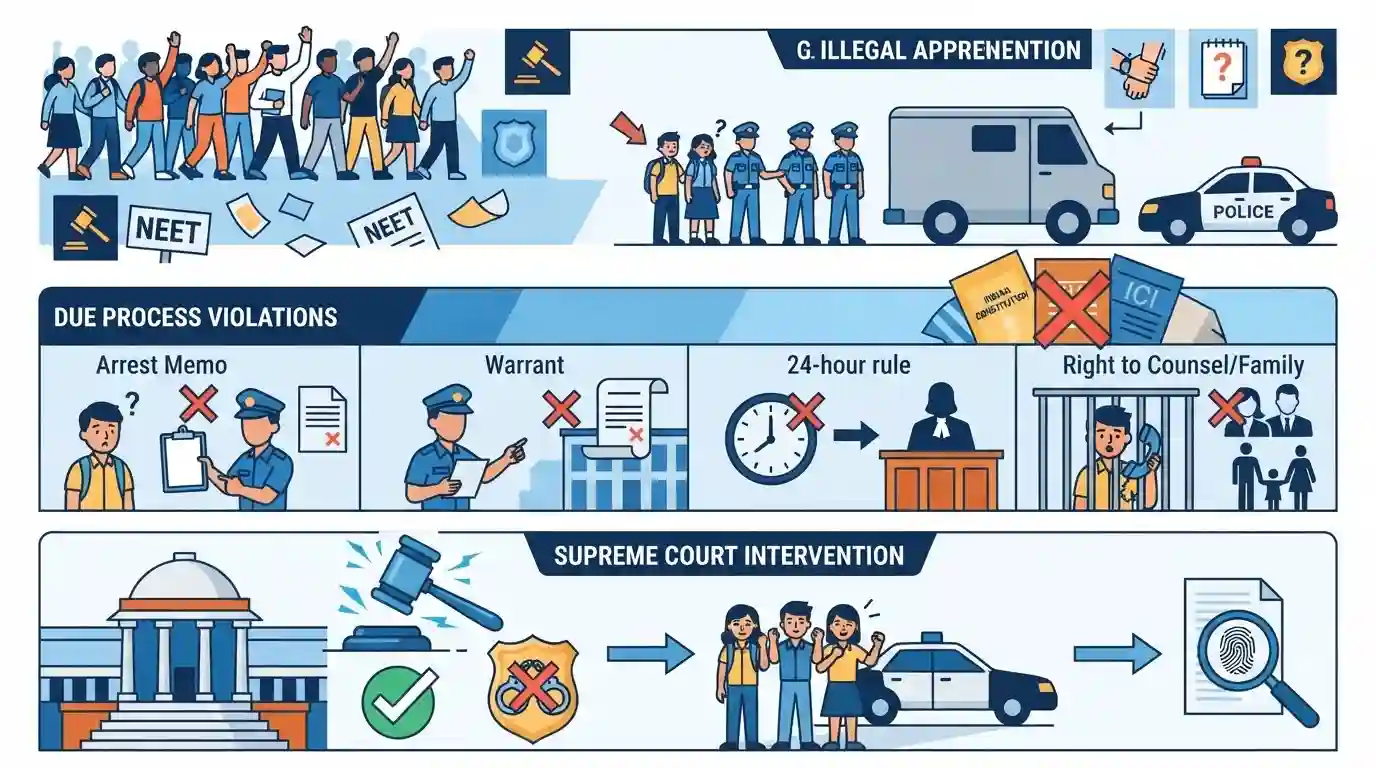
Petitions in the Supreme Court have highlighted alleged illegal detentions of students and volunteers by the Delhi and Bihar Police during protests against exam paper leaks (such as NEET). Detainees were reportedly picked up in unmarked vehicles, questioned without official records, and jailed without arrest warrants, memos of arrest, or production before a magistrate within 24 hours. These instances are claimed to be blatant violations of fundamental rights under Article 21 (Right to Life and Personal Liberty) and Article 22(1) (Protection against arbitrary arrest), as well as Section 47 of the Bharatiya Nagarik Suraksha Sanhita (BNSS), 2023, and the D.K. Basu guidelines. In response, the Supreme Court has restrained authorities from taking coercive action against protesting students lacking criminal antecedents, though it permitted the investigation into the registered FIRs to continue.
મુખ્ય મુદ્દા
- Petitions filed in the Supreme Court allege that Delhi and Bihar Police illegally detained students protesting against exam paper leaks.
- Alleged violations include detention in unmarked vehicles, absence of arrest warrants, failure to prepare arrest memos, and failing to produce detainees before a magistrate within 24 hours.
- These actions are alleged to violate Article 21 (Personal Liberty), Article 22(1) (Protection against arbitrary arrest), Section 47 of the new BNSS, 2023, and the D.K. Basu guidelines on arrests.
- The Supreme Court has allowed the police to continue investigating the FIRs but barred coercive actions against protesting students unless they have criminal antecedents.
મહત્વપૂર્ણ શબ્દો
Article 21

A fundamental right in the Constitution of India guaranteeing that no person shall be deprived of their life or personal liberty except according to procedure established by law.
UPSC context
GS Paper II (Polity & Governance). Vital for understanding civil liberties, judicial activism, and basic structure doctrine.
Article 22(1)
A constitutional fundamental right that protects arrested individuals by mandating they be informed of the grounds for their arrest and granted the right to consult and be defended by a legal practitioner.
UPSC context
GS Paper II (Polity). Crucial for questions on criminal jurisprudence, preventive detention, and police reforms.
Bharatiya Nagarik Suraksha Sanhita, 2023 (BNSS)
The primary legislation in India governing criminal procedure, which replaced the Code of Criminal Procedure (CrPC), 1973, to modernise and streamline the criminal justice administration.
UPSC context
GS Paper II (Criminal Justice Reform). Important for understanding the shift in India's legal architecture and procedural safeguards.
D.K. Basu guidelines
A set of eleven mandatory guidelines laid down by the Supreme Court of India in 1997 to prevent custodial torture and protect the rights of individuals during arrest and detention.
UPSC context
GS Paper II (Polity & Human Rights). Essential for topics on police accountability, judicial activism, and human rights protection.
પ્રિલિમ્સ ટ્રેપ
"Article 22 guarantees every arrested person the right to be produced before a magistrate within 24 hours."
False. Article 22(3) explicitly denies the 24-hour production right and the right to be informed of grounds to enemy aliens and individuals arrested under preventive detention laws.
સંલગ્ન સ્થિર ખ્યાલો
What protections does Article 22 offer for punitive detention?
- Grounds of arrest: The arrested individual must be informed as soon as possible about the specific reasons and factual acts leading to the arrest.
- Legal defense: The arrested person has the fundamental right to consult and be defended by a legal practitioner of their choice.
- 24-hour rule: The person must be produced before the nearest magistrate within 24 hours of arrest, strictly excluding the time required for travel.
What are the core mandates of the D.K. Basu guidelines?
- Identification: Police personnel carrying out the arrest must wear accurate, visible, and clear identification and name tags with their designations.
- Arrest Memo: An arrest memo must be prepared at the time of arrest and attested by at least one witness (a family member or local respectable person).
- Informing relatives: A friend, relative, or well-wisher must be notified as soon as possible about the arrest and the specific location of detention.
આંતર-વિષય પેટર્ન
BNSS Implementation + Constitutional Rights
The transition from CrPC Section 50 to BNSS Section 47 elevates statutory arrest procedures, heavily testing the overlap between new criminal codes and Article 22.
Habeas Corpus + Police Custody Lapses
Alleged detentions without arrest memos immediately trigger the writ of Habeas Corpus, directly linking ground-level police procedural lapses to Article 32/226 constitutional remedies.

Expect a 2026 Prelims question mixing Article 22 constitutional safeguards with the new BNSS statutory provisions for arrest without warrant.
સંલગ્ન PYQ · 4
સંલગ્ન PYQ · 4
- 2023PrelimsGS1
Consider the following statements: 1. According to the Constitution of India, the Central Government has a duty to protect States from internal disturbances. 2. The Constitution of India exempts the States from providing legal counsel to a person being held for preventive detention. 3. According to the Prevention of Terrorism Act, 2002, confession of the accused before the police cannot be used as evidence. How many of the above statements are correct?
- 2021PrelimsGS1
With reference to India, consider the following statements : 1. Judicial custody means an accused is in the custody of the concerned magistrate and such accused is locked up in police station, not in jail. 2. During judicial custody, the police officer in charge of the case is not allowed to interrogate the suspect without the approval of the court. Which of the statements given above is/are correct?
- 2024MainsGS2
Right to privacy is intrinsic to life and personal liberty and is inherently protected under Article 21 of the constitution. Explain. In this reference discuss the law relating to D.N.A. testing of child in the womb to establish its paternity.
- 2020MainsGS2
Judicial Legislation is antithetical to the doctrine of separation of powers as envisaged in the Indian Constitution. In this context justify the filing of large number of public interest petitions praying for issuing guidelines to executive authorities.
