Kodaikanal Berijam Lake Tiger Reserve Proposal and Census
Source:The Hindu ↗
Why It Matters
Understanding the statutory process for declaring Tiger Reserves and the ecological importance of keystone species is vital for UPSC aspirants. The tension between tourism and conservation in ecologically sensitive zones like the Western Ghats is a recurring theme in both Prelims and Mains (Environment and Ecology).
Summary
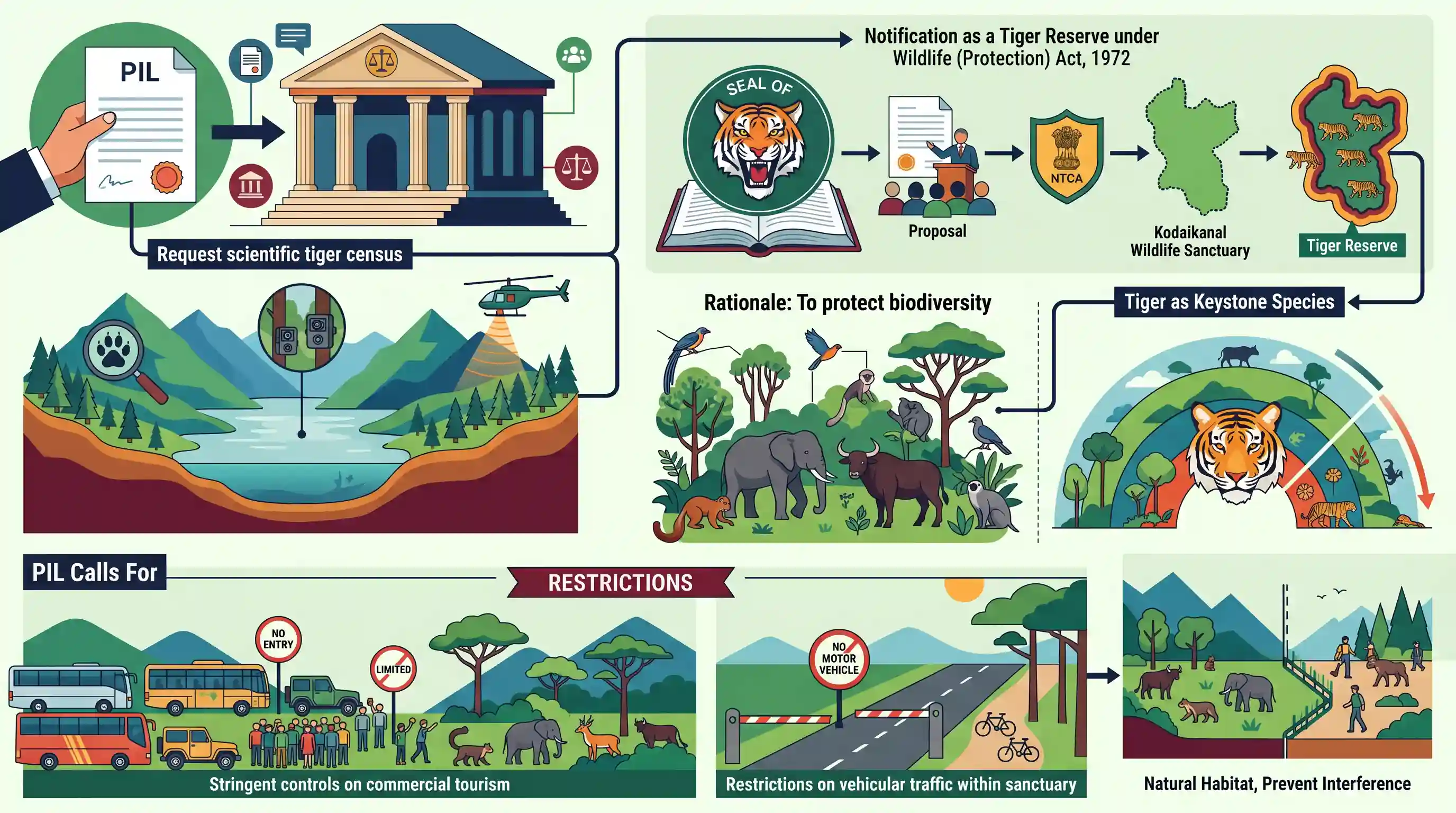
A Public Interest Litigation (PIL) filed in the Madurai Bench of the Madras High Court has requested a scientific tiger census in the Berijam Lake area of Kodaikanal. The petition seeks to recommend the area for notification as a Tiger Reserve under the Wildlife (Protection) Act, 1972, to protect the region's biodiversity. Highlighting the tiger's role as a keystone species, the plea also calls for stringent restrictions on commercial tourism and vehicular traffic within the Kodaikanal Wildlife Sanctuary to prevent human interference in the natural habitat.
Key Points
- A public interest litigation (PIL) in the Madras High Court seeks a scientific tiger census in the Berijam Lake area of the Kodaikanal Wildlife Sanctuary.
- The petitioner urges notifying the area as a Tiger Reserve under Section 38V of the Wildlife (Protection) Act, 1972, following recent tiger sightings.
- The petition emphasizes that protecting the tiger, a keystone species, ensures the conservation of the entire ecosystem and food web.
- There is a strong demand to restrict commercial tourism and vehicular movement in the area to minimize human intervention and protect the habitat.
Important Terms
Wildlife (Protection) Act, 1972

India's primary legal framework for protecting plant and animal species, providing for the establishment of National Parks, Sanctuaries, and Tiger Reserves.
UPSC context
GS III (Environment); tests knowledge of legal protections, species schedules, and protected area notification (Section 38V).
National Tiger Conservation Authority (NTCA)
A statutory body under the Environment Ministry established to strengthen tiger conservation and oversee the management of Tiger Reserves across India.
UPSC context
GS III (Environment); tests knowledge of statutory bodies and specialized conservation efforts for flagship species.
Tiger Reserve
An area notified under Section 38V of the WPA, 1972, comprising core and buffer zones aimed at ensuring viable tiger populations.
UPSC context
GS III (Biodiversity); tests understanding of the notification process, management plans, and land-use restrictions.
Keystone Species
A species whose impact on its ecosystem is disproportionately large relative to its abundance, maintaining the structure and diversity of the habitat.
UPSC context
GS III/Prelims (Ecology); tests fundamental ecological concepts and the rationale behind species-specific conservation programs.
Public Interest Litigation (PIL)
A legal tool allowing citizens to approach the judiciary for the protection of public interest, such as environmental conservation or human rights.
UPSC context
GS II (Polity); tests judicial activism and the judiciary's role in enforcing environmental governance.
Kodaikanal Wildlife Sanctuary
A protected area in Tamil Nadu's Palani Hills characterized by high-altitude shola-grassland ecosystems and serving as a critical wildlife corridor.
UPSC context
GS III (Environment/Geography); tests knowledge of Western Ghats biodiversity hotspots and regional conservation challenges.
Shola Forests
Dwarf tropical montane forests found in high-altitude valleys of South India, often interspersed with montane grasslands.
UPSC context
GS III/Prelims (Geography); tests knowledge of endemic vegetation types and their ecological significance in the Western Ghats.
Prelims Trap
Tiger Reserves are legally notified by the Central Government on the recommendation of the National Tiger Conservation Authority.
Under Section 38V of the Wildlife (Protection) Act, 1972, it is the State Government (not the Central Government) that notifies a Tiger Reserve.
Static Concepts Connected
How is a Tiger Reserve legally notified under the Wildlife (Protection) Act, 1972?
- Notifying Authority: Notified by the State Government under Section 38V of the WPA, 1972, acting purely on the statutory recommendation of the NTCA.
- Core Zone: Known as Critical Tiger Habitat (CTH), this zone is kept inviolate and requires National Park or Wildlife Sanctuary status.
- Buffer Zone: The peripheral area aiming to ensure habitat integrity, where regulated coexistence, ecotourism, and resource use by local communities are permitted.
What distinguishes Critical Tiger Habitat (CTH) from Critical Wildlife Habitat (CWH)?
- Legal Origin: CTH is defined exclusively under the Wildlife (Protection) Act, 1972, whereas CWH is strictly defined under the Forest Rights Act (FRA), 2006.
- Scope and Consent: CTH focuses solely on tigers. CWH covers broader wildlife and explicitly requires the consent of Gram Sabhas before forest dwellers' rights can be modified or resettled.
Cross-Topic Patterns
Judicial intervention in carrying capacity
PILs pushing for ecotourism curbs in the Western Ghats mirror recent Supreme Court directives demanding States to assess the 'carrying capacity' of ecologically fragile hill stations and protected areas.
Palani Hills & Shola ecosystems
Berijam lake is situated in the Palani Hills, a region known for its high-altitude Shola-grassland ecosystems that frequently appear in Prelims regarding endemic species and invasive wattle/eucalyptus threats.

Expect a 2026 Prelims question testing the distinct legal origins of Critical Tiger Habitat (WPA) vs Critical Wildlife Habitat (FRA).
Linked PYQs · 3
Linked PYQs · 3
- 2022PrelimsGS1
With reference to Indian laws about wildlife protection, consider the following statements : 1. Wild animals are the sole property of the government. 2. When a wild animal is declared protected, such animal is entitled for equal protection whether it is found in protected areas or outside. 3. Apprehension of a protected wild animal becoming a danger to human life is sufficient ground for its capture or killing. Which of the statements given above is/are correct?
- 2017PrelimsGS1
From the ecological point of view, which one of the following assumes importance in being a good link between the Eastern Ghats and the Western Ghats?
- 2023PrelimsGS1
Consider the following statements: Once the Central Government notifies an area as a 'Community Reserve' 1. the Chief Wildlife Warden of the State becomes the governing authority of such forest 2. hunting is not allowed in such area 3. people of such area are allowed to collect non-timber forest produce 4. people of such area are allowed traditional agricultural practices How many of the above statements are correct?
