Supreme Court Seeks Centre Reply on BNS Sedition Provision Plea
Source:The Hindu ↗
Why It Matters
The transition from colonial-era criminal laws (IPC) to the Bharatiya Nyaya Sanhita is a major development in Indian governance. Assessing whether these new laws genuinely protect democratic dissent or merely rebrand oppressive measures like sedition is crucial for UPSC aspirants studying the balance between national security and Fundamental Rights (Article 19(1)(a)).
Summary
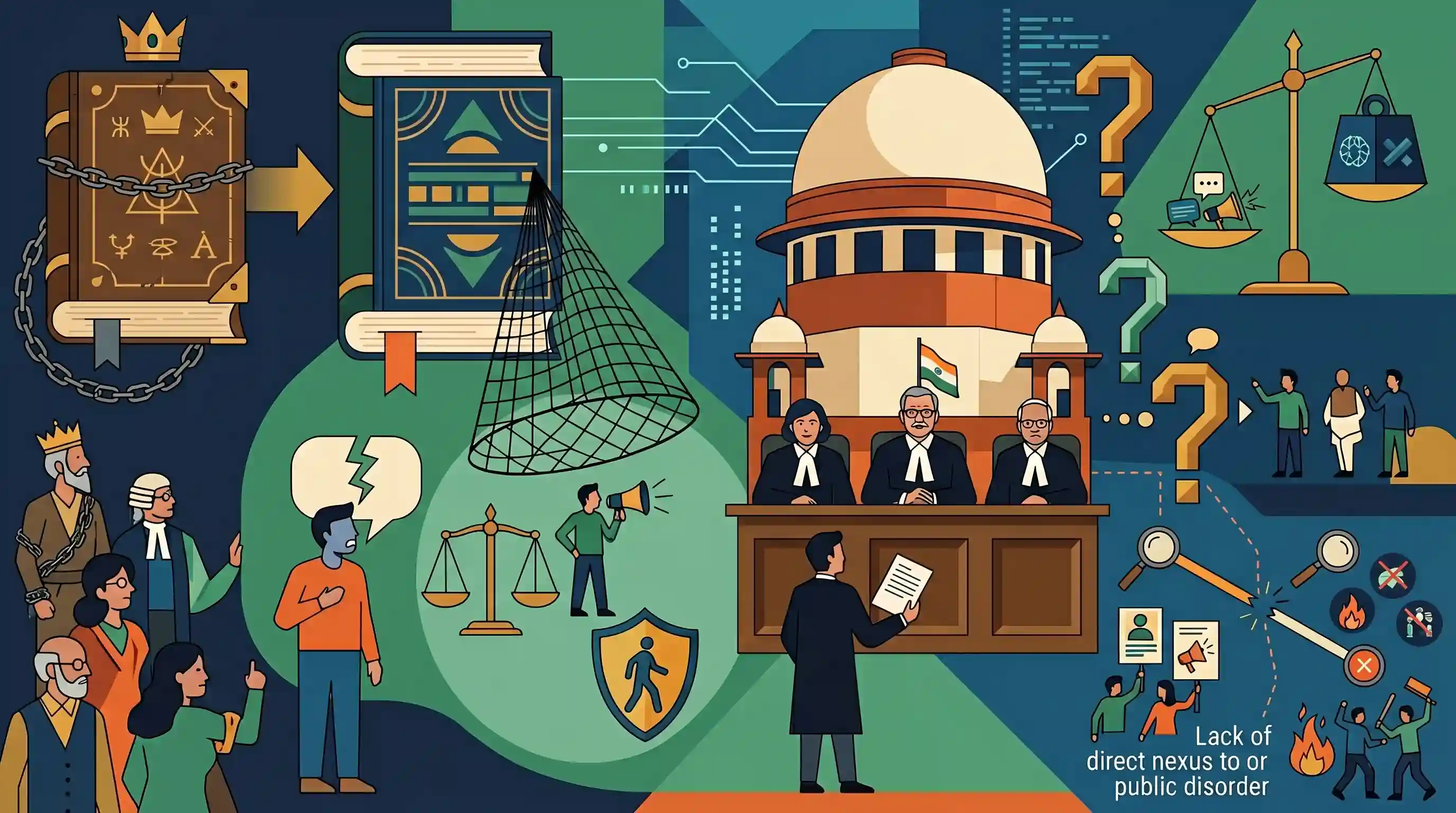
A petition in the Supreme Court challenges Section 152 of the newly enacted Bharatiya Nyaya Sanhita (BNS), describing it as a repackaged version of the colonial-era sedition law (Section 124A of the IPC). The plea argues that the new law retains overly broad and vague language, creating a 'chilling effect' on free speech and violating fundamental rights under Articles 14, 19, and 21. A three-judge bench led by the Chief Justice of India has sought a response from the Centre regarding concerns that the law fails the test of 'reasonable restrictions' by lacking a direct nexus to public disorder.
Key Points
- The Supreme Court has sought the Centre's response on a plea challenging Section 152 of the Bharatiya Nyaya Sanhita (BNS), arguing it is a repackaging of the colonial-era sedition law (Section 124A of the IPC).
- Petitioners contend that Section 152 uses sweeping and vague phrases—such as 'subversive activity' and 'encouragement of separatist feelings'—which violate fundamental rights under Articles 14, 19(1)(a), and 21.
- The plea highlights that the provision imposes disproportionate punishment and creates a 'chilling effect' on free speech without requiring a proximate nexus to public disorder.
- Despite a May 2022 SC order keeping the IPC sedition law in abeyance, critics argue the new BNS (implemented in July 2024) continues the same oppressive substantive framework under the guise of decolonising the criminal justice system.
Important Terms
Bharatiya Nyaya Sanhita (BNS), 2023

The primary penal code of India, enacted in 2023 to replace the colonial-era Indian Penal Code (IPC) as part of a major criminal justice overhaul.
UPSC context
GS Paper II (Governance). Crucial for questions on legal reforms and the decolonization of India's statutes.
Section 152 of BNS
A BNS provision penalizing acts endangering India's sovereignty, unity, and integrity; it is widely debated for being a modernized, potentially broader version of the repealed sedition law.
UPSC context
GS Paper II (Polity). Tests the balance between national security and constitutional rights like freedom of expression.
Section 124A of the IPC
The colonial-era provision that criminalized 'sedition' or inciting disaffection toward the government; it was suspended by the Supreme Court in 2022 and eventually repealed by BNS.
UPSC context
GS Paper II. Relevant for historical legal context and the evolution of speech-related laws in India.
Chilling Effect
A legal phenomenon where vague or overbroad laws deter citizens from exercising their fundamental rights (like free speech) due to fear of prosecution or legal harassment.
UPSC context
GS Paper II (Fundamental Rights). A key judicial concept used to challenge the constitutionality of restrictive laws.
Reasonable Restrictions
Constitutional limits on free speech under Article 19(2) based on grounds like public order and national security; they must be proportional and not arbitrary.
UPSC context
GS Paper II. A core doctrine used by the judiciary to assess the validity of state-imposed curbs.
Article 19(1)(a)
The fundamental right in the Indian Constitution guaranteeing freedom of speech and expression, which is the cornerstone of democratic dissent and government accountability.
UPSC context
GS Paper II. Essential for topics concerning civil liberties and the Bill of Rights.
Prelims Trap
"The Bharatiya Nyaya Sanhita (BNS) explicitly defines and penalizes the offence of 'sedition' under Section 152."
The BNS entirely drops the word "sedition". Section 152 penalizes acts endangering India's sovereignty, unity, and integrity, abandoning the colonial standard of punishing "disaffection against the Government".
Static Concepts Connected
What are the constitutional grounds for restricting Free Speech under Article 19(2)?
- Sovereignty & Security: Restrictions can be imposed to protect the sovereignty and integrity of India, as well as the security of the State.
- Public Order: Speech inciting violence or disrupting public order is restricted. This is the crucial threshold test for subversion/sedition laws.
- Other Grounds: Other grounds include friendly relations with foreign states, decency, morality, defamation, and contempt of court.
What was the Supreme Court's legal threshold for sedition in Kedar Nath Singh (1962)?
- Constitutional Validity: The Court upheld IPC Section 124A (sedition) as constitutionally valid under Article 19(2) restrictions.
- Public Disorder Nexus: It ruled that sedition charges apply only if the speech has a direct tendency to incite violence or create public disorder.
- Government Criticism: Strong words expressing disapprobation of government actions without inciting violence do not constitute sedition.
Cross-Topic Patterns
UAPA vs. BNS Subversion Overlap
Sweeping terms like "subversive activity" in BNS 152 blur the lines between standard criminal law and specialized anti-terror legislation (UAPA), raising concerns about arbitrary state application.
Decolonisation of Criminal Laws
Links to the GS2 governance theme of whether replacing IPC/CrPC with BNS/BNSS genuinely shifts the colonial state-citizen power dynamic or merely repackages coercive state powers.

Expect a 2026 Prelims question testing the exact definitional shift from 'disaffection' (IPC 124A) to 'subversive acts' in BNS 152.
Linked PYQs · 2
Linked PYQs · 2
- 2014MainsGS2
What do you understand by the concept "freedom of speech and expression"? Does it cover hate speech also ? Why do the films in India stand on a slightly different plane from other forms of expression ? Discuss.
- 2022MainsGS2
“Right of movement and residence throughout the territory of India are freely available to the Indian citizens, but these rights are not absolute.” Comment.
