Supreme Court Review Limits on SHANTI Act Nuclear Liability Capping
Source:Indian Express ↗
Why It Matters
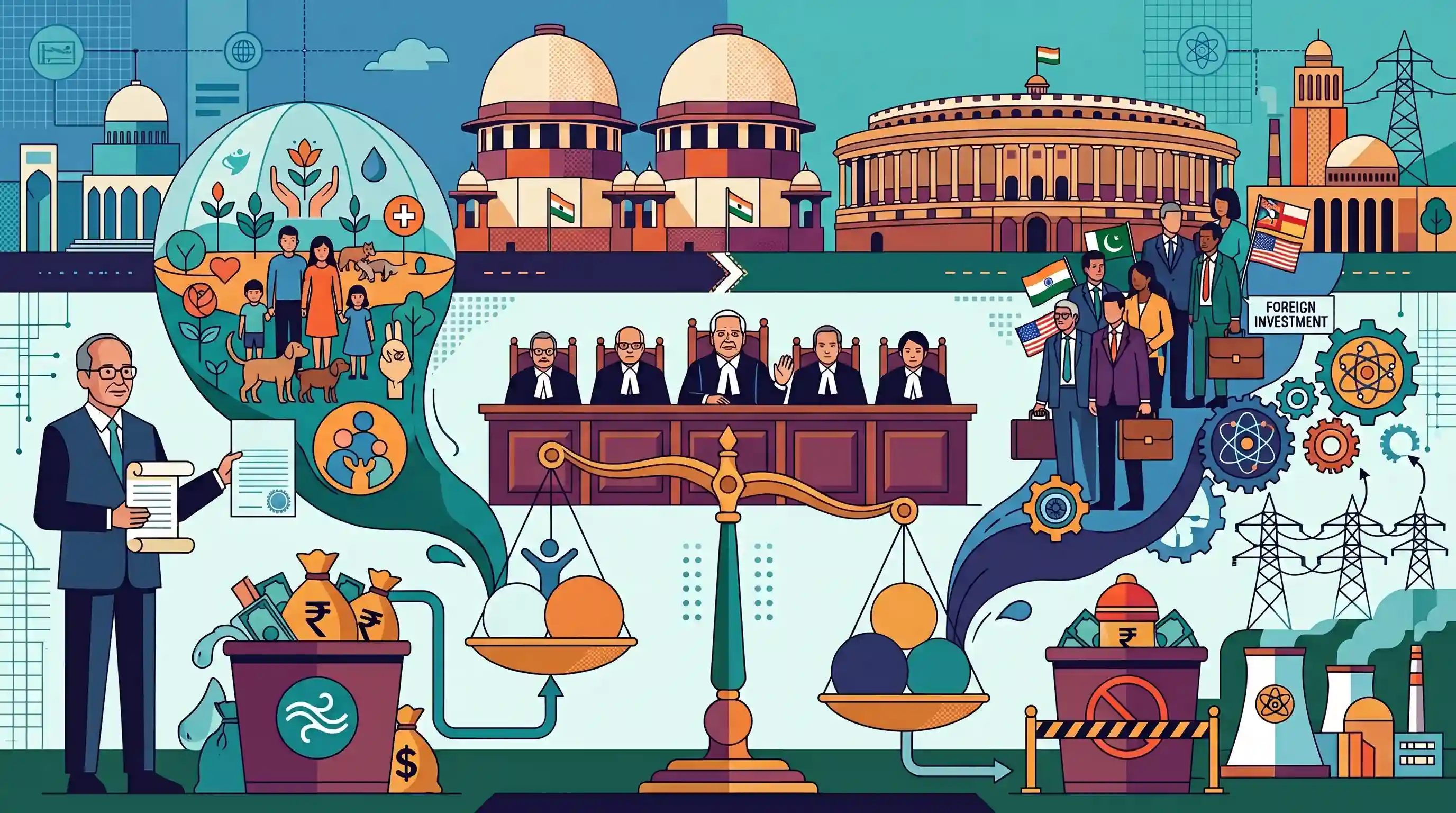
The case serves as a crucial example of the tension between constitutional rights (absolute liability, environmental safety, right to life) and strategic economic policies (energy security, attracting foreign direct investment in hazardous but essential industries). It highlights the limits of judicial review in complex technical and policy domains.
Summary
The Supreme Court of India expressed reluctance to interfere with the Sustainable Harnessing and Advancement of Nuclear Energy for Transforming India (SHANTI) Act, which caps the liability of nuclear operators and the state in the event of an accident. Hearing a PIL by former bureaucrat E A S Sarma, the bench led by CJI Surya Kant termed it a "very sensitive legislative policy issue." While petitioners cited the absolute liability principle from the Shri Ram Oleum Gas Leakage case and Article 21, the Court emphasized the need to balance robust compensatory mechanisms with the necessity of capping investor liability to attract foreign investment and technology for India's nuclear energy sector.
Key Points
- The Supreme Court stated that the legislative policy capping liability for nuclear operators is a highly sensitive issue, demonstrating judicial restraint against "second-guessing" economic and strategic policies.
- A PIL filed by E A S Sarma challenged the SHANTI Act, arguing that capping operator liability at less than Rs 4,000 crore is grossly inadequate in the context of major disasters like Chernobyl and Fukushima.
- Petitioners invoked the principle of 'absolute liability' established in the M C Mehta (Shri Ram Oleum Gas Leakage) case, arguing that the liability cap violates the Right to Life under Article 21.
- The CJI noted that while capping investor liability is necessary to encourage foreign investment and technology transfer in nuclear energy, courts retain the power to direct the state to provide adequate compensation to victims if a disaster occurs.
Important Terms
SHANTI Act, 2025

2025 legislation consolidating India's nuclear laws, allowing private/foreign participation in plant operations, and capping accident liability to attract global investment and technology.
UPSC context
GS Paper 2 (Statutory Bodies, Governance) and GS Paper 3 (Energy Security, Infrastructure).
Absolute Liability Principle
A legal doctrine established in the MC Mehta (1987) case holding hazardous enterprises liable for damages without any exceptions, regardless of negligence or precaution.
UPSC context
GS Paper 2 (Judiciary, Important Judgments) and GS Paper 3 (Environmental Pollution & Degradation).
Article 21
Fundamental Right ensuring no person is deprived of life or personal liberty except according to procedure established by law, often interpreted to include a safe environment.
UPSC context
GS Paper 2 (Indian Constitution - Fundamental Rights). Core of safety-related PILs.
Judicial Restraint
A judicial philosophy where courts avoid interfering in policy decisions or legislative intent, especially in sensitive economic, technical, or fiscal domains.
UPSC context
GS Paper 2 (Separation of Powers, Judicial Review). Tests the boundary of court interventions.
Civil Liability for Nuclear Damage Act (CLNDA)
The 2010 law (repealed by the SHANTI Act) that first established a liability regime for nuclear incidents, involving caps on operator and state financial responsibility.
UPSC context
GS Paper 2 (Legislative Acts) and GS Paper 3 (Nuclear Energy, Disaster Management).
Atomic Energy Regulatory Board (AERB)
India's nuclear safety watchdog; the SHANTI Act grants it statutory recognition to strengthen independent regulation and oversight of nuclear and radiation facilities.
UPSC context
GS Paper 2 (Regulatory Bodies). Crucial for nuclear safety governance.
Prelims Trap
"The Absolute Liability principle prohibits the Parliament from capping the financial liability of operators in hazardous industries."
Absolute liability removes defensive exceptions (like Act of God) for paying damages, but does not prevent Parliament from legally capping an operator's liability and shifting excess burden to the State.
Static Concepts Connected
How does Absolute Liability differ from Strict Liability in Indian environmental jurisprudence?
- Strict Liability: Evolved in Rylands v Fletcher; allows defenses against claims, such as 'Act of God', third-party interference, or the plaintiff's own fault.
- Absolute Liability: Evolved in the M.C. Mehta Oleum gas case; admits no exceptions or defenses for enterprises engaged in inherently dangerous or hazardous activities.
- Compensation Quantum: Under absolute liability, the compensation awarded is directly proportional to the magnitude and financial capacity of the enterprise.
What are the core features of India's nuclear liability framework?
- Capped Operator Liability: Legislation caps the maximum financial liability of the nuclear operator to attract investment, with the State covering excess claims.
- Right of Recourse: Unique to India, the law allows operators to legally claim compensation from suppliers if an accident results from defective equipment or materials.
- International Framework: India ratified the IAEA's Convention on Supplementary Compensation (CSC) in 2016, granting access to international funds for major disasters.
Cross-Topic Patterns
Energy transition vs. OEM liability fears
India's ambitious net-zero and nuclear expansion targets are repeatedly bottlenecked by foreign Original Equipment Manufacturers (OEMs) fearing unlimited tort liability and supplier recourse under Indian environmental jurisprudence.
Judicial restraint in economic policy
Parallels the Supreme Court's refusal to intervene in Demonetization, IBC, and telecom AGR dues. The Court acknowledges its lack of domain expertise in strategic and economic legislative choices.

Expect a 2026 Prelims question testing the Absolute Liability doctrine alongside India's obligations under the IAEA CSC nuclear framework.
Linked PYQs · 4
Linked PYQs · 4
- 2024MainsGS2
Explain the reasons for the growth of public interest litigation in India. As a result of it, has the Indian Supreme Court emerged as the world's most powerful judiciary ?
- 2015MainsGS2
Does the right to clean environment entail legal regulations on burning crackers during Diwali? Discuss in the light of Article 21 of the Indian Constitution and Judgement(s) of the Apex Court in this regard.
- 2020PrelimsGS1
In India, why are some nuclear reactors kept under "IAEA Safeguards" while others are not?
- 2018PrelimsGS1
In the Indian context, what is the implication of ratifying the 'Additional Protocol' with the 'International Atomic Energy Agency (IAEA)'?
