Bhopal Municipal Corporation Fines Contractor for Kaliyasot Felling
Source:indiatoday ↗
Why It Matters
It provides a critical case study on urban environmental governance and the paradox of afforestation drives leading to the destruction of existing mature ecosystems, relevant for questions on environmental conservation and the functioning of municipal corporations.
Summary
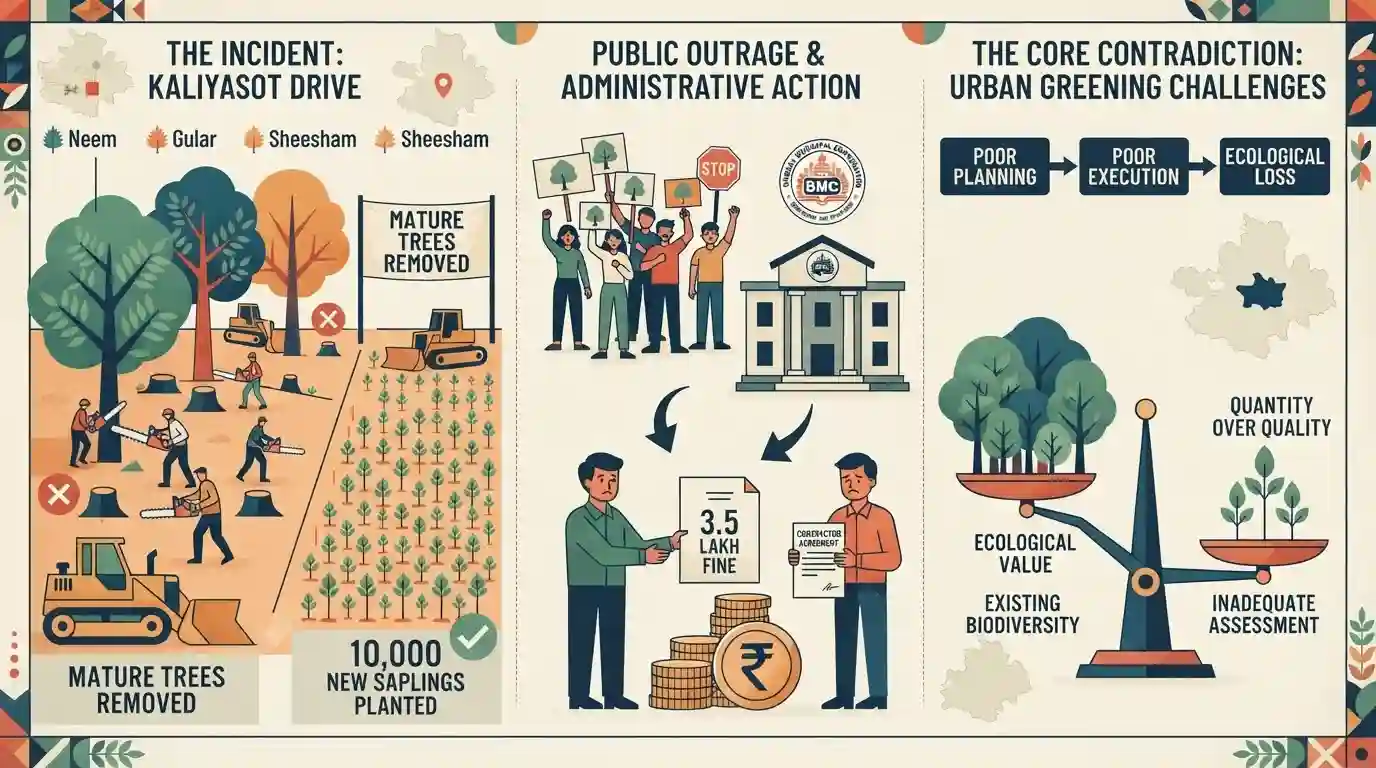
A controversial plantation drive in Bhopal's Kaliyasot area led to the felling of hundreds of mature trees, including neem, gular, and sheesham, to make way for 10,000 new saplings. The project, managed by a contractor for the Bhopal Municipal Corporation (BMC), sparked outrage among environmentalists. Consequently, the civic body imposed a fine of Rs 3.5 lakh on the contractor. This event underscores the administrative challenges and ecological contradictions in executing urban greening initiatives without adequate environmental impact assessments.
Key Points
- Hundreds of mature trees, including neem, gular, and sheesham, were cut down in the Kaliyasot area of Bhopal.
- The deforestation occurred to clear land for a new plantation drive aiming to plant 10,000 saplings, contracted by the Bhopal Municipal Corporation (BMC).
- Following severe backlash from environmentalists over the destruction of existing green cover, the BMC fined the contractor Rs 3.5 lakh.
- The incident highlights critical oversight flaws in urban afforestation programs, where existing ecological assets are harmed to fulfill plantation targets.
Prelims Trap
Urban forestry and environmental protection are managed exclusively by State Forest Departments and lack constitutional status under Urban Local Bodies.
Under the 74th Amendment Act, the 12th Schedule explicitly lists 'urban forestry, protection of the environment and promotion of ecological aspects' as a functional domain of Municipalities.
Static Concepts Connected
What is the constitutional mandate for urban forestry under Urban Local Bodies (ULBs)?
- Twelfth Schedule: Introduced by the 74th Amendment Act of 1992, listing 18 functional responsibilities of municipalities.
- Item 12 Mandate: Explicitly covers 'Urban forestry, protection of the environment and promotion of ecological aspects' (Item 12).
- Capacity Deficit: State legislatures must devolve these powers, but ULBs often lack specialized ecological wings, leading to poor implementation.
Why is clearing mature trees for new plantations ecologically flawed?
- Ecosystem Service Gap: Mature hardwood trees (e.g., Neem, Sheesham) sequester exponentially more carbon and support richer biodiversity than young saplings.
- Transplantation Limits: Mature native species have deep taproots, making transplantation highly unsuccessful compared to shallow-root species.
- CAMPA Limitations: While the CAMPA Act of 2016 funds compensatory planting, artificial monoculture plantations cannot rapidly replicate natural dry deciduous biomes.
Cross-Topic Patterns
Urban governance vs. Ecological assets
Municipalities frequently compromise mature green cover to meet target-driven afforestation mandates due to lack of local ecological expertise and excessive reliance on private contractors.
Dry deciduous silviculture & urban heat
Replacing native dry deciduous species like Neem and Gular with ornamental saplings reduces urban canopy resilience against rising urban heat island effects.

Expect 2026 questions linking CAMPA's ecological limitations with the Twelfth Schedule's municipal mandate on urban forestry.
Linked PYQs · 4
Linked PYQs · 4
- 2022MPPSC_PRELIMSGS1
IIFM (Indian Institute of Forest Management) is situated at
- 2025MPPSC_PRELIMSGS1
The Government of India passed the Environment (Protection) Act to protect and improve the quality of environment in:
- 2023MPPSC_PRELIMSGS1
Green Muffler is related to pollution of:
- 2023MPPSC_PRELIMSGS1
By which Amendment of the Indian Constitution have the municipal laws been updated?
