Plane Crashes into Skyscraper in Beijing Business District
Source:Indian Express ↗
Why It Matters
The event is a stark case study in urban disaster management involving critical high-rise infrastructure. Furthermore, the immediate state censorship of the tragedy serves as an important comparative example of information control versus freedom of expression and transparency in governance.
Summary
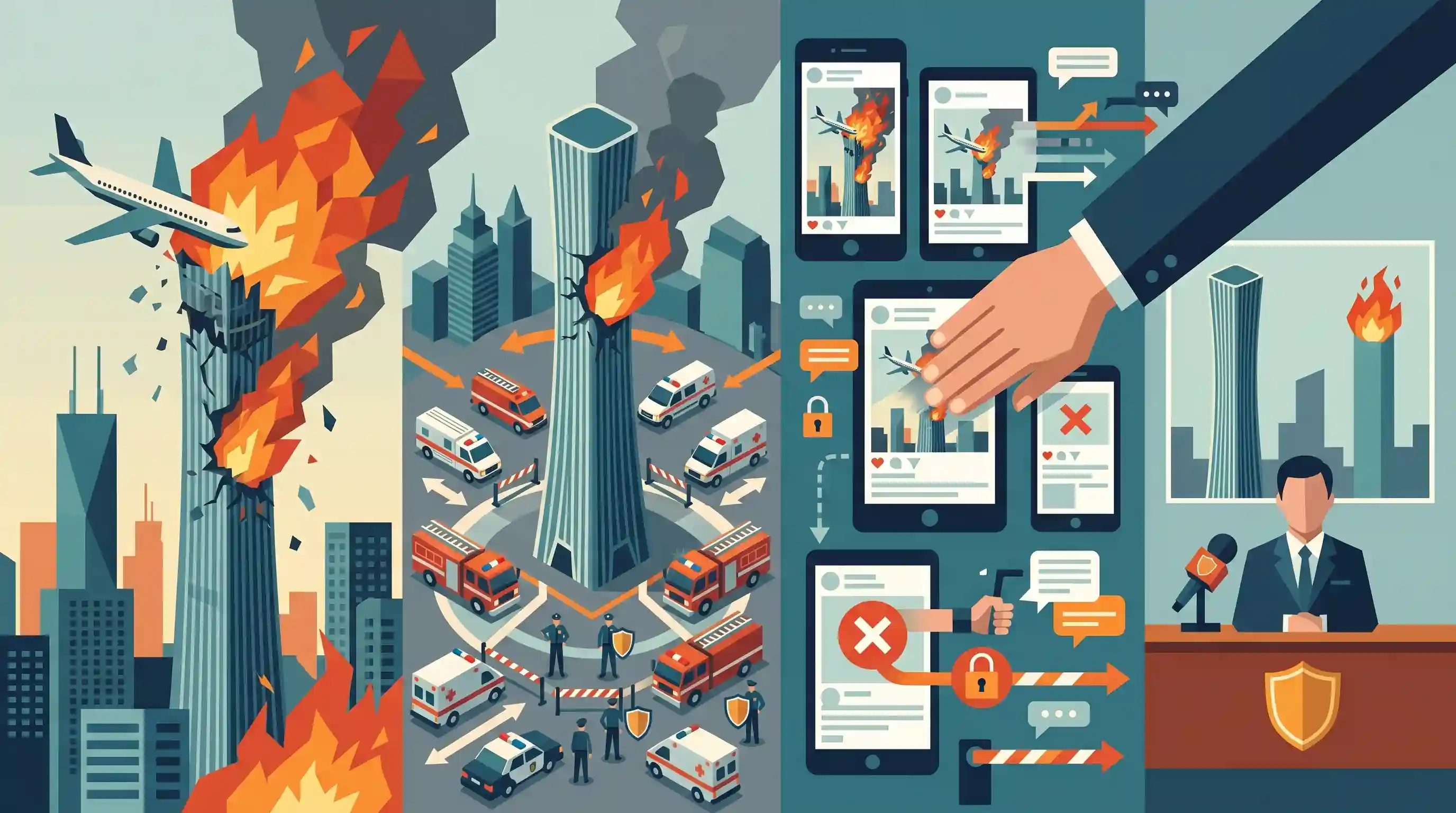
A commercial airliner crashed into the CITIC Tower, Beijing's tallest building, in the city's central business district, triggering a massive fire and significant structural damage. In the immediate aftermath, the Chinese government rapidly restricted access to the site and enacted strict censorship on social media, wiping all footage and discussion of the event. While the cause of the crash remains unknown, the incident draws attention to the vulnerabilities of high-rise urban infrastructure, airspace regulations over densely populated cities, and the mechanics of state-controlled media and transparency in authoritarian regimes.
Key Points
- A large commercial airliner crashed into the CITIC Tower, Beijing's tallest skyscraper in the Guomao business district, causing a massive explosion and fire.
- The 109-story building serves as the headquarters for the state-owned investment company CITIC Group.
- Chinese authorities immediately deployed a heavy security presence to block access to the site and prevent filming.
- State censors scrubbed photos, videos, and discussions of the incident from social media platforms like Weibo, reflecting tight control over information during crises.
- No official statement regarding the cause of the crash or casualty figures has been released by Chinese aviation authorities.
Important Terms
Urban Disaster Management

The systematic process of prevention, mitigation, and response to hazards in densely populated regions, focusing on infrastructure resilience and community preparedness.
UPSC context
GS III (Disaster Management); tests knowledge of urban planning, the Sendai Framework, and man-made disaster protocols.
Critical Infrastructure Protection
Physical or digital assets—such as power grids or strategic buildings—so vital that their destruction would debilitate national security, the economy, or public safety.
UPSC context
GS III (Internal Security); tests awareness of Critical Information Infrastructure (CII) and protective agencies like NCIIPC.
Digital Authoritarianism
The use of technology and surveillance by governments to suppress dissent, monitor citizens, and control the flow of information through censorship.
UPSC context
GS II (Governance/IR); tests critical analysis of transparency, press freedom, and state-controlled media in authoritarian regimes.
CITIC Group
A major Chinese state-owned conglomerate established to pioneer economic reforms; it owns the CITIC Tower and operates globally in finance and manufacturing.
UPSC context
GS II (International Relations); relevant for understanding China's state-led capitalism and its global economic influence.
Airspace Management
The regulatory framework coordinating safe aircraft movement and exercising sovereignty over the portion of the atmosphere above a country's territory.
UPSC context
GS III (Infrastructure/Security); tests knowledge of ICAO standards, aviation safety, and national sovereignty over territorial airspace.
Prelims Trap
"The Sendai Framework legally binds signatory nations to share disaster data and risk information."
The Sendai Framework (2015-2030) is a voluntary, non-binding agreement. While it emphasizes transparent risk information sharing, it does not impose legally binding transparency mandates on sovereign states.
Static Concepts Connected
What governs international airspace sovereignty and restricted zones?
- Chicago Convention: Adopted in 1944, it forms the foundational legal framework for international civil aviation laws and airspace regulation.
- Absolute Sovereignty: Article 1 grants every state complete and exclusive sovereignty over the airspace directly above its territorial lands and waters.
- No-Fly Zones: Nations retain the absolute legal right to restrict or prohibit flights over critical urban business districts or military installations for safety.
How is high-rise disaster resilience governed in India?
- NBC 2016: The National Building Code mandates specific fire-retardant materials, compartmentalization, and designated refuge areas for tall, high-density structures.
- NDMA Guidelines: Focuses on the unique vulnerabilities of vertical urban expansion, requiring strict structural resilience audits and integrated emergency evacuation plans to prevent cascading failures.
Cross-Topic Patterns
CDRI's evolving urban scope
The destruction of socio-economic skyscrapers highlights the India-led CDRI's growing focus on disaster-proofing critical urban assets against complex, cascading systemic shocks.
Sendai Framework vs. Information Censorship
China's information blackout violates the Sendai Framework's core pillar of risk transparency, contrasting sharply with democratic crisis-response models driven by open public data.

CDRI's mandate on critical urban infrastructure + Sendai's risk transparency principles likely to merge in a 2026 Mains GS3 question.
Linked PYQs · 3
Linked PYQs · 3
- 2014MainsGS3
International civil aviation laws provide all countries complete and exclusive sovereignty over the airspace above their territory. What do you understand by 'airspace'? What are the implications of these laws on the space above this airspace? Discuss the challenges which this poses and suggest ways to contain the threat.
- 2014MainsGS2
What do you understand by the concept "freedom of speech and expression"? Does it cover hate speech also ? Why do the films in India stand on a slightly different plane from other forms of expression ? Discuss.
- 2013MainsGS3
How important are vulnerability and risk assessment for pre-disaster management ? As an administrator, what are key areas that you would focus on in a Disaster Management System.
