Policy Gaps And Mitigation Strategies For Early Heatwaves In India
Source:Indian Express ↗
Why It Matters
Heatwaves are increasingly becoming severe, recurring climate-induced disasters in India. Understanding the policy gaps in Heat Action Plans and the debate on classifying heatwaves as a national disaster is crucial for GS3 (Disaster Management & Environment) and GS1 (Geography - Urban Heat Islands).
Summary
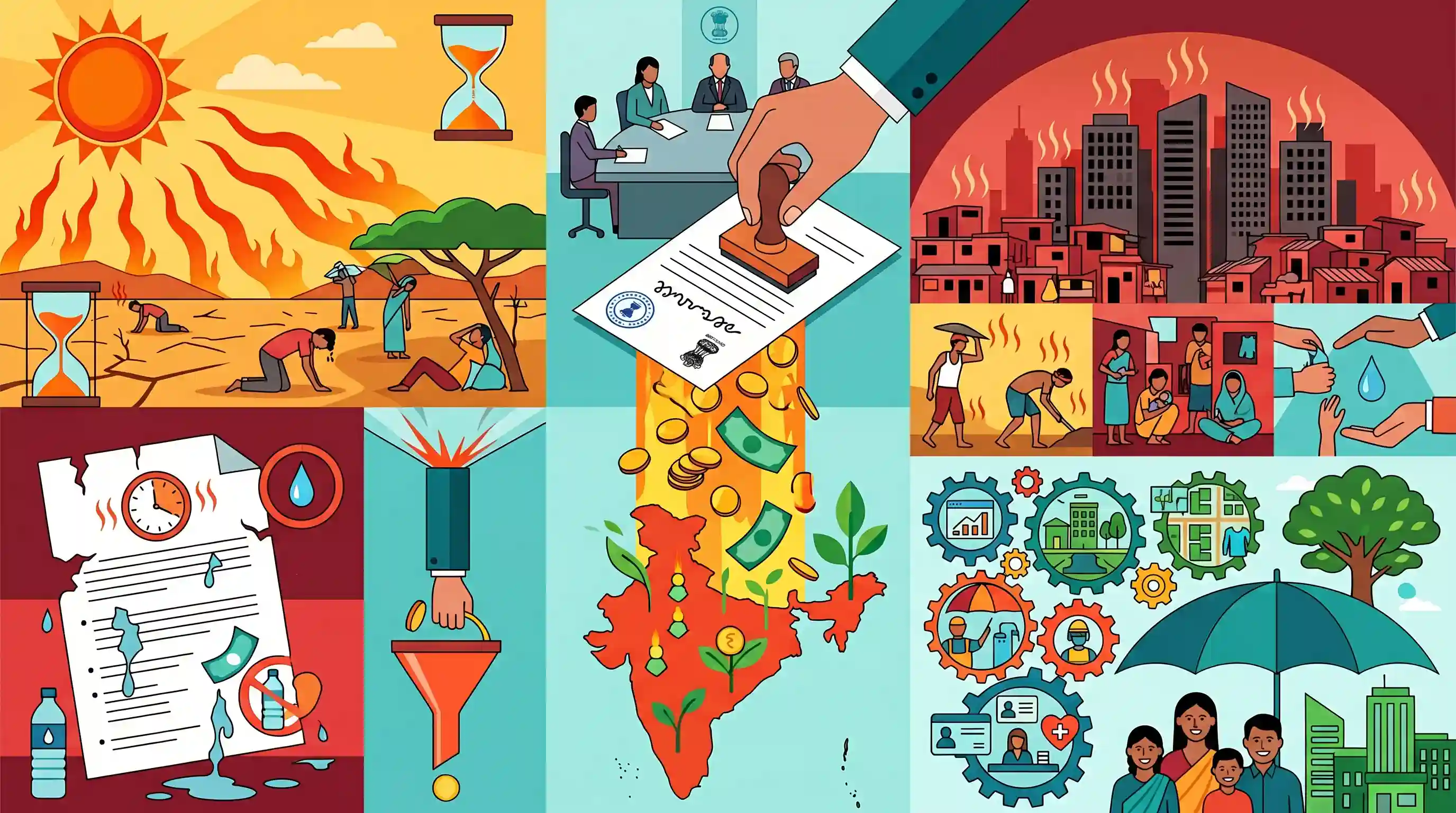
The early onset of severe summer temperatures across India signals that extreme heat is a protracted crisis requiring urgent policy evolution rather than just reactive advisories. Despite the existence of state-level Heat Action Plans (HAPs), poor implementation and chronic underfunding persist. The 16th Finance Commission’s recommendation to officially notify heat waves as a national disaster is a critical step that would unlock central relief funds and enable long-term resilience building. Furthermore, the exacerbating role of the Urban Heat Island effect on low-income, dense settlements underscores the need to integrate climate science with urban planning, labour protection, and social security to protect vulnerable populations.
Key Points
- Extreme heat in India is no longer limited to May-June, with early heat waves reported across multiple states by the IMD.
- While central advisories recommend adjusting work hours and improving hospital preparedness, their unenforceable nature limits their effectiveness in protecting vulnerable workers.
- State-level Heat Action Plans (HAPs) suffer from chronic underfunding, weak institutional capacity, and poor interdepartmental coordination.
- The 16th Finance Commission has recommended notifying heat waves as a national disaster to unlock central relief funds and foster long-term resilience, moving beyond current state-specific disaster classifications.
- The Urban Heat Island effect exacerbates heat stress in built environments, disproportionately impacting low-income communities and necessitating adaptive urban planning strategies like expanding green cover.
Important Terms
Heat Action Plans (HAPs)

Localised policy frameworks designed to coordinate early warnings, public health responses, and adaptive urban strategies to mitigate the human and economic impacts of extreme heat in Indian cities and states.
UPSC context
GS Paper 3 (Disaster Management/Environment). Tests knowledge of climate adaptation strategies and administrative coordination at local levels.
State Disaster Response Fund (SDRF)
The primary fund available with state governments for disaster response under the Disaster Management Act, 2005. The Centre contributes 75% (90% for special category states) of its corpus.
UPSC context
GS Paper 3 (Disaster Management) and GS Paper 2 (Statutory Bodies). Critical for questions on disaster financing and Centre-State relations.
16th Finance Commission
A constitutional body (Article 280) that recommends the distribution of tax revenues and disaster management grants. The 16th Commission recommended notifying heatwaves as national disasters to unlock relief funds.
UPSC context
GS Paper 2 (Constitutional Bodies/Polity) and GS Paper 3 (Economy). Tests fiscal federalism and recent policy shifts in climate finance.
India Meteorological Department (IMD)
The nodal agency under the Ministry of Earth Sciences responsible for meteorological observations, forecasting, and declaring heatwaves based on temperature thresholds or departures from normal values.
UPSC context
GS Paper 1 (Geography) and GS Paper 3 (Disaster Management). Tests scientific criteria for climate phenomena and institutional frameworks.
Urban Heat Island (UHI) Effect
A phenomenon where urban areas experience significantly higher temperatures than surrounding rural areas due to dense buildings, asphalt, and lack of green cover, trapping solar heat.
UPSC context
GS Paper 1 (Geography/Urbanization) and GS Paper 3 (Environment). Key for questions on sustainable urban planning and climate change.
Centre for Energy, Environment and Water (CEEW)
An independent, non-profit policy research institution based in New Delhi that provides data-driven insights to the Indian government on climate risk, energy transition, and water management.
UPSC context
GS Paper 3 (Environment/Science & Technology). Useful for citing reliable research-based evidence in climate policy and energy security.
Prelims Trap
Heatwaves are officially notified as a national disaster eligible for NDRF funding.
Heatwaves are NOT currently a centrally notified disaster. States must fund relief from a capped 10% local disaster window in their State Disaster Response Fund (SDRF).
Static Concepts Connected
What are the IMD criteria for declaring a heat wave in India?
- Base Temperature Threshold: The maximum temperature of a station must reach at least 40°C for plains, 37°C for coastal areas, and 30°C for hilly regions.
- Departure from Normal: A heat wave is declared if the departure from normal is 4.5°C to 6.4°C. It is severe if the departure is >6.4°C.
- Absolute Temperature: Regardless of the normal maximum temperature, a heat wave is declared if the actual maximum temperature crosses 45°C (severe if >47°C).
What factors drive the Urban Heat Island (UHI) effect?
- Low Albedo Surfaces: Concrete and asphalt surfaces absorb and retain significantly more solar radiation than natural landscapes.
- Anthropogenic Heat: Waste heat is continuously emitted from vehicles, industrial facilities, and building air conditioning systems.
- Reduced Evapotranspiration: A lack of green cover and water bodies minimizes the natural cooling provided by vegetation and soil moisture.
Cross-Topic Patterns
Climate Adaptation + Labour Rights
Heat stress severely impacts the productivity of India's informal outdoor workforce (e.g., MGNREGA, gig workers), highlighting the urgent need to integrate climate adaptation with occupational safety and labor rights.
Fiscal Federalism + Disaster Relief Funds
The 16th Finance Commission's recommendations on disaster classification highlight the intersection of fiscal federalism (Article 280) and disaster management architecture (NDRF/SDRF allocations).

Expect a multi-statement Prelims question merging IMD heatwave criteria with SDRF/NDRF funding norms and Finance Commission mandates.
Linked PYQs · 4
Linked PYQs · 4
- 2014MainsGS3
Drought has been recognized as a disaster in view of its spatial expanse, temporal duration, slow onset and lasting effects on vulnerable sections. With a focus on the September 2010 guidelines from the National Disaster Management Authority (NDMA), discuss the mechanisms for preparedness to deal with likely El Niño and La Niña fallouts in India.
- 2013MainsGS1
Bring out the causes for the formation of heat islands in the urban habitat of the world.
- 2024MainsGS3
Flooding in urban areas is an emerging climate-induced disaster. Discuss the causes of this disaster. Mention the features of two such major floods in the last two decades in India. Describe the policies and frameworks in India that aim at tackling such floods.
- 2017MainsGS3
'Climate change' is a global problem. How India will be affected by climate change? How Himalayan and coastal states of India will be affected by climate change?
