India and US Initiate Bilateral Trade Negotiations
Source:The Hindu ↗
Why It Matters
The evolving trade dynamics between India and the U.S., particularly concerning tariffs and market access, are critical for India's economic growth and export strategy. Aspirants must understand how protectionist measures like Section 301 investigations and shifts in bilateral trade agreements impact domestic industries and international diplomacy.
Summary
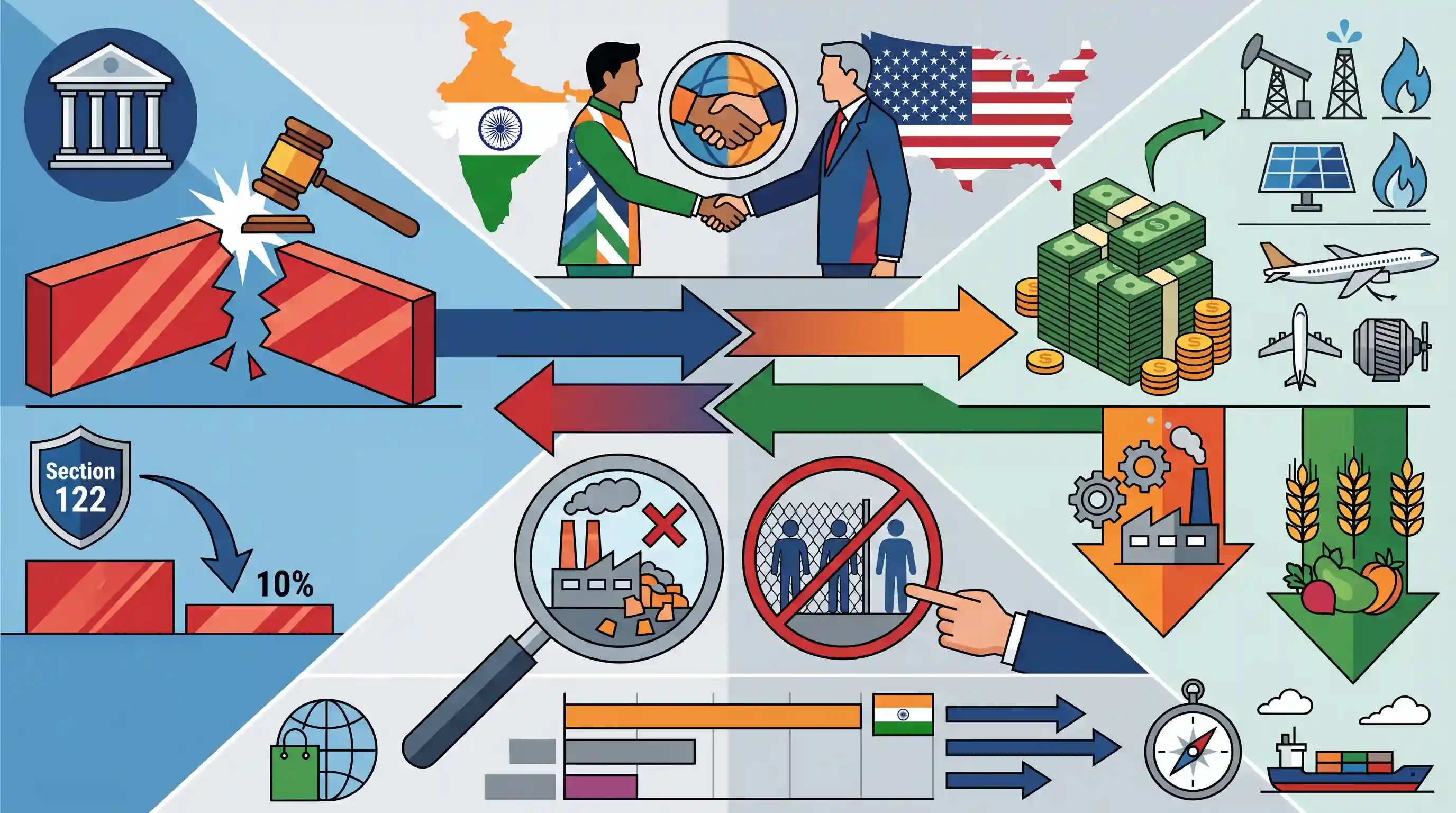
Indian Commerce Minister Piyush Goyal and U.S. Trade Representative Jamieson Greer have initiated crucial bilateral talks in New Delhi to finalize the first phase of the Bilateral Trade Agreement (BTA). The negotiations are taking place amidst a dynamic shift in the U.S. tariff landscape, driven by the U.S. Supreme Court's decision to strike down the Trump administration's sweeping 50% tariffs and the subsequent imposition of a temporary 10% tariff under Section 122 of the Trade Act. To boost economic ties, India has proposed reducing tariffs on various U.S. industrial and agricultural products and intends to import $500 billion in U.S. goods, including energy products and aircraft, over the next five years. Meanwhile, India is also navigating newly launched U.S. Section 301 investigations targeting excess industrial capacity and forced labor. Securing advantageous tariff rates is vital for India to maintain its export competitiveness and a healthy trade surplus against rival Asian economies.
Key Points
- India and the U.S. have commenced discussions in New Delhi to finalize the first phase of their Bilateral Trade Agreement (BTA).
- The talks follow significant changes in U.S. tariff policy, as the U.S. Supreme Court recently struck down sweeping 50% tariffs imposed by the Trump administration, leading to a temporary 10% tariff under Section 122 of the Trade Act.
- India has proposed lowering tariffs on U.S. industrial and agricultural goods while intending to purchase $500 billion worth of U.S. energy, tech, and aircraft products over five years.
- The U.S. has included India in Section 301 investigations concerning alleged excess industrial capacity and forced-labor concerns in global supply chains.
- The U.S. was India's second-largest trading partner in 2025-26, with India maintaining a $34.4 billion trade surplus.
Important Terms
Section 301

A provision of the U.S. Trade Act of 1974 authorizing the U.S. Trade Representative to investigate and retaliate against "unfair," "discriminatory," or "unjustifiable" foreign trade practices that burden American commerce.
UPSC context
GS Paper II & III. Tests understanding of trade protectionism, trade wars, and the legal tools used by major economies to challenge partner nations.
Section 122
A U.S. legal provision allowing the President to impose temporary (150-day) import surcharges of up to 15% to address "large and serious" balance-of-payments deficits.
UPSC context
GS Paper II (International Relations). Relevant for discussing the legal limitations of executive power in trade policy and balance-of-payments crises.
Bilateral Trade Agreement (BTA)
A reciprocal trade pact between two nations—currently in interim negotiations between India and the U.S.—designed to reduce tariffs, enhance market access, and resolve sectoral trade disputes.
UPSC context
GS Paper II (India-US Relations). Tests knowledge of India's shift toward bilateralism and strategic economic alignment with the U.S. to counter regional rivals.
U.S. Trade Representative (USTR)
The U.S. government agency and chief official (currently Jamieson Greer in 2026) responsible for developing trade policy and leading international trade negotiations on behalf of the President.
UPSC context
GS Paper II. Important for identifying key institutional actors in global trade governance and India's bilateral diplomatic engagements.
Excess Industrial Capacity
An economic condition where a nation's manufacturing production significantly exceeds its domestic consumption, often leading to low-priced exports that trade partners may view as market-distorting.
UPSC context
GS Paper III (Economy). Tests analysis of global supply chains, manufacturing competitiveness, and non-tariff barriers in international trade.
U.S. Supreme Court (Trade Jurisdiction)
The executive body in the U.S. judicial system that, in early 2026, limited presidential power by ruling that tariff authority is a congressional "taxing power" under Article I of the Constitution.
UPSC context
GS Paper II. Relevant for comparing constitutional separation of powers (India vs. US) regarding international treaties and taxation.
Prelims Trap
"India maintains a structural merchandise trade deficit with the United States."
India consistently runs a merchandise trade surplus with the US, unlike its massive deficit with China. This surplus often makes India a target for US tariff pressures.
Static Concepts Connected
What is Section 301 of the US Trade Act?
- Unilateral Tool: US domestic law allowing the USTR to investigate and unilaterally penalize foreign countries for trade practices deemed "unfair" or discriminatory.
- WTO Conflict: Actions under Section 301 often bypass the WTO's dispute settlement mechanism, conflicting with the Most-Favored-Nation (MFN) principle.
How are Non-Tariff Barriers (NTBs) evolving in modern trade?
- Labor Standards: Advanced economies increasingly use import bans or investigations based on alleged forced labor or poor working conditions.
- Capacity & Environment: Policies targeting "excess industrial capacity" or carbon emissions (e.g., CBAM) act as de facto barriers against developing nations.
Cross-Topic Patterns
Labor Standards as Trade Barriers
US Section 301 probes into forced labor highlight how advanced economies increasingly weaponize domestic human rights and environmental metrics as non-tariff barriers against developing nations.
China+1 vs Rising Protectionism
India’s goal to attract global supply chains under the China+1 strategy clashes directly with rising US unilateral tariffs and investigations into "excess industrial capacity."

Expect a 2026 prelims question contrasting unilateral trade defense tools (like US Section 301) against the WTO's Most-Favored-Nation rules.
Linked PYQs · 4
Linked PYQs · 4
- 2012MainsGS2
Discuss the likely negative impact of the protectionist measures proposed by the US on India's software industry.
- 2018MainsGS2
What are the key areas of reform if the WTO has to survive in the present context of "Trade War', especially keeping in mind the interest of India?
- 2023MainsGS3
What are the direct and indirect subsidies provided to farm sector in India? Discuss the issues raised by the World Trade Organization (WTO) in relation to agricultural subsidies.
- 2017MainsGS3
Account for the failure of manufacturing sector in achieving the goal of labour-intensive exports. Suggest measures for more labour-intensive rather than capital-intensive exports.
