Domestic Manufacturing Promotion and Import Substitution Policy
Source:The Hindu ↗
Why It Matters
This article underscores India's dual macroeconomic challenge: maintaining industrial growth (IIP) and managing currency depreciation amid geopolitical headwinds (West Asia crisis). It highlights the practical application of import substitution and domestic manufacturing pushes as strategic tools to stabilize the rupee and reduce vulnerability to global supply chain shocks.
Summary
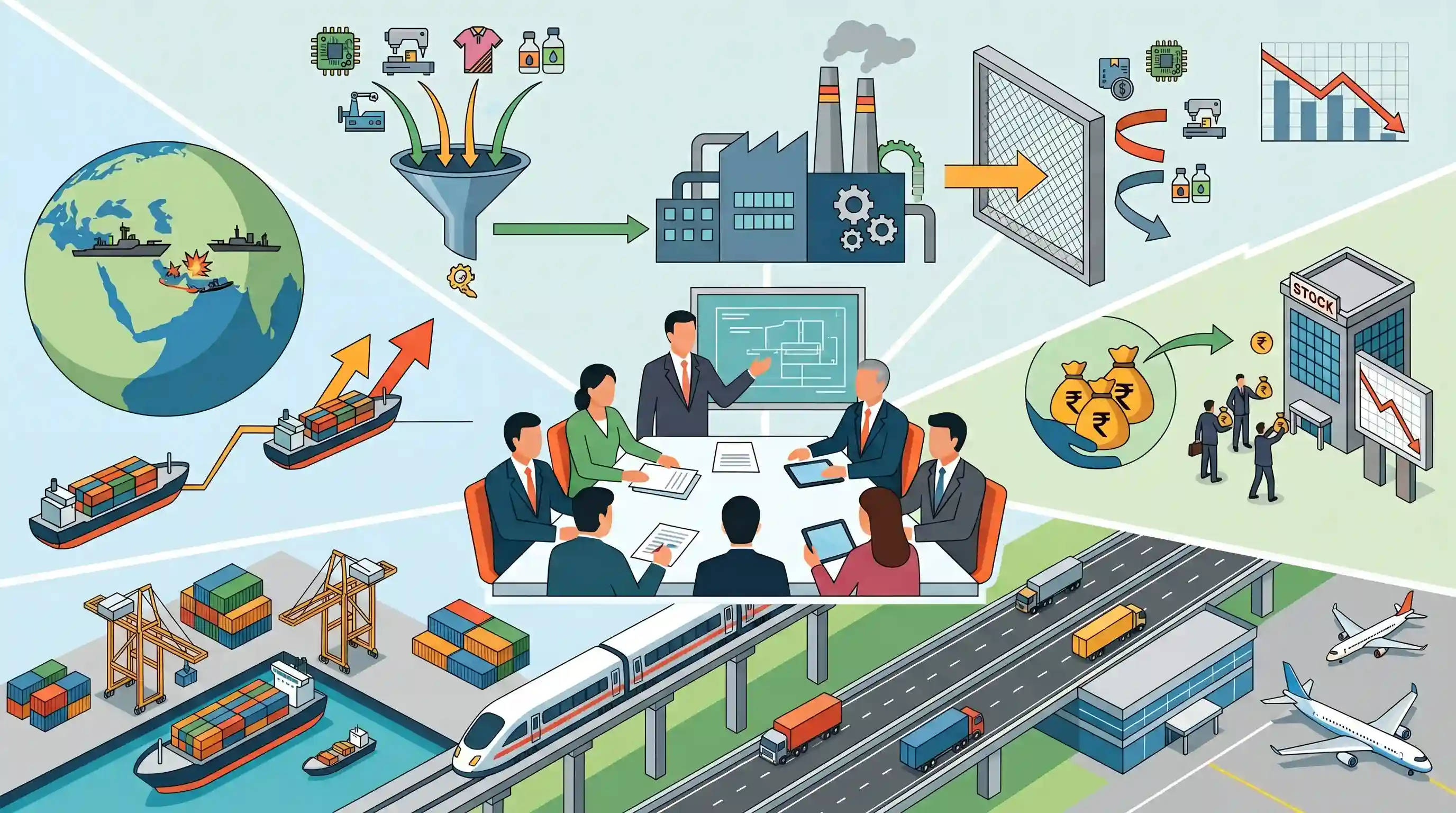
Commerce and Industry Minister Piyush Goyal convened an inter-ministerial meeting with industry representatives to discuss strategies for boosting domestic manufacturing and curbing India's escalating import bill. The initiative focuses on identifying 100 critical products that are heavily imported in order to promote local production. The move aims to stem significant foreign exchange outflows, which have exacerbated the depreciation of the rupee amid rising FPI withdrawals. Additionally, geopolitical shocks, particularly the U.S.-Iran conflict disrupting the Strait of Hormuz, have inflated logistics costs, prompting the government to schedule follow-up discussions on port infrastructure and exporter challenges.
Key Points
- The government is identifying 100 products, such as chemicals, plastics, and auto components, to boost their domestic manufacturing and reduce import reliance.
- India's import bill rose to ₹775 billion in 2025-26, driving significant foreign exchange outflows and contributing to the depreciation of the rupee (closing at 95.73 to the USD).
- The West Asia crisis and U.S.-Iran conflict have disrupted shipping lanes around the Strait of Hormuz, substantially raising input and logistics costs for manufacturers.
- Net foreign investments turned negative in March 2026 (-$11.7 billion) as Foreign Portfolio Investment (FPI) outflows eclipsed Foreign Direct Investment (FDI) inflows.
- India's industrial output (IIP) growth decelerated to a five-month low of 4.1% in March, highlighting the pressing need for inter-ministerial interventions to resolve exporter/importer challenges at ports.
Important Terms
Foreign Portfolio Investment (FPI)

Investments by foreign entities in a country's financial assets like stocks and bonds without acquiring ownership control. They are highly liquid and sensitive to global market volatility.
UPSC context
GS Paper III (Economy); tests understanding of capital flows, market stability, and external sector vulnerabilities.
Strait of Hormuz
A strategic maritime chokepoint between Iran and Oman connecting the Persian Gulf to the open ocean. It is a critical energy lifeline for India's oil and gas imports.
UPSC context
GS Paper II (IR); critical for energy security and analyzing geopolitical risks in West Asia impacting the Indian economy.
Import Substitution
An economic strategy to replace foreign imports with domestic production using protective measures like tariffs and quotas to foster self-reliance and protect domestic "infant industries."
UPSC context
GS Paper III (Industrial Policy); assesses knowledge of India's economic history, Atmanirbhar Bharat, and trade competitiveness.
Ministry of Commerce and Industry
The nodal government body responsible for foreign trade policy and industrial development. It manages key initiatives like "Make in India" and the Production Linked Incentive (PLI) scheme.
UPSC context
GS Paper II (Governance); relates to executive functions, trade negotiations, and industrial policy implementation.
Logistics Costs
The total expenditure incurred in the transportation and warehousing of goods. High costs (historically 13-14% of India's GDP) act as a "hidden tax" on industrial competitiveness.
UPSC context
GS Paper III (Infrastructure); focuses on ease of doing business and National Logistics Policy efficiency.
Rupee Depreciation
The market-driven fall in the value of the Indian Rupee against foreign currencies (like the US Dollar) caused by capital outflows or high import demand.
UPSC context
GS Paper III (Economy); crucial for understanding Balance of Payments, inflation, and RBI monetary interventions.
Prelims Trap
Depreciation of the Rupee inherently decreases India's import bill by making imports unaffordable.
Because India's major imports (like crude oil and critical intermediates) are highly price-inelastic, depreciation actually increases the rupee-cost of imports, inflating the import bill in the short term.
Static Concepts Connected
What is the Index of Industrial Production (IIP)?
- Compiler: It is compiled and published monthly by the National Statistical Office (NSO) under the Ministry of Statistics and Programme Implementation.
- Base Year: The current base year used for the IIP calculation is 2011-12.
- Components: Sectoral composition includes Manufacturing (approx. 77.6%), Mining (14.3%), and Electricity (7.9%).
- Core Sector: The Eight Core Industries (Refinery Products, Electricity, Steel, Coal, Crude Oil, Natural Gas, Cement, Fertilizers) comprise 40.27% of its total weight.
What is the geographical significance of the Strait of Hormuz?
- Connecting Waters: It connects the Persian Gulf in the west to the Gulf of Oman and the Arabian Sea in the southeast.
- Bordering Nations: It is bounded by Iran to the north and the Musandam Peninsula (shared by Oman and the UAE) to the south.
- Strategic Chokepoint: It is one of the world's most critical maritime chokepoints, handling roughly 20% of global oil consumption.
Cross-Topic Patterns
Geopolitics driving Imported Inflation
Disruptions in the Strait of Hormuz raise freight and insurance costs, cascading into higher input costs for Indian manufacturing and worsening imported cost-push inflation.
Hot Money and Currency Volatility
Geopolitical shocks trigger a "flight to safety," causing abrupt FPI withdrawals from emerging markets. This strains forex reserves and forces currency depreciation, highlighting the danger of relying on "hot money."

A multi-statement question linking West Asian maritime chokepoints (Hormuz) to India's CAD and imported inflation is highly probable in 2026.
Linked PYQs · 5
Linked PYQs · 5
- 2017MainsGS3
Account for the failure of manufacturing sector in achieving the goal of labour-intensive exports. Suggest measures for more labour-intensive rather than capital-intensive exports.
- 2023MainsGS3
Faster economic growth requires increased share of the manufacturing sector in GDP, particularly of MSMEs. Comment on the present policies of the Government in this regard.
- 2022PrelimsGS1
With reference to the Indian economy, consider the following statements: 1. If the inflation is too high, Reserve Bank of India (RBI) is likely to buy government securities. 2. If the rupee is rapidly depreciating, RBI is likely to sell dollars in the market. 3. If interest rates in the USA or European Union were to fall, that is likely to induce RBI to buy dollars. Which of the statements given above are correct?
- 2019PrelimsGS1
Which one of the following is not the most likely measure the Government/RBI takes to stop the slide of Indian rupee?
- 2024PrelimsGS1
Consider the following statements : Statement-I : Sumed pipeline is a strategic route for Persian Gulf oil and natural gas shipments to Europe. Statement-II : Sumed pipeline connects the Red Sea with the Mediterranean Sea. Which one of the following is correct in respect of the above statements?
