India US Bilateral Trade and Tariff Negotiations
Source:The Hindu ↗
Why It Matters
This development is crucial for understanding the complexities of India-U.S. strategic and economic relations, specifically how domestic legal rulings and protectionist policies (like tariffs) in the U.S. impact bilateral trade negotiations. For UPSC aspirants, it bridges GS-2 (Bilateral agreements affecting India's interests) and GS-3 (Effects of global protectionism on the Indian economy).
Summary
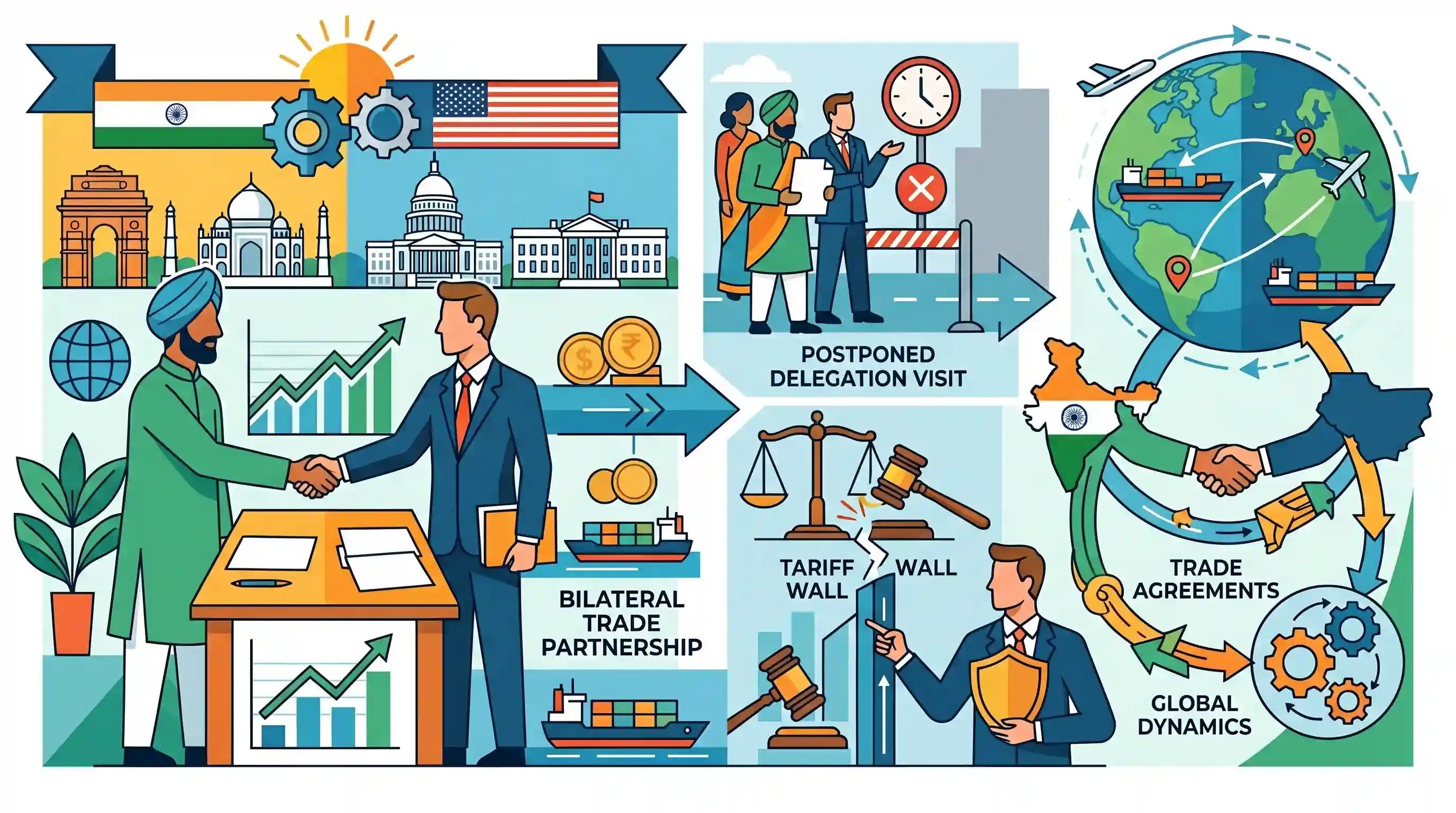
Indian Commerce and Industry Minister Piyush Goyal held a 'fruitful' meeting with U.S. Commerce Secretary Howard Lutnick and U.S. Ambassador Sergio Gor in New Delhi to discuss expanding the bilateral trade partnership. This engagement follows India's recent decision to postpone a delegation's visit to Washington aimed at finalizing an 'interim agreement' on trade. The postponement was triggered by a U.S. Supreme Court ruling that invalidated President Donald Trump's use of a specific law to impose tariffs on nations like India. Nevertheless, the U.S. side has communicated that tariffs remain a priority and that the negotiated trade deals are still advantageous. Both countries had previously announced a framework for reciprocal trade, though its final execution is now being navigated alongside evolving U.S. trade policies.
Key Points
- India's Commerce Minister Piyush Goyal held discussions with U.S. Commerce Secretary Howard Lutnick and U.S. Ambassador Sergio Gor in New Delhi to expand trade ties.
- The meeting occurred after India postponed a negotiating team's visit to Washington, which was intended to finalize an interim trade agreement.
- The delay followed a U.S. Supreme Court ruling that struck down President Donald Trump's use of specific legislation to impose tariffs on partner countries, including India.
- Despite the court ruling, the U.S. Commerce Secretary assured partners that tariffs might still be implemented by other means and emphasized that the interim deals negotiated remain beneficial.
- India and the U.S. have previously agreed on a 'framework for an Interim Agreement' regarding reciprocal trade, which was targeted for implementation by April 2026.
Important Terms
Interim Trade Agreement

A limited-scope trade pact that liberalizes tariffs on select goods as a precursor to a more comprehensive Free Trade Agreement (FTA).
UPSC context
GS Paper II: Bilateral trade agreements; GS Paper III: Economic liberalization and its impact on Indian trade.
Early Harvest Scheme
A trade deal strategy where countries agree to liberalize certain sectors immediately before finalizing a full-fledged trade agreement.
UPSC context
GS Paper III: Trade policy and strategies; useful for questions on CEPA and FTA negotiations.
International Emergency Economic Powers Act (IEEPA)
A 1977 U.S. federal law authorizing the President to regulate international commerce during national emergencies; recently ruled as not authorizing unilateral tariffs.
UPSC context
Prelims/GS Paper II: International law and the limits of executive power in trade diplomacy.
Reciprocal Tariffs
A trade policy where a country applies import duties on a partner's goods at the same rate that partner applies to its own exports.
UPSC context
GS Paper III: Global trade dynamics and the shift from multilateralism to protectionism.
Trade Protectionism
An economic policy of restricting imports through tariffs or quotas to protect domestic industries from foreign competition.
UPSC context
GS Paper III: Issues relating to planning, mobilization of resources, growth, and employment.
Prelims Trap
Interim trade agreements (mini-deals) are temporary bilateral arrangements and are therefore exempt from WTO rules.
Under WTO's GATT Article XXIV, interim agreements must include a plan and schedule for the eventual formation of a comprehensive Free Trade Area.
Static Concepts Connected
What is an Early Harvest Scheme (Interim Trade Agreement)?
- Nature: A precursor to a Comprehensive Free Trade Agreement (FTA) where trading partners mutually reduce tariffs on a select list of goods to build trust.
- WTO Compliance: Must comply with GATT Article XXIV, which requires interim agreements to demonstrate a plan to form a comprehensive FTA within a reasonable timeframe.
- India's Approach: India successfully utilized this approach with Australia (ECTA) and is pursuing similar frameworks with the UK and the US.
What is the Generalized System of Preferences (GSP)?
- Mechanism: A unilateral, non-reciprocal tariff preference scheme offered by developed nations, allowing duty-free imports from developing nations.
- UNCTAD Origins: Instituted under the aegis of UNCTAD in 1971 to promote export-driven economic growth in the developing world.
- India-US Status: The US revoked India's GSP status in 2019, citing India's failure to provide 'equitable and reasonable access' to its markets.
Cross-Topic Patterns
Strategic alignment vs Trade friction
India and the US are rapidly deepening defense and technology ties via Quad and iCET, yet continue to face structural trade barriers, highlighting the modern decoupling of security alignment and economic policy.
Domestic judiciary shaping global trade
The US Supreme Court striking down executive tariff legislation demonstrates how domestic judicial rulings in partner nations directly impact bilateral trade negotiations and global supply chains.

Prelims 2026 is highly likely to feature a multi-statement question distinguishing Early Harvest Schemes, CECA, and CEPA under WTO rules.
Linked PYQs · 3
Linked PYQs · 3
- 2025MainsGS3
What are the challenges before the Indian economy when the world is moving away from free trade and multilateralism to protectionism and bilateralism? How can these challenges be met?
- 2018MainsGS3
How would the recent phenomena of protectionism and currency manipulations in world trade affect macroeconomic stability of India?
- 2017PrelimsGS1
Consider the following statements: 1. India has ratified the Trade Facilitation Agreement (TFA) of WTO. 2. TFA is a part of WTO's Bali Ministerial Package of 2013. 3. TFA came into force in January 2016. Which of the statements given above is/are correct?
